. 2023 Jun;23(3):691-704.
doi: 10.3758/s13415-023-01091-7. Epub 2023 Apr 14.

Dissociation and integration of outcome and state uncertainty signals in cognitive control

Affiliations

Dissociation and integration of outcome and state uncertainty signals in cognitive control

William H Alexander et al. Cogn Affect Behav Neurosci. 2023 Jun.

Abstract

Signals related to uncertainty are frequently observed in regions of the cognitive control network, including anterior cingulate/medial prefrontal cortex (ACC/mPFC), dorsolateral prefrontal cortex (dlPFC), and anterior insular cortex. Uncertainty generally refers to conditions in which decision variables may assume multiple possible values and can arise at multiple points in the perception-action cycle, including sensory input, inferred states of the environment, and the consequences of actions. These sources of uncertainty are frequently correlated: noisy input can lead to unreliable estimates of the state of the environment, with consequential influences on action selection. Given this correlation amongst various sources of uncertainty, dissociating the neural structures underlying their estimation presents an ongoing issue: a region associated with uncertainty related to outcomes may estimate outcome uncertainty itself, or it may reflect a cascade effect of state uncertainty on outcome estimates. In this study, we derive signals of state and outcome uncertainty from mathematical models of risk and observe regions in the cognitive control network whose activity is best explained by signals related to state uncertainty (anterior insula), outcome uncertainty (dlPFC), as well as regions that appear to integrate the two (ACC/mPFC).

Keywords: Anterior cingulate; Anterior insula; Dorsolateral prefrontal cortex; Modeling; Risk.


Figures

Fig. 1
Fig. 1
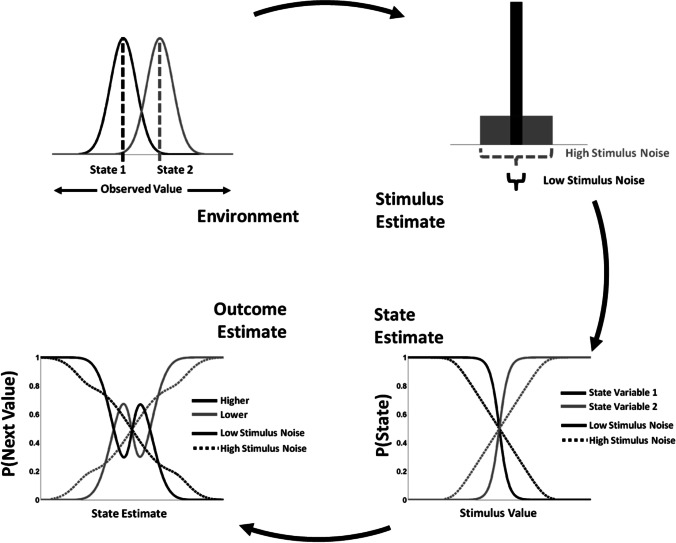
Cascades of uncertainty. Uncertainty may be introduced at multiple points in the perception-action cycle. Given an environment that may be in one of two possible states (upper left frame) and an experimental task to judge whether subsequent values will be lower or higher than an observed value, uncertainty introduced early in the form of stimulus noise (upper right frame) reduces precision in subsequent estimates of the current state of the environment (lower right frame), which in turn leads to increased uncertainty regarding future outcomes (lower left frame)
Fig. 2
Fig. 2
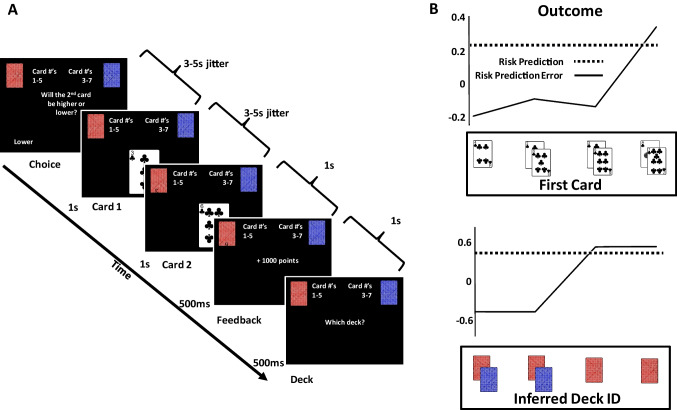
A) Experimental task. Subjects were asked to guess whether the second of two successively-presented cards would be higher or lower than the first. Card numbers ranged from 1 to 7 and could be drawn from one of two possible decks on each trial. Cards drawn from the Red deck were numbered 1 to 5, and cards drawn from the Blue deck were numbered 3 to 7. Based on the cards observed during the trial, subjects could infer which deck was used on each trial, and they were asked to identify the deck at the end of each trial. B) Outcome and State Uncertainty Signals. Our mathematical model of state and outcome risk, derived from Preuschoff et al. (2008), suggests how Risk Prediction Error (Risk PE) signals following the presentation of the first card might be dissociated for Outcome and State Risk. Outcome Risk PEs (top frame) are equivalent following the presentation of cards 2, 3, 5, and 6; however, for cards 3 & 5, the identity of the deck cannot be inferred, whereas for cards 2 and 6, deck identity can be inferred. For equal Outcome Risk PEs, the risk model predicts differing levels of State Risk PE (bottom frame)
Fig. 3
Fig. 3
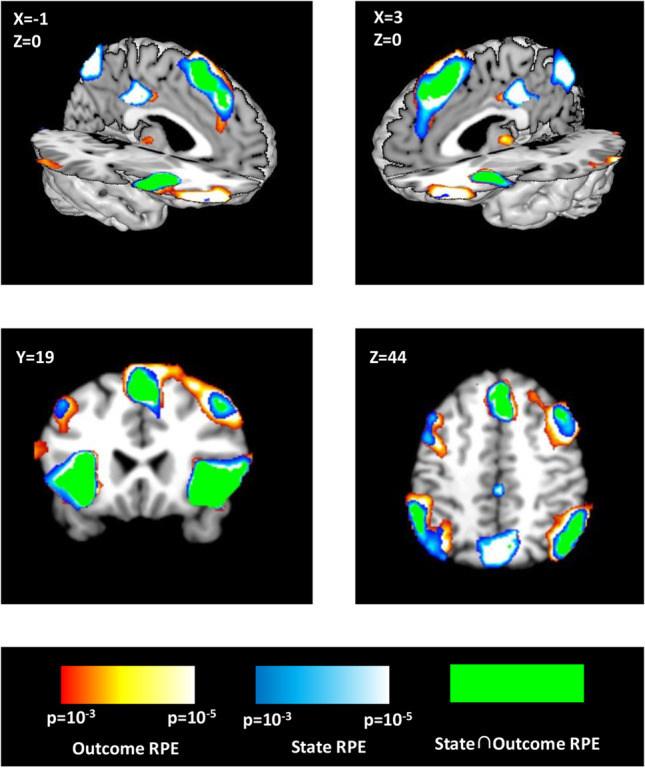
Risk Prediction Error in the Cognitive Control Network. Values derived from the mathematical model of risk for State and Outcome Risk PEs correlate with activity in regions commonly associated with cognitive control and decision-making. Blue indicates voxels correlating with State Risk PE (GLM 1), red with Outcome Risk PE (GLM 2), and green the overlap for voxels surviving an uncorrected threshold of p < 0.001 for both State and Outcome Risk PE. Regions observed to correlate with both types of Risk PE include ACC/mPFC, anterior insula, parietal, and right caudal dlPFC (BA 9). Outcome Risk PE selectively correlated with bilateral rostral dlPFC, as well as left BA 9, although this latter result did not survive FWE (p < 0.05) correction at the cluster level
Fig. 4
Fig. 4
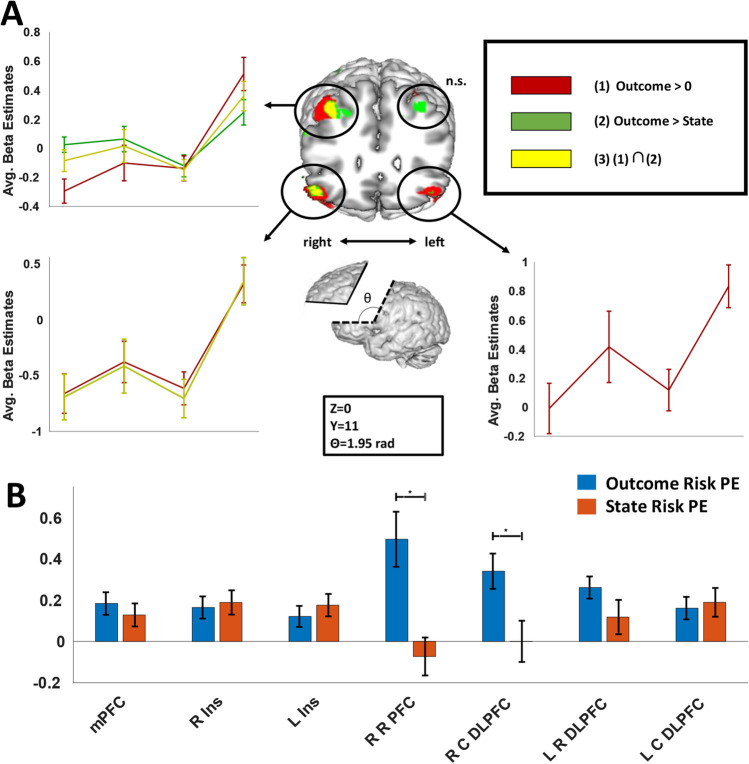
Outcome Risk PE-specific activity. A) Activity in regions in bilateral rostral lPFC and caudal dlPFC corresponded to Outcome Risk PE signals derived from the mathematical model of risk. The number of voxels surviving threshold (uncorrected p < 0.001) was greater for comparisons of Outcome Risk PE versus State Risk PE than for comparison of Outcome Risk PE versus 0, indicating the State Risk PEs were slightly anti-correlated with activity in these regions. This is especially apparent in left caudal dlPFC, in which activity is more in line with a negative State Risk PE signal than for Outcome Risk PEs. B) Significant interaction between Risk Type and Region appears to be driven by increased activity associated with Outcome Risk PEs in right lateral PFC
Fig. 5
Fig. 5
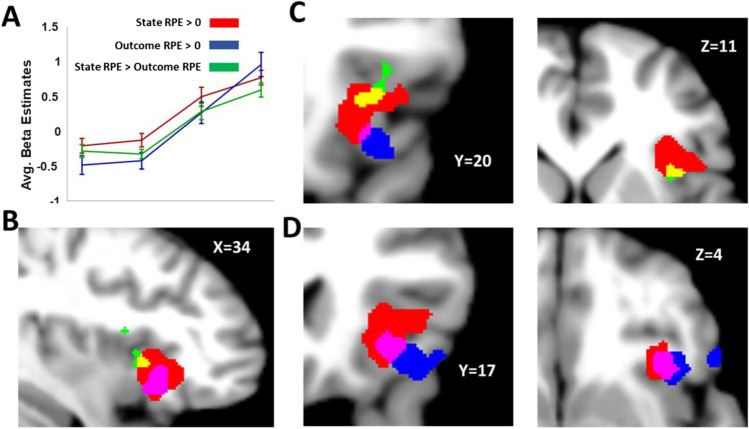
State risk prediction errors in right anterior insula. Signals corresponding uniquely to State Risk PEs (green/yellow) were observed in right dorsal anterior insula cortex (small volume correction p(FWE) < 0.05). Signals related to Outcome Risk PEs (blue) were also observed ventrally to State Risk PEs (voxel threshold < 0.001), consistent with previous observations (Preuschoff et al., ; Rudorf et al., 2012); however these signals were not uniquely explained by Outcome Risk PEs, and overlapped regions in anterior insula whose activity was also explained by State Risk PEs (magenta)

References

    1. Alexander WH, Brown JW. Medial prefrontal cortex as an action-outcome predictor. Nature Neuroscience. 2011;14:1338–1344. doi: 10.1038/nn.2921. - DOI - PMC - PubMed
    1. Alexander WH, Brown JW. A general role for medial prefrontal cortex in event prediction. Frontiers in Computational Neuroscience. 2014;8:69. doi: 10.3389/fncom.2014.00069. - DOI - PMC - PubMed
    1. Alexander WH, Brown JW. Hierarchical error representation: A computational model of anterior cingulate and dorsolateral prefrontal cortex. Neural Computation. 2015;27(11):2354–2410. doi: 10.1162/NECO_a_00779. - DOI - PubMed
    1. Alexander WH, Brown JW. Frontal cortex function as derived from hierarchical predictive coding. Scientific Reports. 2018;8(1):3843. doi: 10.1038/s41598-018-21407-9. - DOI - PMC - PubMed
    1. Alexander, W. H., Vassena, E., Deraeve, J., & Langford, Z. D. (2017). Integrative modeling of prefrontal cortex. Journal of Cognitive Neuroscience, 1–10. 10.1162/jocn_a_01138 - PubMed

Publication types