Review
. 2023 Jun:81:102940.
doi: 10.1016/j.copbio.2023.102940. Epub 2023 Apr 13.

A molecular assessment of the practical potential of DNA-based computation

Affiliations
Review

A molecular assessment of the practical potential of DNA-based computation

Rachel E Polak et al. Curr Opin Biotechnol. 2023 Jun.

Abstract

The immense information density of DNA and its potential for massively parallelized computations, paired with rapidly expanding data production and storage needs, have fueled a renewed interest in DNA-based computation. Since the construction of the first DNA computing systems in the 1990s, the field has grown to encompass a diverse array of configurations. Simple enzymatic and hybridization reactions to solve small combinatorial problems transitioned to synthetic circuits mimicking gene regulatory networks and DNA-only logic circuits based on strand displacement cascades. These have formed the foundations of neural networks and diagnostic tools that aim to bring molecular computation to practical scales and applications. Considering these great leaps in system complexity as well as in the tools and technologies enabling them, a reassessment of the potential of such DNA computing systems is warranted.


Conflict of interest statement

Conflict of interest statement The authors declare that they have no known competing financial interests or personal relationships that could have appeared to influence the work reported in this paper.

Figures
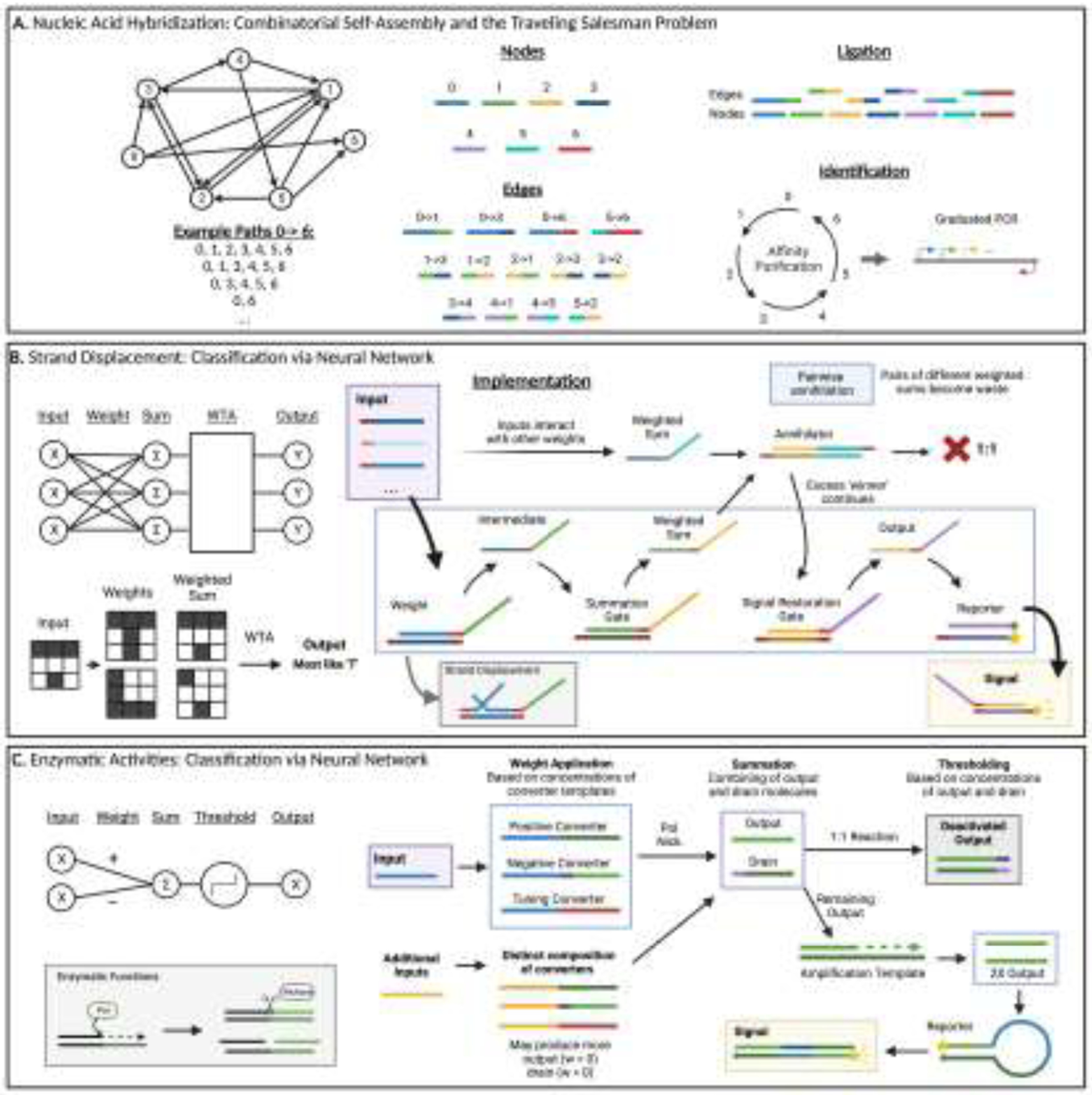
Figure 1
Figure 1
A. Nucleic Acid Hybridization: Combinatorial Self-Assembly and the Traveling Salesman Problem Nodes were represented by a specified sequence with edge sequences complementary to both the 3’ end of its origin node sequence and the 5’ end of its destination node. Edges leading to or from 0 or 6 were complementary to the full sequence of those nodes. When combined in a one-pot ligation reaction, these complementary regions ligated to form strands encoding possible paths. The double-stranded sequences were then PCR-amplified with primers annealing to the sequences of nodes 0 and 6, , satisfying the requirement that each path enter at node 0 and exit at node 6. These products were selected for the correct size by gel electrophoresis. To isolate paths containing every node, Adelman then used sequential affinity purification to pull down each node in turn and verified the correct final sequence through graduated PCR. B. Strand Displacement: Classification via Neural Network Cascading strand displacement converts an input molecule into an intermediate strand through a weight molecule, in proportion to the initial concentration of the input. The intermediate interacts with a summation gate to produce a strand representing the weighted sum. This weighted sum strand participates in a pairwise annihilation reaction that performs the winner-take-all (WTA) function, in which weighted sums are compared to known digits, or ‘memories,’ and only the most similar remembered digit given as output. This occurs on the molecular level via 1:1 deactivation of distinct weighted sums through hybridization, leaving only the most prevalent weighted sum molecule active. This ‘winner’ may continue to signal restoration that produces an output strand and leads to fluorescence of a reporter molecule. Weight concentrations were assigned based on the color value (darkness of writing) of each of 100 pixels within the image. Values of input symbols were compared to the values of representative images of digits through the network, and the most similar digit reported as output. C. Enzymatic Activities: Classification via Neural Network The PEN DNA toolbox mechanism is used to generate a short output strand upon addition of the input strands, implementing positive weight, while also producing a drain molecule that hybridizes and deactivates the output, acting as the negative weight. These weights were tuned using additional template strands that competed for the inputs but produced a nonfunctional molecule. Interaction of the output strand and drain strand performed the thresholding, as output molecules that overcome the drain mechanism remain available for an amplification step using an additional template strand. This generates more output strands to interact with the reporter molecule to generate fluorescent signal. Created with Biorender.com
Figure 2
Figure 2
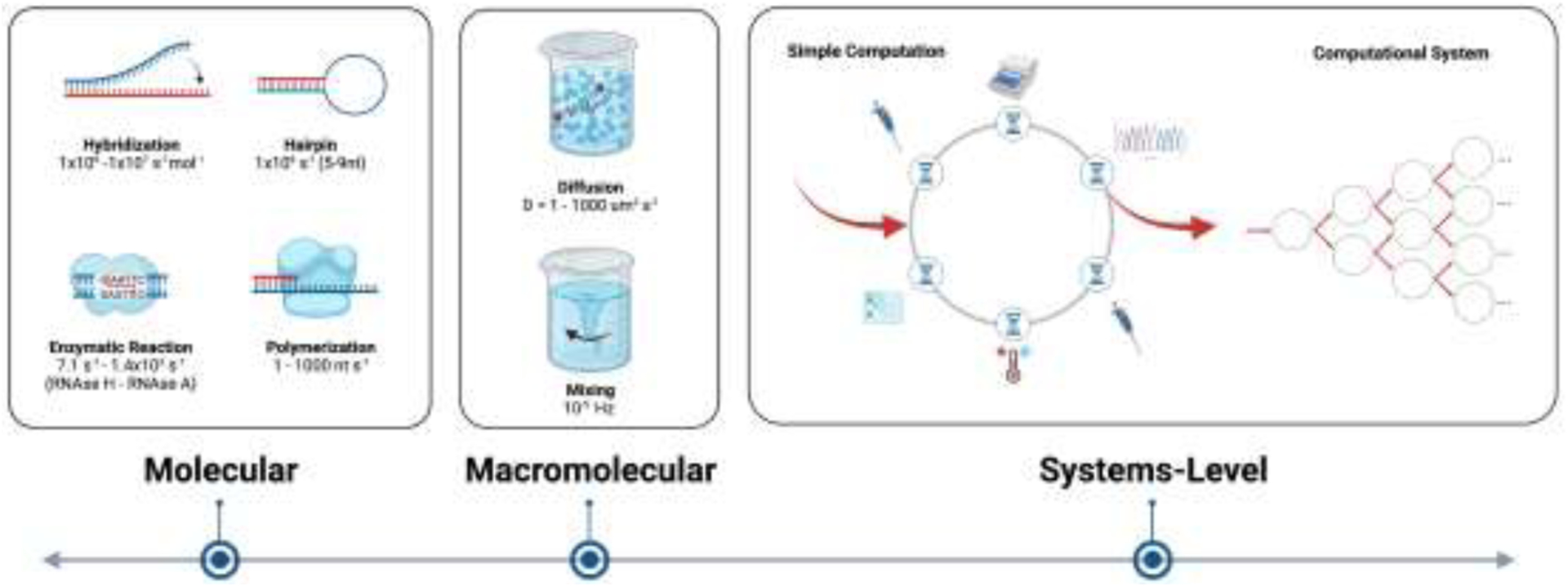
Schematic of computational configurations. Molecular interactions such as hybridization and enzymatic reaction can provide foundational limitations of a system, but macroscale factors such as speed of diffusion must also be considered. System configuration plays the most important role in computation capability, as requirements for specific design, incubation times, and physical manipulations may greatly extend latencies of computation. Created with BioRender.com.

References

    1. IEA: Data Centres and Data Transmission Networks. IEA, Paris: 2020. Accessed 21/11/2022.
    1. Adleman LM: Molecular Computation of Solutions to Combinatorial Problems. Science (1979) 1994, 266:1021–1024. - PubMed
    1. Faulhammer D, Cukras AR, Lipton RJ, Landweber LF: Molecular computation: RNA solutions to chess problems. 1999. - PMC - PubMed
    1. Mao C, LaBean TH, Reif JH, Seeman NC: Logical computation using algorithmic self-assembly of DNA triple-crossover molecules. Nature 2000, 407:493–496. - PubMed
    1. Woods D, Doty D, Myhrvold C, Hui J, Zhou F, Yin P, Winfree E: Diverse and robust molecular algorithms using reprogrammable DNA self-assembly. Nature 2019, 567:366–372. - PubMed
    2. This study constructed a set of DNA tiles comprised of 355 single DNA strands and performed numerous algorithms based upon the reprogrammable self-assembly of these tiles.

Publication types