


Hospitalization for child maltreatment and other types of injury during the COVID-19 pandemic
- PMID: 37060690
- PMCID: PMC10080276
- DOI: 10.1016/j.chiabu.2023.106186
Hospitalization for child maltreatment and other types of injury during the COVID-19 pandemic
Abstract
Background: The possibility that child maltreatment was misclassified as unintentional injury during the COVID-19 pandemic has not been evaluated.
Objective: We assessed if child maltreatment hospitalizations changed during the pandemic, and if the change was accompanied by an increase in unintentional injuries.
Participants and setting: This study included children aged 0-4 years who were admitted for maltreatment or unintentional injuries between April 2006 and March 2021 in hospitals of Quebec, Canada.
Methods: We used interrupted time series regression to estimate the effect of the pandemic on hospitalization rates for maltreatment, compared with unintentional transport accidents, falls, and mechanical force injuries. We assessed if the change in maltreatment hospitalization was accompanied by an increase in specific types of unintentional injury.
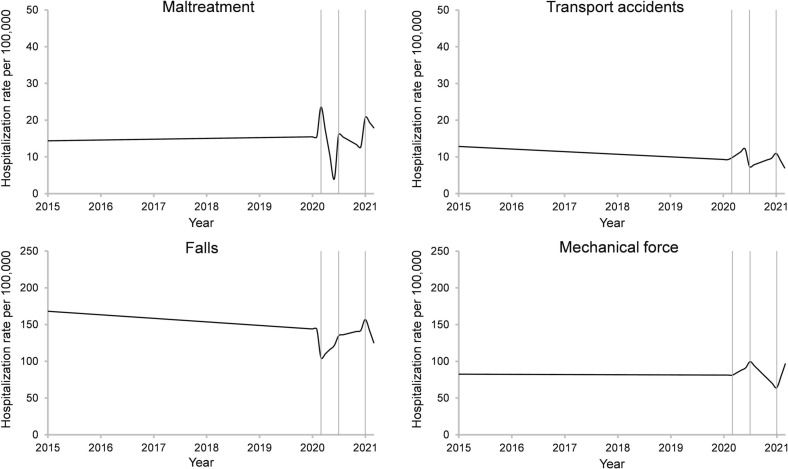
Results: Hospitalizations for child maltreatment decreased from 16.3 per 100,000 (95 % CI 9.1-23.4) the year before the pandemic to 13.2 per 100,000 (95 % CI 6.7-19.7) during the first lockdown. Hospitalizations for most types of unintentional injury also decreased, but injuries due to falls involving another person increased from 9.0 to 16.5 per 100,000. Hospitalization rates for maltreatment and unintentional injury remained low during the second lockdown, but mechanical force injuries involving another person increased from 3.8 to 8.1 per 100,000.
Conclusions: Hospitalizations for child maltreatment may have been misclassified as unintentional injuries involving another person during the pandemic. Children admitted for these types of unintentional injuries may benefit from closer assessment to rule out maltreatment.
Keywords: Accidents; COVID-19; Child maltreatment; Diagnostic errors; Hospital surveillance systems; Injuries.
Copyright © 2023 The Authors. Published by Elsevier Ltd.. All rights reserved.
Conflict of interest statement
Declaration of competing interest None.
Figures
References
-
- Alami H., Lehoux P., Fleet R., Fortin J.-P., Liu J., Attieh R., Cadeddu S.B.M., Abdoulaye Samri M., Savoldelli M., Ag Ahmed M.A. How can health systems better prepare for the next pandemic? Lessons learned from the management of COVID-19 in Quebec (Canada) Frontiers in Public Health. 2021;9 doi: 10.3389/fpubh.2021.671833. - DOI - PMC - PubMed
-
- Amick M., Bentivegna K., Hunter A.A., Leventhal J.M., Livingston N., Bechtel K., Holland M.L. Child maltreatment-related children's emergency department visits before and during the COVID-19 pandemic in Connecticut. Child Abuse & Neglect. 2022;128 doi: 10.1016/j.chiabu.2022.105619. - DOI - PMC - PubMed
-
- Auger N., Low N., Ayoub A., Lee G.E., Luu T.M. Maternal Substance Abuse and the Later Risk of Fractures in Offspring: L'abus maternel de substances et le risque ultérieur de fractures chez les enfants. Canadian Journal of Psychiatry. 2021;66(6):551–559. doi: 10.1177/0706743720970826. - DOI - PMC - PubMed
-
- Bram J.T., Johnson M.A., Magee L.C., Mehta N.N., Fazal F.Z., Baldwin K.D., Riley J., Shah A.S. Where have all the fractures gone? The epidemiology of pediatric fractures during the COVID-19 pandemic. Journal of Pediatric Orthopedics. 2020;40(8):373–379. doi: 10.1097/BPO.0000000000001600. - DOI - PubMed
Publication types
MeSH terms
LinkOut - more resources
Full Text Sources
Medical
Miscellaneous
