


External validation of the QLifetime cardiovascular risk prediction tool: population cohort study
- PMID: 37061672
- PMCID: PMC10105395
- DOI: 10.1186/s12872-023-03209-8
External validation of the QLifetime cardiovascular risk prediction tool: population cohort study
Abstract
Background: Prediction of lifetime cardiovascular disease (CVD) risk is recommended in many clinical guidelines, but lifetime risk models are rarely externally validated. The aim of this study was to externally validate the QRiskLifetime incident CVD risk prediction tool.
Methods: Independent external validation of QRiskLifetime using Clinical Practice Research Datalink data, examining discrimination and calibration in the whole population and stratified by age, and reclassification compared to QRISK3. Since lifetime CVD risk is unobservable, performance was evaluated at 10-years' follow-up, and lifetime performance inferred in terms of performance for in the different age-groups from which lifetime predictions are derived.
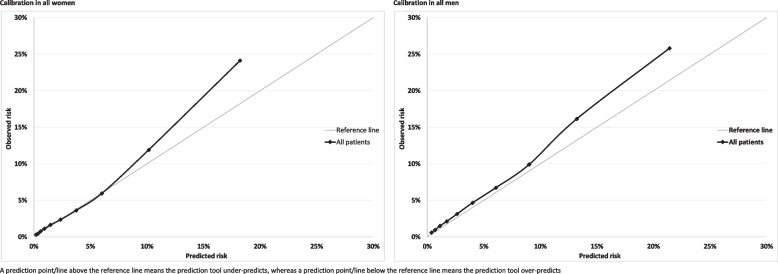
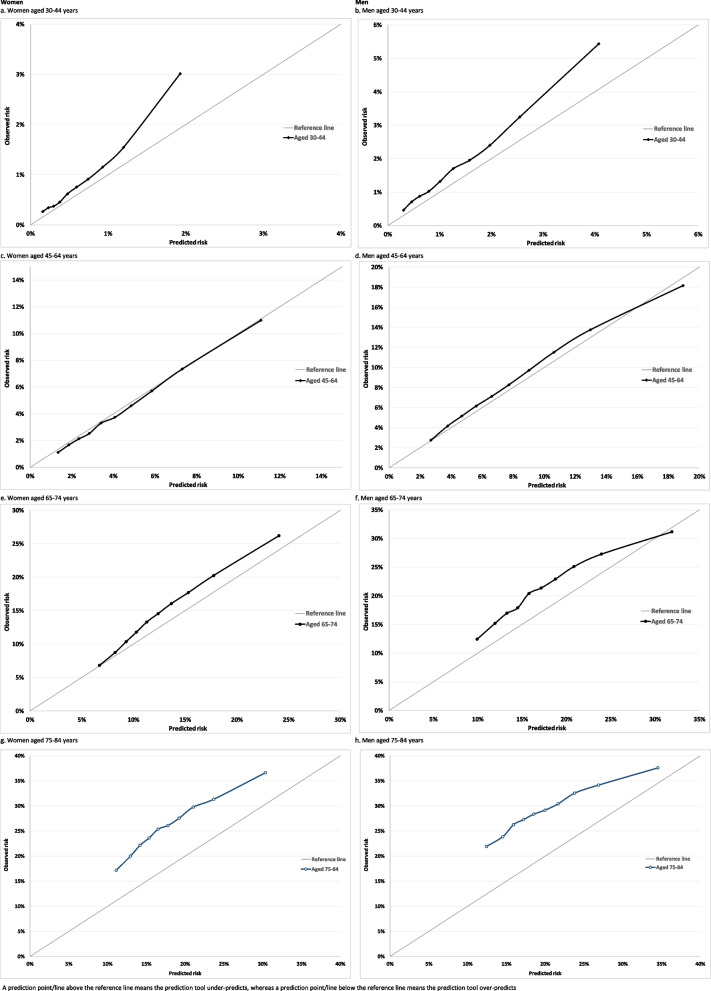
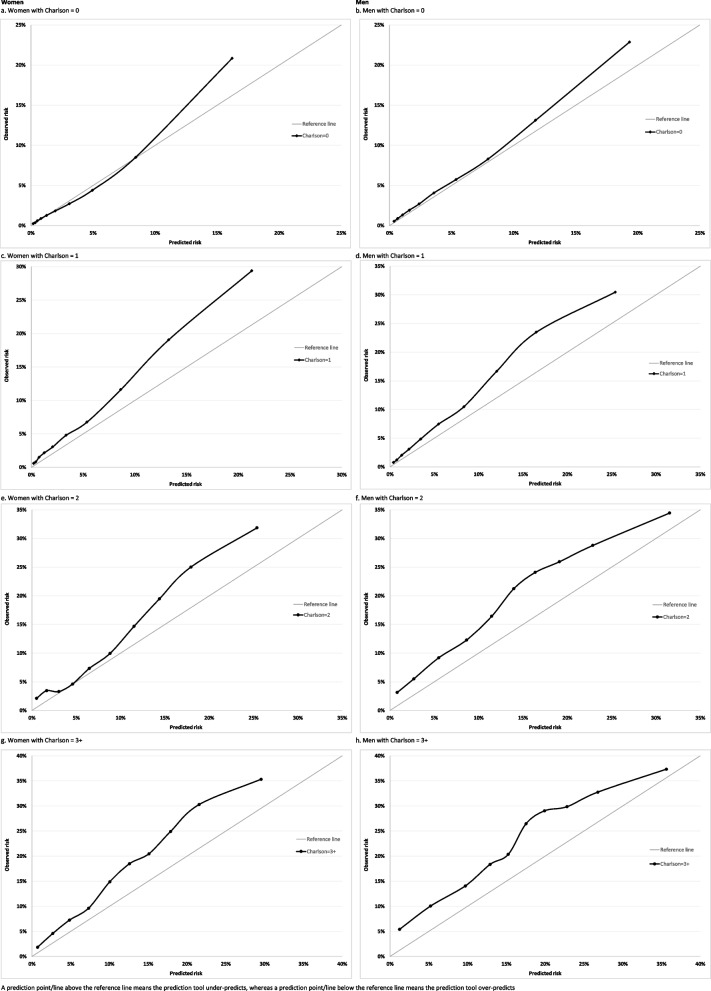
Results: One million, two hundreds sixty thousand and three hundreds twenty nine women and 1,223,265 men were included in the analysis. Discrimination was excellent in the whole population (Harrell's-C = 0.844 in women, 0.808 in men), but moderate to poor stratified by age-group (Harrell's C in people aged 30-44 0.714 for both men and women, in people aged 75-84 0.578 in women and 0.556 in men). Ten-year CVD risk was under-predicted in the whole population, and in all age-groups except women aged 45-64, with worse under-prediction in older age-groups. Compared to those at highest QRISK3 estimated 10-year risk, those with highest lifetime risk were younger (mean age: women 50.5 vs. 71.3 years; men 46.3 vs. 63.8 years) and had lower systolic blood pressure and prevalence of treated hypertension, but had more family history of premature CVD, and were more commonly minority ethnic. Over 10-years, the estimated number needed to treat (NNT) with a statin to prevent one CVD event in people with QRISK3 ≥ 10% was 34 in women and 37 in men, compared to 99 and 100 for those at highest lifetime risk.
Conclusions: QRiskLifetime underpredicts 10-year CVD risk in nearly all age-groups, so is likely to also underpredict lifetime risk. Treatment based on lifetime risk has considerably lower medium-term benefit than treatment based on 10-year risk.
Keywords: Cardiovascular risk; Competing mortality risk; External validation; Lifetime models; Primary prevention; QLifetime; Risk prediction.
© 2023. The Author(s).
Conflict of interest statement
No competing interests to declare. BG reports funding from NIHR, Legal and General PLC, Medical Research Council, and Chief Scientist Office unrelated to this study. DM reports funding from NIHR, Chief Scientist Office and Tenovus unrelated to this study. JF reports funding from NIHR, Legal and General PLC, EPSRC, EU EIT Digital, and Luxembourg National Research Fund; and consulting fees for University of Edinburgh from Hitachi Ltd (Japan), unrelated to this study. PTD reports funding from EU Health FP7 and Chief Scientist Office unrelated to this study.
Figures
References
-
- Grundy SM, Stone NJ, Bailey AL, et al. 2018 AHA/ACC/AACVPR/AAPA/ABC/ACPM/ADA/AGS/APhA/ASPC/NLA/PCNA Guideline on the Management of Blood Cholesterol: A Report of the American College of Cardiology/American Heart Association Task Force on Clinical Practice Guidelines. Circulation. 2019;139(25):e1082–e1143. doi: 10.1161/cir.0000000000000625. - DOI - PMC - PubMed
-
- Jaspers NEM, Blaha MJ, Matsushita K, et al. Prediction of individualized lifetime benefit from cholesterol lowering, blood pressure lowering, antithrombotic therapy, and smoking cessation in apparently healthy people. Eur Heart J. 2020;41(11):1190–9. doi: 10.1093/eurheartj/ehz239. - DOI - PMC - PubMed
Publication types
MeSH terms
Grants and funding
LinkOut - more resources
Full Text Sources
