Inequalities in SARS-CoV-2 case rates by ethnicity, religion, measures of socioeconomic position, English proficiency, and self-reported disability: cohort study of 39 million people in England during the alpha and delta waves
- PMID: 37063237
- PMCID: PMC10568121
- DOI: 10.1136/bmjmed-2022-000187
Inequalities in SARS-CoV-2 case rates by ethnicity, religion, measures of socioeconomic position, English proficiency, and self-reported disability: cohort study of 39 million people in England during the alpha and delta waves
Abstract
Objective: To examine sociodemographic inequalities in people with SARS-CoV-2 during the second (alpha) and third (delta) waves of the covid-19 pandemic.
Design: Retrospective, population based cohort study.
Setting: Resident population of England.
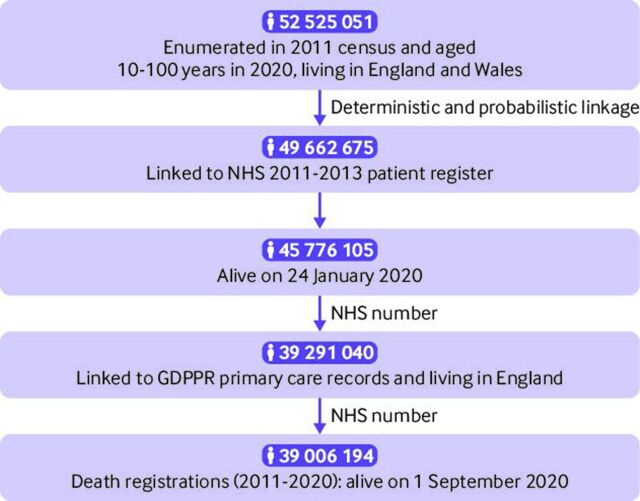
Participants: 39 006 194 people aged 10 years and older who were enumerated in the 2011 census, registered with the NHS, and alive on 1 September 2020.
Main outcome measures: Age standardised SARS-CoV-2 case rates (ie, the number of people who received a positive test result per 100 000 person weeks at risk) during the second wave (1 September 2020 to 22 May 2021) or third wave (23 May to 10 December 2021) of the pandemic. Age standardised rates were calculated by sociodemographic characteristics and adjusted rate ratios were estimated using generalised linear regression models with a Poisson distribution (models were adjusted for covariates including sex, age, geographical variables, and sociodemographic characteristics).
Results: During the study period, 5 767 584 people (14.8% of the study population) tested positive for SARS-CoV-2. In the second wave, the fully adjusted relative risks of having a positive test were highest for the Bangladeshi and Pakistani ethnic groups compared with the white British group, with rate ratios of 1.75 (95% confidence interval 1.73 to 1.77) and 1.69 (1.68 to 1.70), respectively. Muslim and Sikh religious groups had fully adjusted rate ratios of 1.51 (1.50 to 1.51) and 1.64 (1.63 to 1.66), respectively, compared with the Christian group. Greater area deprivation, disadvantaged socioeconomic position, living in a care home, and low English language proficiency were also associated with higher relative risk of having a positive test. However, the inequalities among groups varied over time. Being Christian, white British, without a disability, and from a more advantaged socioeconomic position were associated with increased relative risk of testing positive during the third wave.
Conclusion: Research is urgently needed to understand the large sociodemographic inequalities in SARS-CoV-2 case rates in order to inform policy interventions in future waves or pandemics.
Keywords: COVID-19; epidemiology; public health; socioeconomic factors; statistics.
© Crown copyright 2023.
Conflict of interest statement
Competing interests: All authors have completed the ICMJE uniform disclosure form at www.icmje.org/disclosure-of-interest/ and declare: no support from any organisation for the submitted work; KK chairs the Ethnicity Subgroup of the UK Scientific Advisory Group for Emergencies (SAGE), and is a member of SAGE; ASW’s institution received grants from the Department of Health and Social Care and the National Institutes of Health Research; RA received grants from New York University Abu Dhabi and Upjohn.
Figures
References
-
- GOV.UK . Coronavirus (COVID-19) in the UK dashboard. 2021.
-
- Lilleker D, Coman IA, Gregor M, et al. Political communication and covid-19. 2021. 10.4324/9781003120254 - DOI
-
- Bosworth ML, Ayoubkhani D, Nafilyan V, et al. Deaths involving COVID-19 by self-reported disability status during the first two waves of the COVID-19 pandemic in england: a retrospective, population-based cohort study. Lancet Public Health 2021;6:e817–25. 10.1016/S2468-2667(21)00206-1 - DOI - PMC - PubMed
LinkOut - more resources
Full Text Sources
Miscellaneous