


Sneaky copulations by subordinate males suggest direct fitness benefits from male-male associations in spotted bowerbirds (Ptilonorhynchus maculatus)
- PMID: 37063455
- PMCID: PMC10092701
- DOI: 10.1111/eth.13336
Sneaky copulations by subordinate males suggest direct fitness benefits from male-male associations in spotted bowerbirds (Ptilonorhynchus maculatus)
Abstract
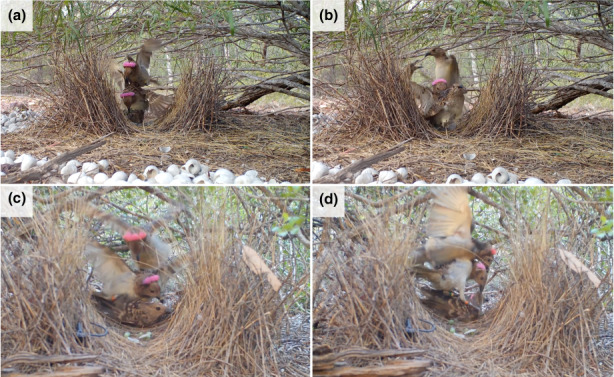
Male spotted bowerbirds (Ptilonorhynchus maculatus) build and defend a structure of sticks and straw-the bower-decorated with colourful objects to attract mates during the breeding season. Specific non-territorial, subordinate males are tolerated by resident males at bowers over multiple breeding seasons. Prior research showed that these male-male associations exhibit attributes of coalitionary behaviour and that subordinate males gain delayed benefits from associating with bower owners, namely future bower inheritance. Yet, it remained unclear whether subordinate males may additionally gain direct fitness benefits from attending established bowers. Here, we report on four separate instances of sneaky copulations (or attempts of copulating) by subordinate males at resident males' bowers. Multiple non-resident males disrupted the ongoing copulations between the bower owner and a receptive female, and these events were followed by violent aggressive interactions. These observations shed new light on same-sex social dynamics in spotted bowerbirds and support the hypothesis that subordinate males are sexually mature individuals that occasionally obtain access to females while attending established bowers. We discuss these findings in light of the literature on male courtship coalitions and agonistic behaviour in bowerbirds, and highlight further aspects of subordinate behaviour that require empirical investigation.
Keywords: alternative reproductive tactic; bowerbird; cheating; courtship coalition; direct fitness benefits; sneaky copulation.
© 2022 The Authors. Ethology published by Wiley‐VCH GmbH.
Conflict of interest statement
The authors declare that they have no competing interests.
Figures
References
-
- Aldrich, J. W. , & Bole, B. P. (1937). The birds and mammals of the western slope of the Azuero peninsula (Republic of Panama). Scientific Publications of the Cleveland Musum of Natural History.
-
- Borgia, G. (1995a). Threat reduction as a cause of differences in bower architecture, bower decoration and male display in two closely‐related bowerbirds Chlamydera nuchalis and C. maculata . Emu, 95(1), 1–12. 10.1071/mu9950001 - DOI
-
- Borgia, G. (1995b). Complex male display and female choice in the spotted bowerbird: Specialized functions for different bower decorations. Animal Behaviour, 49(5), 1291–1301. 10.1006/anbe.1995.0161 - DOI
Grants and funding
LinkOut - more resources
Full Text Sources