. 2023 Mar 15:29:173-184.
doi: 10.1016/j.omtm.2023.03.006. eCollection 2023 Jun 8.

Simultaneous engineering of natural killer cells for CAR transgenesis and CRISPR-Cas9 knockout using retroviral particles

Affiliations

Simultaneous engineering of natural killer cells for CAR transgenesis and CRISPR-Cas9 knockout using retroviral particles

Dong-Hyeon Jo et al. Mol Ther Methods Clin Dev. .

Abstract

Natural killer (NK) cells are potent cytotoxic innate lymphocytes that can be used for cancer immunotherapy. Since the balance of signals from activating and inhibitory receptors determines the activity of NK cells, their anti-tumor activity can be potentiated by overexpressing activating receptors or knocking out inhibitory receptors via genome engineering, such as chimeric antigen receptor (CAR) transgenesis and CRISPR-Cas9-mediated gene editing, respectively. Here, we report the development of a one-step strategy for CRISPR-Cas9-mediated gene knockout and CAR transgenesis in NK cells using retroviral particles. We generated NK cells expressing anti-epidermal growth factor receptor (EGFR)-CAR with simultaneous TIGIT gene knockout using single transduction and evaluated the consequence of the genetic modifications in vitro and in vivo. Taken together, our results demonstrate that retroviral particle-mediated engineering provides a strategy readily applicable to simultaneous genetic modifications of NK cells for efficient immunotherapy.

Keywords: CRISPR-Cas9; EGFR; TIGIT; chimeric antigen receptors; flow virometry; genetic engineering; immunotherapy; natural killer cells; retroviral particles; virus-like-particles.


Conflict of interest statement

The authors declare no competing interests.

Figures
None
Graphical abstract
Figure 1
Figure 1
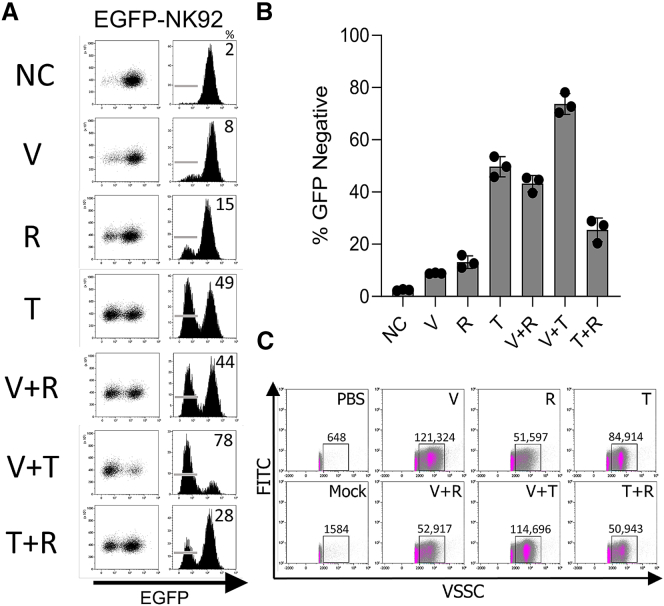
VSV-G- and BaEV-TR-envelope-pseudotyped RPs efficiently targeted the EGFP gene in EGFP-NK92 cells (A) Representative flow cytometry of EGFP expression in EGFP-NK92 cells transduced with RPs pseudotyped with various envelope glycoproteins. (B) The EGFP knockout efficiency in EGFP-NK92 cells transduced by RPs pseudotyped with various envelope glycoproteins (n = 3). (C) Flow virometry analysis of variously pseudotyped RPs. The numbers indicate the total number of viral particles in the gated area. NC, negative control; V, VSV-G; T, BaEV-TR; R, BaEVRless; VSSC, violet side scatter.
Figure 2
Figure 2
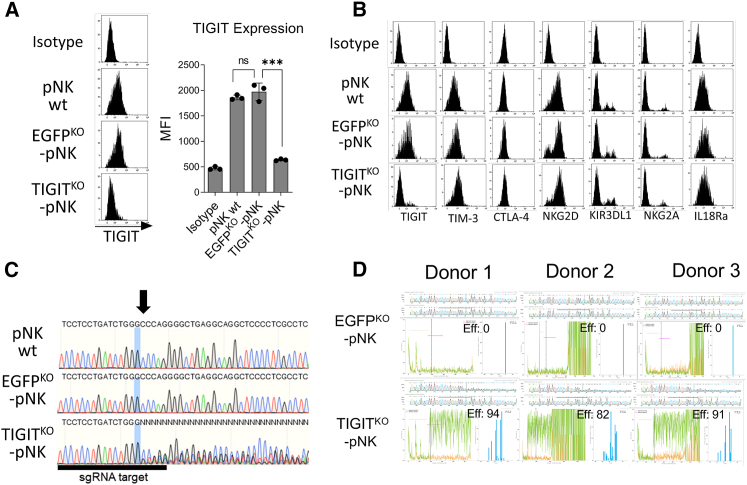
Anti-TIGIT RPs abrogated TIGIT expression in primary human NK cells (A) Representative mean fluorescence intensity (MFI) of TIGIT surface expression in human pNK cells transduced with RPs targeting the TIGIT gene (n = 3). Data represent mean ± SD. (B) Representative histograms depicting the expression of various surface receptors on pNK cells transduced by RPs. (C) Sequences of the whole TIGIT PCR fragments from pNK cells treated with RPs. The arrow indicates a mutation starting site analyzed by Sanger sequencing. (D) ICE analysis of sequenced TIGIT PCR fragments from three donors that received CRISPR-Cas9 and sgRNA-loaded RPs. The upper chromatograms show sequencing results (Cas9-RNP-RP samples, top; non-treated controls, bottom). The sequence signal plots show the discordant sequences between control (orange) and RP-received samples (green). The right bar graphs indicate frequencies of indel mutations. Eff, editing efficiency; ns, non-significant; ∗p < 0.05; ∗∗p < 0.01; ∗∗∗p < 0.001; ∗∗∗∗p < 0.0001.
Figure 3
Figure 3
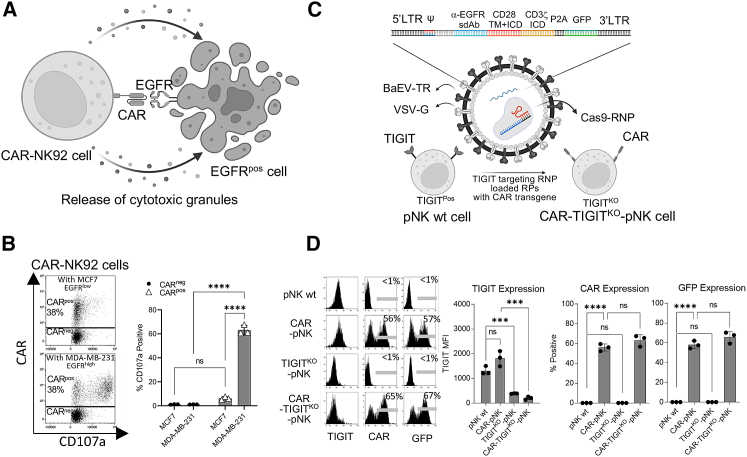
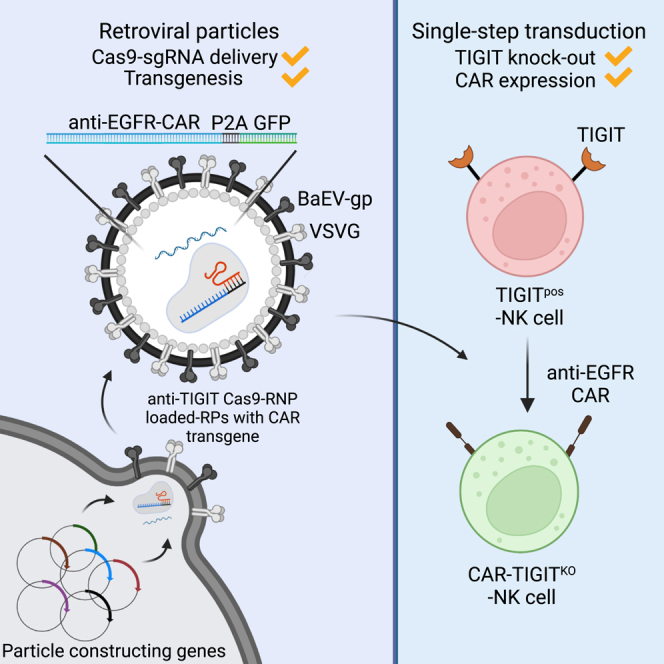
Simultaneous TIGIT gene knockout with CAR integration into an NK cell genome by Cas9-RNP-loaded RPs (A) Graphical summary depicting anti-EGFR-CAR-induced tumor killing in NK cells. (B) Representative dot plots and bar graphs of the enhanced anti-tumor activity of CAR-NK92 cells against the EGFRhigh TNBC cell line, MDA-MB-231. (C) Graphical summary depicting the strategy by which RPs engineer NK cells with anti-EGFR-CAR transgenesis and TIGIT gene knockout. (D) TIGIT, CAR, and GFP expression on pNK cells from three different donors that were transduced by RPs. ns, non-significant; ∗p < 0.05; ∗∗p < 0.01; ∗∗∗p < 0.001; ∗∗∗∗p < 0.0001.
Figure 4
Figure 4
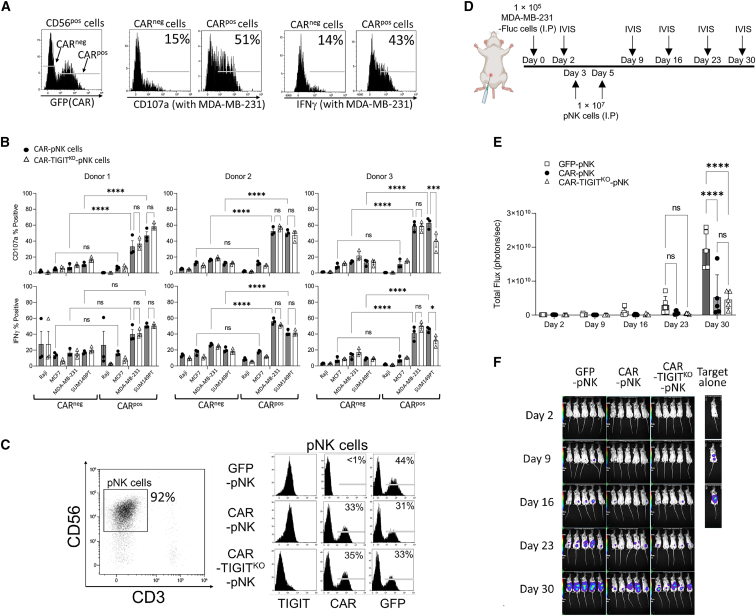
TIGIT knockout failed to enhance the anti-tumor activity of human NK cell function in vitro and in vivo (A) Representative histograms show the gating strategy to measure CD107a and IFN-γ expression on NK cells in regards to CAR expression. (B) The proportions of CD107a+ and IFN-γ+ cells among the total NK cell population upon stimulation with various target cells (n = 3). Expanded pNK cells from three donors were analyzed. Data represent mean ± SD. (C) NK cell phenotypes used in the first dose on the day of injection. TIGIT, CAR, and GFP expression on CD3CD56+ cells were analyzed. (D) Schematic of experimental procedures for the evaluation of the anti-tumor activity of genetically modified pNK cells in vivo using an MDA-MB-231 intraperitoneal xenograft mouse model (n = 5). (E) Tumor burden of each group was measured using total bioluminescence values from control pNK, CAR-pNK, or CAR-TIGITKO-pNK cells. (F) Bioluminescence images were acquired on days 2, 9, 16, 23, and 30 by IVIS. ns, non-significant; ∗p < 0.05; ∗∗p < 0.01; ∗∗∗p < 0.001; ∗∗∗∗p < 0.0001. I.P., intraperitoneal injection.
Figure 5
Figure 5
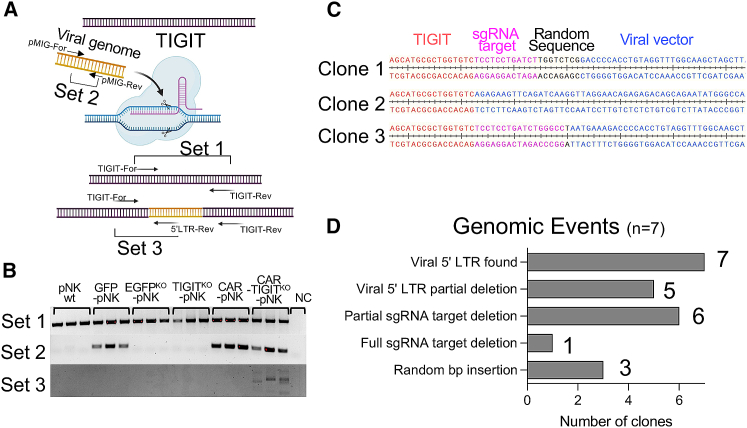
Site-specific CAR integration into an NK cell genome by Cas9-sgRNA RPs (A) Illustrative concept of a site-specific CAR integration into a genome by Cas9-sgRNAs. The bottom DNA indicates the genomic modification after the engineering using Cas9-RNP-loaded RPs. Arrows indicate the locations and directions of primers for PCR. (B) PCR amplicons from PCR using primer set 1, set 2, and set 3. Note that the amplicons from PCR with primer set 3 indicate possible site-specific CAR integration into the TIGIT locus. (C) Representative Sanger sequencing results of three independent amplicons from PCR with primer set 3. (D) Summary of various genomic events in seven independent amplicons from PCR with primer set 3.

References

    1. Rafiq S., Hackett C.S., Brentjens R.J. Engineering strategies to overcome the current roadblocks in CAR T cell therapy. Nat. Rev. Clin. Oncol. 2020;17:147–167. doi: 10.1038/s41571-019-0297-y. - DOI - PMC - PubMed
    1. Roselli E., Frieling J.S., Thorner K., Ramello M.C., Lynch C.C., Abate-Daga D. CAR-T engineering: optimizing signal transduction and effector mechanisms. BioDrugs. 2019;33:647–659. doi: 10.1007/s40259-019-00384-z. - DOI - PubMed
    1. Fehniger T.A., Cooper M.A. Harnessing NK cell memory for cancer immunotherapy. Trends Immunol. 2016;37:877–888. doi: 10.1016/j.it.2016.09.005. - DOI - PMC - PubMed
    1. Guillerey C., Huntington N.D., Smyth M.J. Targeting natural killer cells in cancer immunotherapy. Nat. Immunol. 2016;17:1025–1036. doi: 10.1038/ni.3518. - DOI - PubMed
    1. Liu E., Tong Y., Dotti G., Shaim H., Savoldo B., Mukherjee M., Orange J., Wan X., Lu X., Reynolds A., et al. Cord blood NK cells engineered to express IL-15 and a CD19-targeted CAR show long-term persistence and potent antitumor activity. Leukemia. 2018;32:520–531. doi: 10.1038/leu.2017.226. - DOI - PMC - PubMed