


In situ coagulation-electrochemical oxidation of leachate concentrate: A key role of cathodes
- PMID: 37065009
- PMCID: PMC10091031
- DOI: 10.1016/j.ese.2023.100267
In situ coagulation-electrochemical oxidation of leachate concentrate: A key role of cathodes
Abstract
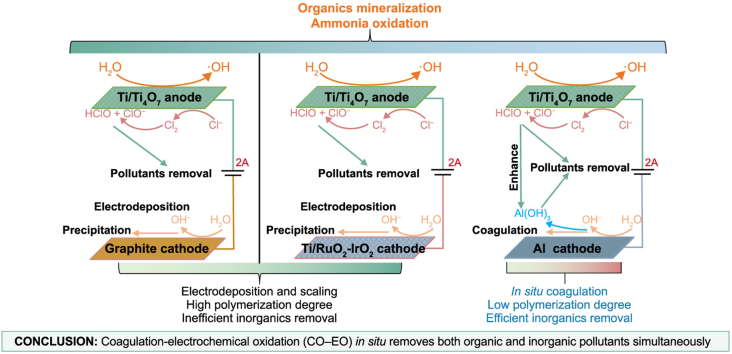
To efficiently remove organic and inorganic pollutants from leachate concentrate, an in situ coagulation-electrochemical oxidation (CO-EO) system was proposed using Ti/Ti4O7 anode and Al cathode, coupling the "super-Faradaic" dissolution of Al. The system was evaluated in terms of the removal efficiencies of organics, nutrients, and metals, and the underlying cathodic mechanisms were investigated compared with the Ti/RuO2-IrO2 and graphite cathode systems. After a 3-h treatment, the Al-cathode system removed 89.0% of COD and 36.3% of total nitrogen (TN). The TN removal was primarily ascribed to the oxidation of both ammonia and organic-N to N2. In comparison, the Al-cathode system achieved 3-10-fold total phosphorus (TP) (62.6%) and metal removals (>80%) than Ti/RuO2-IrO2 and graphite systems. The increased removals of TP and metals were ascribed to the in situ coagulation of Al(OH)3, hydroxide precipitation, and electrodeposition. With the reduced scaling on the Al cathode surface, the formation of Al3+ and electrified Al(OH)3 lessened the requirement for cathode cleaning and increased the bulk conductivity, resulting in increased instantaneous current production (38.9%) and operating cost efficiencies (48.3 kWh kgCOD -1). The present study indicated that the in situ CO-EO process could be potentially used for treating persistent wastewater containing high levels of organic and inorganic ions.
Keywords: Cathode material; Electrochemical process; Leachate concentrate; Removal mechanism; in situ coagulation treatment.
© 2023 The Author(s).
Conflict of interest statement
The authors declare that they have no known competing financial interests or personal relationships that could have appeared to influence the work reported in this paper.
Figures


References
-
- Top S., Sekman E., Hoşver S., Bilgili M.S. Characterization and electrocaogulative treatment of nanofiltration concentrate of a full-scale landfill leachate treatment plant. Desalination. 2011;268(1–3):158–162.
-
- Cui Y., Xue W., Yang S., Tu J., Guo X., Liu Z. Electrochemical/peroxydisulfate/Fe3+ treatment of landfill leachate nanofiltration concentrate after ultrafiltration. Chem. Eng. J. 2018;353:208–217.
-
- Chang H., Hu R., Zou Y., Quan X., Zhong N., Zhao S., Sun Y. Highly efficient reverse osmosis concentrate remediation by microalgae for biolipid production assisted with electrooxidation. Water Res. 2020;174 - PubMed
-
- Chu D., Ye Z.L., Chen S. Interactions among low-molecular-weight organics, heavy metals, and Fe (III) during coagulation of landfill leachate nanofiltration concentrate. Waste Manage. (Tucson, Ariz.) 2020;104:51–59. - PubMed
-
- Fernandes A., Pacheco M., Ciríaco L., Lopes A. Review on the electrochemical processes for the treatment of sanitary landfill leachates: present and future. Appl. Catal. B Environ. 2015;176:183–200.
LinkOut - more resources
Full Text Sources
