


Prognostic Factors for Clinical Outcomes After Arthroscopic Rotator Cuff Repair
- PMID: 37065182
- PMCID: PMC10102950
- DOI: 10.1177/23259671231160738
Prognostic Factors for Clinical Outcomes After Arthroscopic Rotator Cuff Repair
Abstract
Background: Limited knowledge exists regarding prognostic factors after rotator cuff repair.
Purpose: To identify pre- and perioperative predictors for functional outcomes after arthroscopic rotator cuff repair.
Study design: Case-control study; Level of evidence, 3.
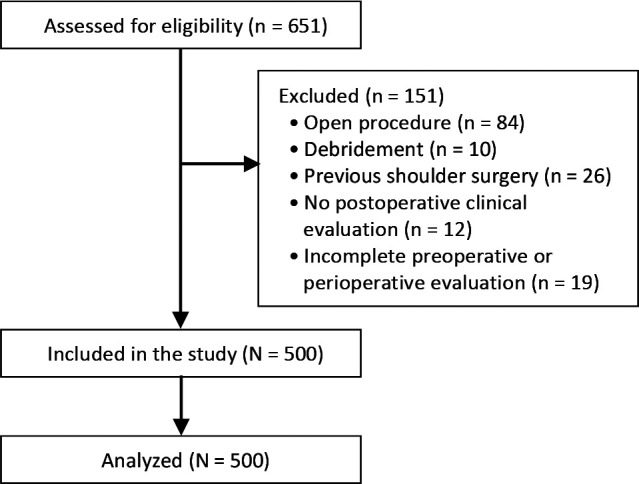
Methods: This study included patients who underwent arthroscopic rotator cuff repair between January 2013 and April 2019 and who had preoperative magnetic resonance imaging scans. The procedures were performed by 4 shoulder surgeons at a single institution. Excluded were patients who had previous surgeries, those who underwent open surgery, and those without 12- and 24-month follow-up clinical data. Patient-reported outcomes (American Shoulder and Elbow Surgeons [ASES] Standardized Shoulder Assessment Form and University of California, Los Angeles [UCLA] Shoulder Rating Scale scores) were assessed preoperatively and at 6, 12, and 24 months postoperatively. Using multiple linear regression analysis, the authors evaluated the influence of 29 variables relating to patient, lesion, and procedure characteristics on postoperative outcomes, with the 24-month ASES score as the dependent variable.
Results: The study sample consisted of 474 patients (500 shoulders). The median ASES score increased from 41.6 preoperatively to 88.3 at 24 months (P < .001), and the median UCLA score increased from 14 preoperatively to 32 in the same period (P < .001). The following variables were found to be independent predictors for higher 24-month postoperative ASES score: male sex, absence of rheumatologic disease, older age, lower degree of supraspinatus muscle fatty degeneration, acromioplasty, and a higher preoperative ASES score.
Conclusion: The prognostic factors for better clinical results at 24 months after arthroscopic rotator cuff repair were male sex, absence of rheumatologic disease, older age, lower degree of fatty degeneration of the supraspinatus muscle, concomitant acromioplasty, and higher preoperative ASES score.
Keywords: outcome prognostic tool; prognostic factors; risk factors; rotator cuff; rotator cuff repair; shoulder function.
© The Author(s) 2023.
Conflict of interest statement
The authors declared that they have no conflicts of interest in the authorship and publication of this contribution. AOSSM checks author disclosures against the Open Payments Database (OPD). AOSSM has not conducted an independent investigation on the OPD and disclaims any liability or responsibility relating thereto.
Figures
References
-
- Abrams GD, Gupta AK, Hussey KE, et al. Arthroscopic repair of full-thickness rotator cuff tears with and without acromioplasty: randomized prospective trial with 2-year follow-up. Am J Sports Med. 2014;42(6):1296–1303. - PubMed
-
- Baumgarten KM, Schweinle WE III, Chang PS. Do patients who smoke tobacco have success with primary arthroscopic rotator cuff repair? A comparison with nonsmokers. J Shoulder Elbow Surg. 2020;29(8):1650–1655. - PubMed
-
- Collin P, Colmar M, Thomazeau H, et al. Clinical and MRI outcomes 10 years after repair of massive posterosuperior rotator cuff tears. J Bone Joint Surg Am. 2018;100(21):1854–1863. - PubMed
LinkOut - more resources
Full Text Sources
Miscellaneous
