Identified optimal candidates for pulmonary resection in octogenarians with non-small cell lung cancer: a web-based predictive model
- PMID: 37065566
- PMCID: PMC10089884
- DOI: 10.21037/jtd-22-997
Identified optimal candidates for pulmonary resection in octogenarians with non-small cell lung cancer: a web-based predictive model
Abstract
Background: A survival benefit from pulmonary resection was observed in octogenarians with non-small cell lung cancer (NSCLC). Meanwhile, the identification of patients who can indeed benefit can be difficult. Therefore, we aimed to establish a web-based predictive model to identify optimal candidates for pulmonary resection.
Methods: Octogenarians with NSCLC in Surveillance, Epidemiology and End Results (SEER) database were enrolled and split into the surgery and non-surgery groups based on whether they received pulmonary resection. Propensity-score matching (PSM) was utilized to eliminate the imbalance. Independent prognostic factors were identified. Patients in the surgery group who lived longer than the median cancer-specific survival (CSS) time of the non-surgery group were assumed to benefit from the surgery. The surgery group was further divided into the beneficial group and the non-beneficial group based on the median CSS time of the non-surgery group. Among the surgery group, a nomogram was established through a logistic regression model.
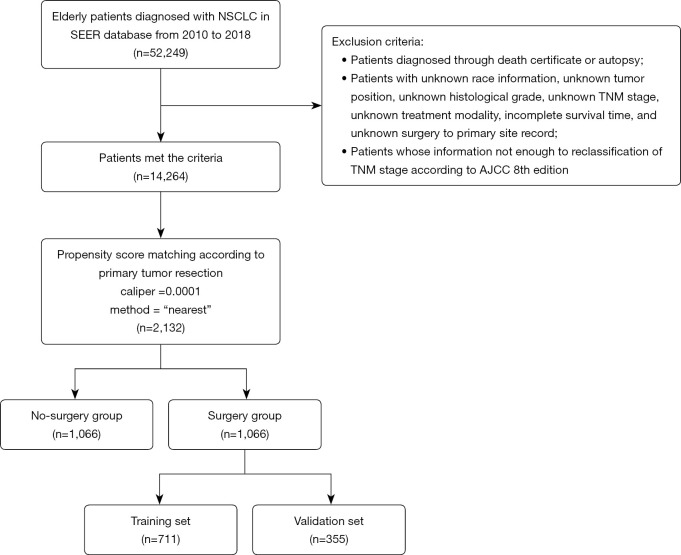
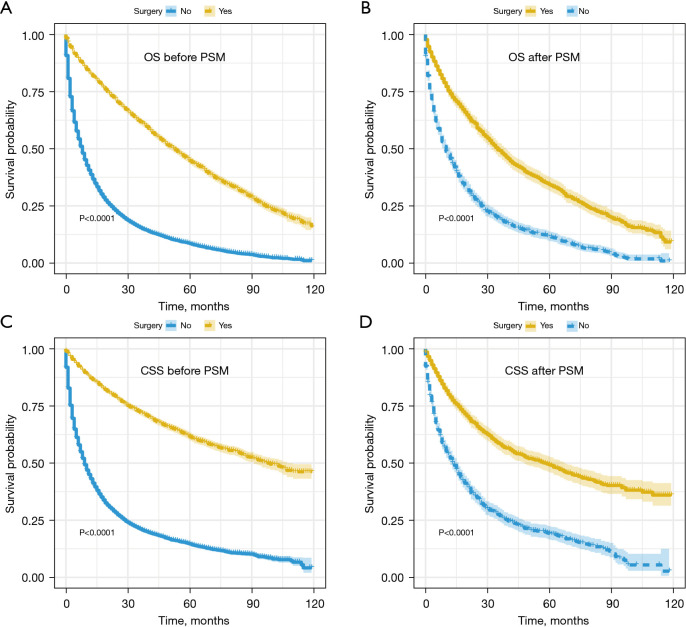
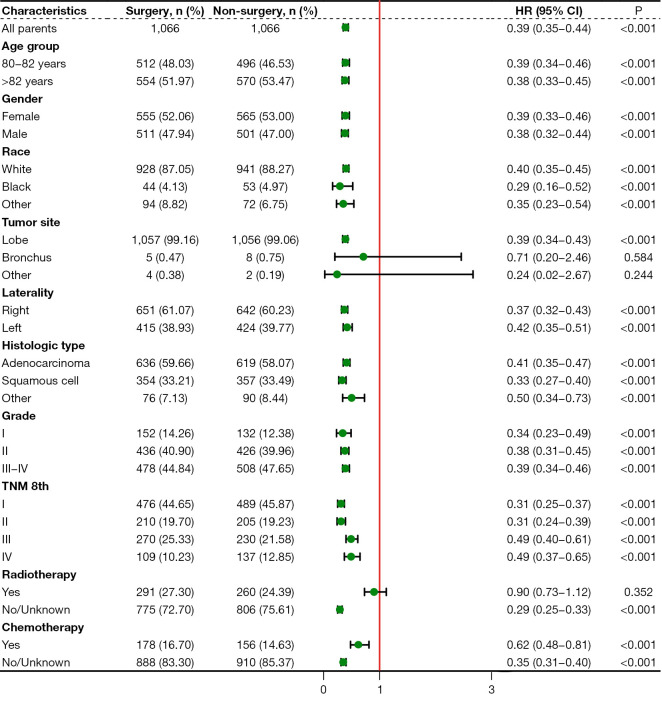
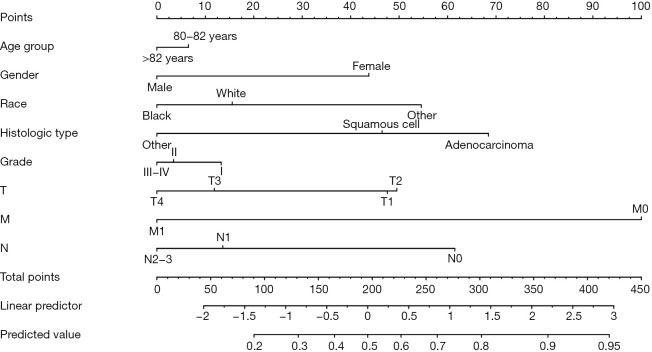
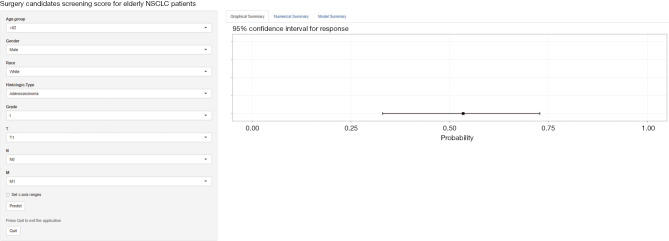
Results: A total of 14,264 eligible patients were extracted, with 4,475 (31.37%) patients receiving pulmonary resection. Surgery was an independent favorable factor of prognosis after PSM (median CSS time: 58 vs. 14 months, P<0.001). A total of 750 (70.4%) patients lived longer than 14 months (beneficial group) in the surgery group. Factors including age, gender, race, histologic type, differentiation grade, and tumor-node-metastasis (TNM) stage were used to formulate the web-based nomogram. The precise discrimination and predictive capability of the model were validated through receiver operating characteristic curves, calibration plots, and decision curve analyses.
Conclusions: A web-based predicted model was constructed to distinguish specific patients who can indeed benefit from pulmonary resection among octogenarians with NSCLC.
Keywords: Non-small cell lung cancer (NSCLC); nomogram; octogenarians; web-based predictive model.
2023 Journal of Thoracic Disease. All rights reserved.
Conflict of interest statement
Conflicts of Interest: All authors have completed the ICMJE uniform disclosure form (available at https://jtd.amegroups.com/article/view/10.21037/jtd-22-997/coif). The authors have no conflicts of interest to declare.
Figures
Comment in
-
How to determine surgical management in octogenarian patients with lung cancer?J Thorac Dis. 2023 Aug 31;15(8):4130-4133. doi: 10.21037/jtd-23-626. Epub 2023 Aug 1. J Thorac Dis. 2023. PMID: 37691664 Free PMC article. No abstract available.
-
Surgery for octogenarians: the secret is in the selection.J Thorac Dis. 2023 Aug 31;15(8):4134-4136. doi: 10.21037/jtd-23-864. Epub 2023 Jul 21. J Thorac Dis. 2023. PMID: 37691681 Free PMC article. No abstract available.
References
-
- Committee for Scientific Affairs , The Japanese Association for Thoracic Surgery, Shimizu H, Okada M, et al. Thoracic and cardiovascular surgeries in Japan during 2017: Annual report by the Japanese Association for Thoracic Surgery. Gen Thorac Cardiovasc Surg 2020;68:414-49. 10.1007/s11748-020-01298-2 - DOI - PubMed
LinkOut - more resources
Full Text Sources
Miscellaneous