


Mapping the Response of Human Osteocytes in Native Matrix to Mechanical Loading Using RNA Sequencing
- PMID: 37065632
- PMCID: PMC10097643
- DOI: 10.1002/jbm4.10721
Mapping the Response of Human Osteocytes in Native Matrix to Mechanical Loading Using RNA Sequencing
Abstract
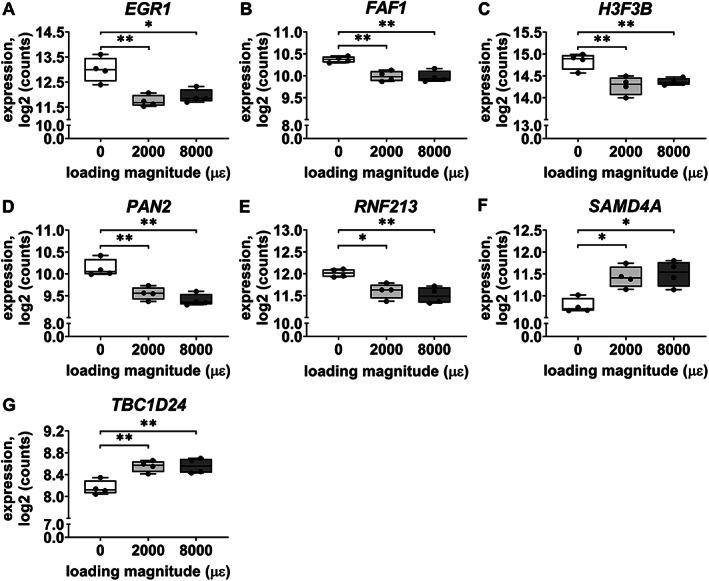
Osteocytes sense mechanical loads and transduce mechanical signals into a chemical response. They are the most abundant bone cells deeply embedded in mineralized bone matrix, which affects their regulatory activity in the mechanical adaptation of bone. The specific location in the calcified bone matrix hinders studies on osteocytes in the in vivo setting. Recently, we developed a three-dimensional mechanical loading model of human osteocytes in their native matrix, allowing to study osteocyte mechanoresponsive target gene expression in vitro. Here we aimed to identify differentially expressed genes by mapping the response of human primary osteocytes in their native matrix to mechanical loading using RNA sequencing. Human fibular bone was retrieved from 10 donors (age: 32-82 years, 5 female, 5 male). Cortical bone explants (8.0 × 3.0 × 1.5 mm; length × width × height) were either not loaded or mechanically loaded by 2000 or 8000 μɛ for 5 minutes, followed by 0, 6, or 24 hours post-culture without loading. High-quality RNA was isolated, and differential gene expression analysis performed by R2 platform. Real-time PCR was used to confirm differentially expressed genes. Twenty-eight genes were differentially expressed between unloaded and loaded (2000 or 8000 μɛ) bone at 6 hours post-culture, and 19 genes at 24 hours post-culture. Eleven of these genes were related to bone metabolism, ie, EGR1, FAF1, H3F3B, PAN2, RNF213, SAMD4A, and TBC1D24 at 6 hours post-culture, and EGFEM1P, HOXD4, SNORD91B, and SNX9 at 24 hours post-culture. Mechanical loading significantly decreased RNF213 gene expression, which was confirmed by real-time PCR. In conclusion, mechanically loaded osteocytes differentially expressed 47 genes, of which 11 genes were related to bone metabolism. RNF213 might play a role in mechanical adaptation of bone by regulating angiogenesis, which is a prerequisite for successful bone formation. The functional aspects of the differentially expressed genes in bone mechanical adaptation requires future investigation. © 2023 The Authors. JBMR Plus published by Wiley Periodicals LLC on behalf of American Society for Bone and Mineral Research.
Keywords: 3D; HUMAN BONE; MECHANICAL LOADING; NATIVE MATRIX; OSTEOCYTES; RNA SEQUENCING.
© 2023 The Authors. JBMR Plus published by Wiley Periodicals LLC on behalf of American Society for Bone and Mineral Research.
Conflict of interest statement
The authors have no conflicts of interest to declare that are relevant to the content of this article.
Figures




References
-
- Franz‐Odendaal TA, Hall BK, Witten PE. Buried alive: how osteoblasts become osteocytes. Dev Dyn. 2006;235:176‐190. - PubMed
-
- Kamioka H, Honjo T, Takano‐Yamamoto T. A three‐dimensional distribution of osteocyte processes revealed by the combination of confocal laser scanning microscopy and differential interference contrast microscopy. Bone. 2001;28:145‐149. - PubMed
-
- You LD, Weinbaum S, Cowin SC, Schaffler MB. Ultrastructure of the osteocyte process and its pericellular matrix. Anat Rec A Discov Mol Cell Evol Biol. 2004;278:505‐513. - PubMed
-
- Burger EH, Klein‐Nulend J. Mechanotransduction in bone—role of the lacuno‐canalicular network. FASEB J. 1999;13:S101‐S112. - PubMed
-
- Klein‐Nulend J, van der Plas A, Semeins CM, et al. Sensitivity of osteocytes to biomechanical stress in vitro. FASEB J. 1995;9:441‐445. - PubMed
LinkOut - more resources
Full Text Sources
Molecular Biology Databases
Research Materials