Review
. 2023 Mar 31:11:1142287.
doi: 10.3389/fchem.2023.1142287. eCollection 2023.

Mass spectrometry-based metabolomics for discovering active ingredients and exploring action mechanism of herbal medicine

Affiliations
Review

Mass spectrometry-based metabolomics for discovering active ingredients and exploring action mechanism of herbal medicine

Sifan Guo et al. Front Chem. .

Abstract

Natural products derived from herbal medicine are a fruitful source of lead compounds because of their structural diversity and potent bioactivities. However, despite the success of active compounds derived from herbal medicine in drug discovery, some approaches cannot effectively elucidate the overall effect and action mechanism due to their multi-component complexity. Fortunately, mass spectrometry-based metabolomics has been recognized as an effective strategy for revealing the effect and discovering active components, detailed molecular mechanisms, and multiple targets of natural products. Rapid identification of lead compounds and isolation of active components from natural products would facilitate new drug development. In this context, mass spectrometry-based metabolomics has established an integrated pharmacology framework for the discovery of bioactivity-correlated constituents, target identification, and the action mechanism of herbal medicine and natural products. High-throughput functional metabolomics techniques could be used to identify natural product structure, biological activity, efficacy mechanisms, and their mode of action on biological processes, assisting bioactive lead discovery, quality control, and accelerating discovery of novel drugs. These techniques are increasingly being developed in the era of big data and use scientific language to clarify the detailed action mechanism of herbal medicine. In this paper, the analytical characteristics and application fields of several commonly used mass spectrometers are introduced, and the application of mass spectrometry in the metabolomics of traditional Chinese medicines in recent years and its active components as well as mechanism of action are also discussed.

Keywords: Metabolomic; biomarker; herbal medicine; mass spectrometry; mechanism; target.


Conflict of interest statement

The authors declare that the research was conducted in the absence of any commercial or financial relationships that could be construed as a potential conflict of interest.

Figures
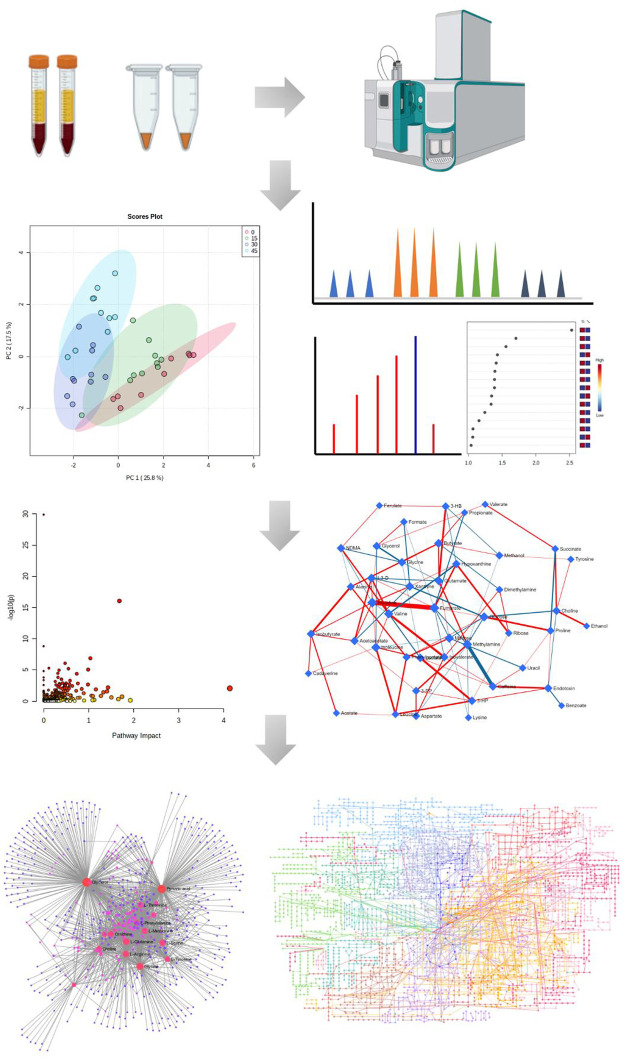
FIGURE 1
FIGURE 1
The experiment workflow of metabolomics. All images were obtained using the example data provided by the MetaboAnalyst 5.0 and figures created by BioRender.
FIGURE 2
FIGURE 2
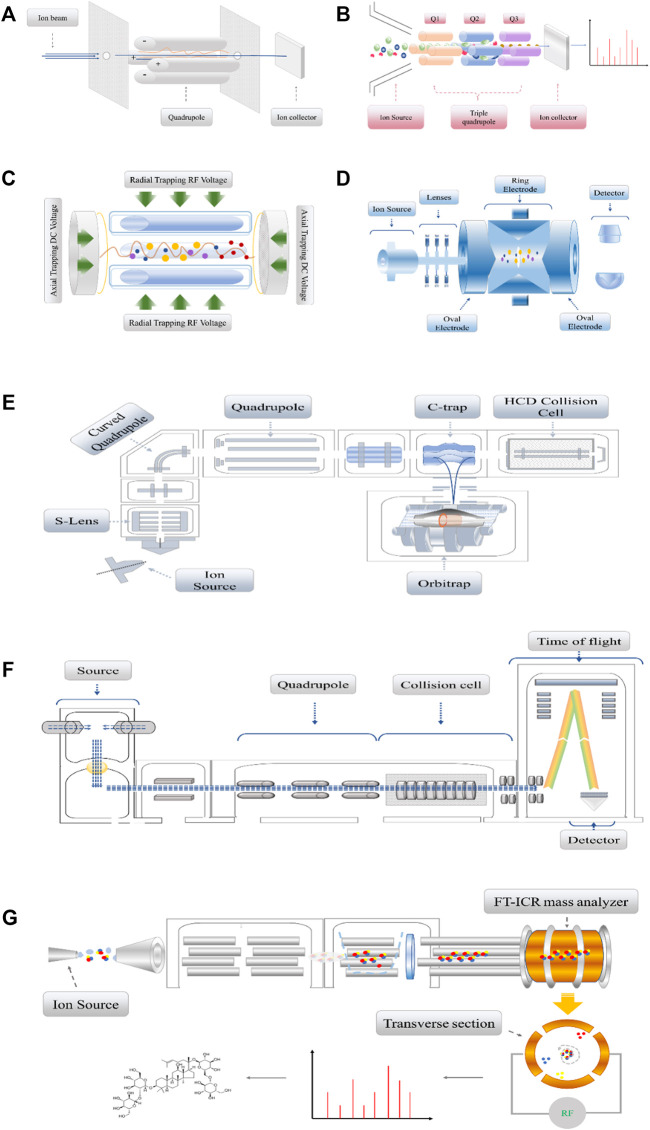
(A). The single quadrupole detector consists of four parallel cylindrical or hyperbolic cylindrical electrodes which are equally spaced with the central axis to form two groups of positive and negative electrodes. The DC voltage and RF voltage in the x and y directions are applied to generate a dynamic electric field. (B). Triple quadrupole detector, which by breaking the sample in the ion source to obtain specific daughter ions, daughter ions by Q1, Q2, and Q3 after the selection of the receiver into electrical signals. (C). Linear ion trap, which are designed as three segments in their entirety, apply Radial Trapping RF Voltage and Axial Trapping DC Voltage between electrodes. (D). 3D ion trap diagram is composed of a ring electrode and two oval electrodes. Two oval electrodes have small holes as ion channels. Generally, RF AC voltage or DC voltage is applied on the ring electrode. (E). The Orbitrap detector, after ionization of the analytes in the Ion Source, will sequentially enter the Quadrupole, the C-trap, and the Orbitrap. If debris is also collected, the detected material will also be fragmented in a high-energy collision cell. It works like electrons rotate around the nucleus. (F). The schematic diagram of a substance passing through the Q-TOF mass spectrometer. According to the equation of kinetic energy with mass and velocity: E = mv2, ions with smaller mass-to-charge ratio will obtain higher velocity, shorter flight time, and then convert into mass spectra. (G). The FT-ICR mass spectrometer is a cavity with uniform superconducting magnetic field. Ions move in a circular orbit perpendicular to the magnetic field. When the cyclotron ion beam approaches a pair of traps, the image current signal will be detected on the traps, and the original data is transformed by Fourier transform to form a mass spectrum.
FIGURE 3
FIGURE 3
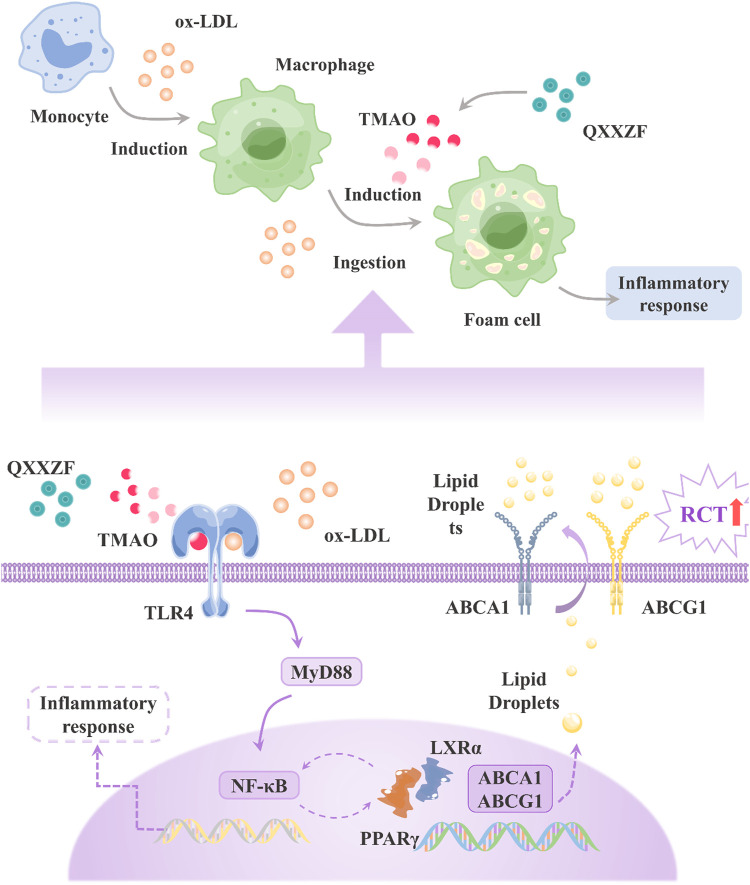
Mechanism of Qing-Xue-Xiao-Zhi formula in attenuating atherosclerosis. QXXZF, Qing-Xue-Xiao-Zhi formula; ox-LDL, oxidized low-density lipoprotein; TMAO, trimethylamine N-oxide; RCT, reverse cholesterol transport; ABCA1, ATP-binding cassette A1; ABCG1, ATP-binding cassette G1; PPARγ, peroxisome proliferator-activated receptor γ; LXRα, liver X receptor α; TLR4, Toll-like receptor 4; MyD88, Myeloid Differentiation primary response 88; NF-κB, Nuclear Factor kappa B.
FIGURE 4
FIGURE 4
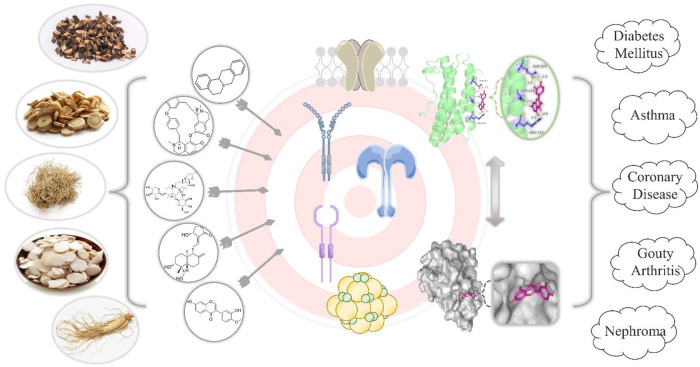
‘Drug-Ingredient-Target-Disease’ Network Diagram. Drug ingredients bind to common targets such as enzymes, ion channels, receptors, or other biomolecules. In this figure, quercetin is used as an example to show its docking diagram with the stick structure and surface structure of IL6 target.
FIGURE 5
FIGURE 5
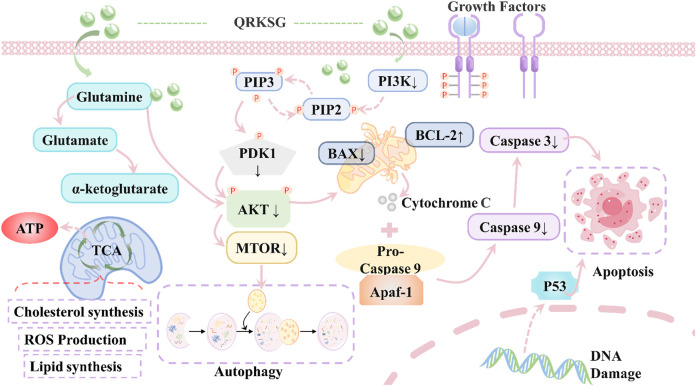
Mechanism of Qing-Re-Ka-Sen Granule in Treating Nephrotic Syndrome. QRKSG, Qing-Re-Ka-Sen granule; PI3K, Phosphatidylinositol3-kinase; PIP2, Phosphoinositide 2 kinase; PIP3, Phosphoinositide 3 kinase; PDK1, Pyruvate dehydrogenase kinase 1; AKT, AKT Serine/Threonine Kinase; mTOR, mammalian target of rapamycin; BAX, BCL2-associated X protein; BCL2, Apoptosis Regulator; TCA, tricarboxylic acid cycle; ROS, reactive oxygen species; P53, tumor suppressor gene.

References

    1. Amberg A., Riefke B., Schlotterbeck G., Ross A., Senn H., Dieterle F., et al. (2017). NMR and MS methods for metabolomics. Methods Mol. Biol. 1641, 229–258. 10.1007/978-1-4939-7172-5_13 - DOI - PubMed
    1. Bai G., Zhang T., Hou Y., Ding G., Jiang M., Luo G. (2018). From quality markers to data mining and intelligence assessment: A smart quality-evaluation strategy for traditional Chinese medicine based on quality markers. Phytomedicine 44, 109–116. 10.1016/j.phymed.2018.01.017 - DOI - PubMed
    1. Cao H., Zhang A., Zhang H., Sun H., Wang X. (2015). The application of metabolomics in traditional Chinese medicine opens up a dialogue between Chinese and Western medicine. Phytotherapy Res. 29 (2), 159–166. 10.1002/ptr.5240 - DOI - PubMed
    1. Chen C., Yin Q., Tian J., Gao X., Qin X., Du G., et al. (2021). Studies on the changes of pharmacokinetics behaviors of phytochemicals and the influence on endogenous metabolites after the combination of Radix Bupleuri and Radix Paeoniae Alba based on multi-component pharmacokinetics and metabolomics. Front. Pharmacol. 12, 630970. 10.3389/fphar.2021.630970 - DOI - PMC - PubMed
    1. Chen H., Zhang F., Zhang J., Zhang X., Guo Y., Yao Q. (2020). A holistic view of berberine inhibiting intestinal carcinogenesis in conventional mice based on microbiome-metabolomics analysis. Front. Immunol. 11, 588079. 10.3389/fimmu.2020.588079 - DOI - PMC - PubMed

LinkOut - more resources