[Preprint]. 2023 Sep 1:2023.04.03.535431.
doi: 10.1101/2023.04.03.535431.

Systemic Proteome Phenotypes Reveal Defective Metabolic Flexibility in Mecp2 Mutants

Affiliations

Systemic Proteome Phenotypes Reveal Defective Metabolic Flexibility in Mecp2 Mutants

Stephanie A Zlatic et al. bioRxiv. .

Update in

Abstract

Genes mutated in monogenic neurodevelopmental disorders are broadly expressed. This observation supports the concept that monogenic neurodevelopmental disorders are systemic diseases that profoundly impact neurodevelopment. We tested the systemic disease model focusing on Rett syndrome, which is caused by mutations in MECP2. Transcriptomes and proteomes of organs and brain regions from Mecp2-null mice as well as diverse MECP2-null male and female human cells were assessed. Widespread changes in the steady-state transcriptome and proteome were identified in brain regions and organs of presymptomatic Mecp2-null male mice as well as mutant human cell lines. The extent of these transcriptome and proteome modifications was similar in cortex, liver, kidney, and skeletal muscle and more pronounced than in the hippocampus and striatum. In particular, Mecp2- and MECP2-sensitive proteomes were enriched in synaptic and metabolic annotated gene products, the latter encompassing lipid metabolism and mitochondrial pathways. MECP2 mutations altered pyruvate-dependent mitochondrial respiration while maintaining the capacity to use glutamine as a mitochondrial carbon source. We conclude that mutations in Mecp2/MECP2 perturb lipid and mitochondrial metabolism systemically limiting cellular flexibility to utilize mitochondrial fuels.


Conflict of interest statement

Conflict of Interests: None

Figures

Figure 1.
Figure 1.. The Mecp2tm1.1Bird/y Tissue-Specific Transcriptomes.
A. Volcano plots of microdissected cortex, hippocampus, striatum, liver, skeletal muscle, and kidney. Fold of change threshold is 1.5-fold and corrected p value cut-off is set at 0.05. Red and blue symbols represent transcripts whose steady-state levels are increased and decreased in mutants, respectively (n=5 animals of each genotype). B. Top 10 most increased and decreased transcripts in Mecp2 null tissues. Data expressed as log2 fold of change. Gray area depicts the −1 to +1 log2 interval. C. UMAP analysis wild type and mutant tissue whole transcriptomes. D. Pearson correlation similarity matrix of wild type and mutant microdissected brain regions whole transcriptomes. E. Pearson correlation of two independent microdissected cortical transcriptome datasets (n=5 animals of each genotype per dataset). F-G. Pearson correlation of microdissected cortical transcriptome Replicate #1 with bulk cortical tissue or nuclear fraction transcriptomes reported by Clemens et al. (Clemens et al., 2020). This dataset was chosen because of the age, the use of the Mecp2tm1.1Bird/y mouse strain, and brain region analyzed match those used by us. The top 100 most increased and decreased transcripts in the Replicate #1 mutant dataset were compared with Replicate #2 in E and with Clemens et al datasets in F-G. The two most changed transcripts Mecp2 and Irak1 are antipodes shared by all datasets.
Figure 2.
Figure 2.. The Mecp2tm1.1Bird/y Tissue-Specific Proteomes.
A. Volcano plots of microdissected cortex, hippocampus, striatum, liver, skeletal and muscle. Fold of change threshold is 1.5-fold and p value cut-off is set at 0.05. Red and blue symbols represent proteins whose steady-state levels are increased and decreased in mutants, respectively (n=5 animals of each genotype). B. Top 10 most increased and decreased proteins in Mecp2 null tissues. Data expressed as log2 fold of change. Gray area depicts the −0.5 to +0.5 log2 interval. C. Pearson correlation of differentially expressed transcripts thresholded just by corrected p values <0.05 and their matching protein pair for each tissue. D. Spearman correlation of the whole quantified proteome and transcriptome for microdissected cortex and liver. E. Venn diagrams of overlapping proteins with altered steady-state levels in mutant brain regions and the sum of all differentially expressed proteins in brain (ΣBrain) compared to muscle and liver mutant proteomes. Hypergeometric p values for the different datasets overlaps. See Supplementary Table 2.
Figure 3.
Figure 3.. Human Cell Lines MECP2 Proteomes Converge on Metabolic and Mitochondrial Ontologies.
A. Immunoblots of HAP1 and SH-SY5Y cell lines control and MECP2 edited. Actin B (ACTB) was used as loading control. Lanes 3–4 and 5–6 represent two independent wild type and null cell lines respectively. B. Volcano plots of LUHMES, SH-SY5Y, and HAP1 wild type and MECP2-null cells. Fold of change threshold is 1.5–2-fold and corrected p value cut-off is set at 0.05 for LUHMEs cells, and 0.001 for HAP1 and SH-SY5Y cells. Red and blue symbols represent proteins whose steady-state levels are increased and decreased in mutants, respectively (n=5 independent replicates per genotype, except for LUHMEs cells n=3). C. Parental GO term ontologies represented in the differentially expressed proteomes of mutant mouse tissues and human cell lines. Clustering performed with Pearson correlation. ΣBrain represents the added microdissected cortex and hippocampal Mecp2 proteomes. D. Ontologies, KEGG terms, and pathways enriched and shared by datasets used in C. Accumulative hypergeometric p-values and enrichment factors were calculated and used for filtering. Significant terms were clustered into a tree using kappa-statistical similarities among their gene memberships. Grey denotes no representation of the dataset in an ontology.
Figure 4.
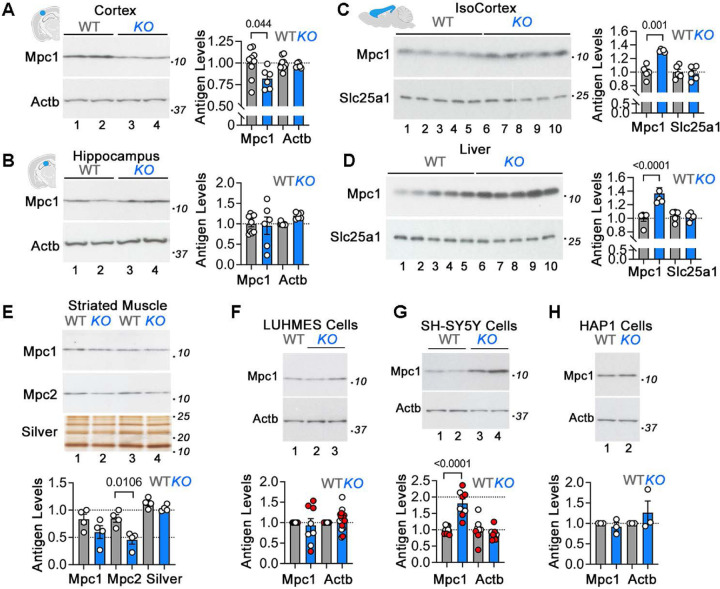
Figure 4.. Alterations of Mitochondrial Pyruvate Carrier Levels in Mecp2tm1.1Bird/y Tissues and MECP2 Mutant Cells.
A to H show immunoblots and quantifications of the mitochondrial pyruvate transporters Mpc1 and Mpc2 in Mecp2tm1.1Bird/y tissue extracts (A, B, and E), Mecp2tm1.1Bird/y total membrane fractions (C and D), and MECP2-null human cell lines (F-H). Loading controls used were beta actin (Actb), the mitochondrial citrate transporter (Slc25a1), or silver stained SDS-PAGE. Quantifications are normalized to wild type antigen levels. Each dot represents an animal or a biological replicate. Red and white dots in F and G depict two independent MECP2-null clones. p values were obtained with two-sided permutation t-test with 5000 bootstrap samples. See Supplementary Table 2.
Figure 5.
Figure 5.. Mitochondrial Respiration is Altered in Mecp2tm1.1Bird/y Isocortex Primary Cultures and MECP2 Mutant Cells.
A-C. Primary cultured isocortex neurons from postnatal 1 cultured for 14 days were subjected to a Seahorse stress test in the presence of complete media. Oxygen consumption rate was normalized to wild type animal values at measurement 3. B. Depicts basal respiration and C presents maximal respiration elicited after FCCP addition (arrow). Each symbol corresponds to an independent animal, pink symbols mark female animals. D to F show mitochondrial stress test, basal and maximal respiration in wild type and MECP2-null differentiated LUHMES cells. G to I depict mitochondrial stress test, basal, and maximal respiration in wild type and MECP2-null differentiated SH-SY5Y neuroblastoma cells. J-L mitochondrial stress test, basal, and maximal respiration in wild type and MECP2-null HAP1 cells. M. Wild type (lane 1), stably expressing GFP (lane 5) and MECP2-null HAP1 cells (lane 2), stably expressing GFP (lane 6) or mouse Mecp2-GFP (lanes 3–4) were immunoprecipitated with anti-GFP antibodies and analyzed by immunoblot with antibodies against GFP. N-P depict mitochondrial stress test, basal, and maximal respiration in MECP2-null HAP1 cells stably expressing GFP (gray symbols) or Mecp2-GFP (blue symbols). D, G, J and N brackets and shaded area show average ± 95 confidence interval. Inflection after datapoint 3 marks addition of oligomycin and drop after datapoint 9 marks addition of rotenone and antimycin. All other data show average ± SEM. Each symbol is an independent biological replicate. Red symbols show an independent clone isolate. p values were obtained with two-sided permutation t-test with 5000 bootstrap samples.
Figure 6.
Figure 6.. Exogenous Pyruvate and Glutamine Differentially Support Mitochondrial Respiration in Mecp2tm1.1Bird/y Isocortex Primary Cultures and MECP2 Mutant Cells.
A. Diagram of key glycolysis and Krebs cycle steps analyzed. Purple font indicates metabolites experimentally manipulated. B-D. Primary cultured isocortex neurons from postnatal 1 cultured for 14 days were subjected to a Seahorse stress test in the presence media with 1 mM pyruvate as the only fuel source. C. Depicts basal respiration and D presents maximal respiration elicited after FCCP addition (arrow). Each symbol corresponds to an independent animal, pink symbols mark female animals. p values were obtained with two-sided permutation t-test with 5000 bootstrap samples. E to G show mitochondrial stress test, acute response to fuel addition, and maximal respiration in wild type and MECP2-null HAP1 cells in media without fuel (white symbols) complete media (gray and blue symbols), or media with 1 mM pyruvate (green symbols). For E, inflection after data point 4 marks addition of the fuel source to basal media. One-way ANOVA followed by Bonferroni corrections. Each symbol represents an independent biological replicate. Arrows indicate fuel and FCCP additions. H-I depict mitochondrial basal, and maximal respiration in wild type and MECP2-null HAP1 cells fed media in the absence or presence of increasing concentrations of either pyruvate (H) or glutamine (I). For H n=2 and for I n=8. Two-way ANOVA where factors are genotype (G) and fuel, followed by Benjamini, Krieger and Yekutieli corrections. B and E, inflections after datapoint 3 or 7 respectively, mark addition of oligomycin and drop after datapoint 9 or 13 marks addition of rotenone and antimycin. All data show average ± SEM.
Figure 7.
Figure 7.. The Utilization of Endogenous Pyruvate for Mitochondrial Respiration is Selectively Impaired in MECP2 Mutant Cells.
A. Diagram of key glycolysis and Krebs cycle steps analyzed. Purple font indicates metabolites experimentally manipulated. B-E. show mitochondrial stress test, basal, and maximal respiration in wild type (white and gray symbols) and MECP2-null HAP1 cells (blue and teal symbols) in glucose and galactose complete media with or without glutamine [(−)Gln]. C. Compares complete glucose and galactose media in wild type and mutant cells shown in B. D-E, each symbol represents an independent biological replicate. One-way ANOVA followed by Benjamini, Krieger and Yekutieli corrections. F, conversion of 13C3-pyruvate into metabolites of the Krebs cycle in wild type and MECP2-null HAP1 cells (blue bars), n=5. G, heat map of the proteome and phosphoproteome log2 normalized expression levels for subunits of the pyruvate dehydrogenase complex, pyruvate dehydrogenase kinases and subunits of the pyruvate dehydrogenase phosphatase in wild type and MECP2-null HAP1 cells. Each column is an independent biological replicate. For F and G, p values were obtained with two-sided permutation t-test with 5000 bootstrap samples. H. Diagram of key glycolysis and Krebs cycle steps analyzed. Purple font indicates metabolites experimentally manipulated or drugs added and their target. I, mitochondrial stress test, J, basal, and K, maximal respiration in wild type and MECP2-null HAP1 cells fed 1mM pyruvate media in the presence of vehicle or increasing concentrations of AZD7545. I to K, n=4. I and J, mixed-effect analysis where factors are genotype (G) and drug (D), followed by Šídák’s multiple comparisons test. B, C and I inflections after datapoint 3 marks addition of oligomycin and drop after datapoint 9 marks addition of rotenone and antimycin. All data show average ± SEM.

References

    1. A, O., U, M., Lf, B., and A, G.C. (2021). Energy metabolism in childhood neurodevelopmental disorders. EBioMedicine 69, 103474. - PMC - PubMed
    1. Afgan E., Baker D., Batut B., van den Beek M., Bouvier D., Cech M., Chilton J., Clements D., Coraor N., Gruning B.A., et al. (2018). The Galaxy platform for accessible, reproducible and collaborative biomedical analyses: 2018 update. Nucleic acids research 46, W537–W544. - PMC - PubMed
    1. Amici D.R., Jackson J.M., Truica M.I., Smith R.S., Abdulkadir S.A., and Mendillo M.L. (2021). FIREWORKS: a bottom-up approach to integrative coessentiality network analysis. Life Sci Alliance 4. - PMC - PubMed
    1. Amir R.E., Van den Veyver I.B., Wan M., Tran C.Q., Francke U., and Zoghbi H.Y. (1999). Rett syndrome is caused by mutations in X-linked MECP2, encoding methyl-CpG-binding protein 2. Nat Genet 23, 185–188. - PubMed
    1. Andrews S. (2012). FASTQC

Publication types