Review
. 2023 Apr 1;150(7):dev200885.
doi: 10.1242/dev.200885. Epub 2023 Apr 17.

The evolution of gastrulation morphologies

Affiliations
Review

The evolution of gastrulation morphologies

Guillermo Serrano Nájera et al. Development. .

Abstract

During gastrulation, early embryos specify and reorganise the topology of their germ layers. Surprisingly, this fundamental and early process does not appear to be rigidly constrained by evolutionary pressures; instead, the morphology of gastrulation is highly variable throughout the animal kingdom. Recent experimental results demonstrate that it is possible to generate different alternative gastrulation modes in single organisms, such as in early cnidarian, arthropod and vertebrate embryos. Here, we review the mechanisms that underlie the plasticity of vertebrate gastrulation both when experimentally manipulated and during evolution. Using the insights obtained from these experiments we discuss the effects of the increase in yolk volume on the morphology of gastrulation and provide new insights into two crucial innovations during amniote gastrulation: the transition from a ring-shaped mesoderm domain in anamniotes to a crescent-shaped domain in amniotes, and the evolution of the reptilian blastoporal plate/canal into the avian primitive streak.

Keywords: Cell behaviours; EMT; Evolution; Gastrulation; Morphogenesis; Yolk.


Conflict of interest statement

Competing interests The authors declare no competing or financial interests.

Figures
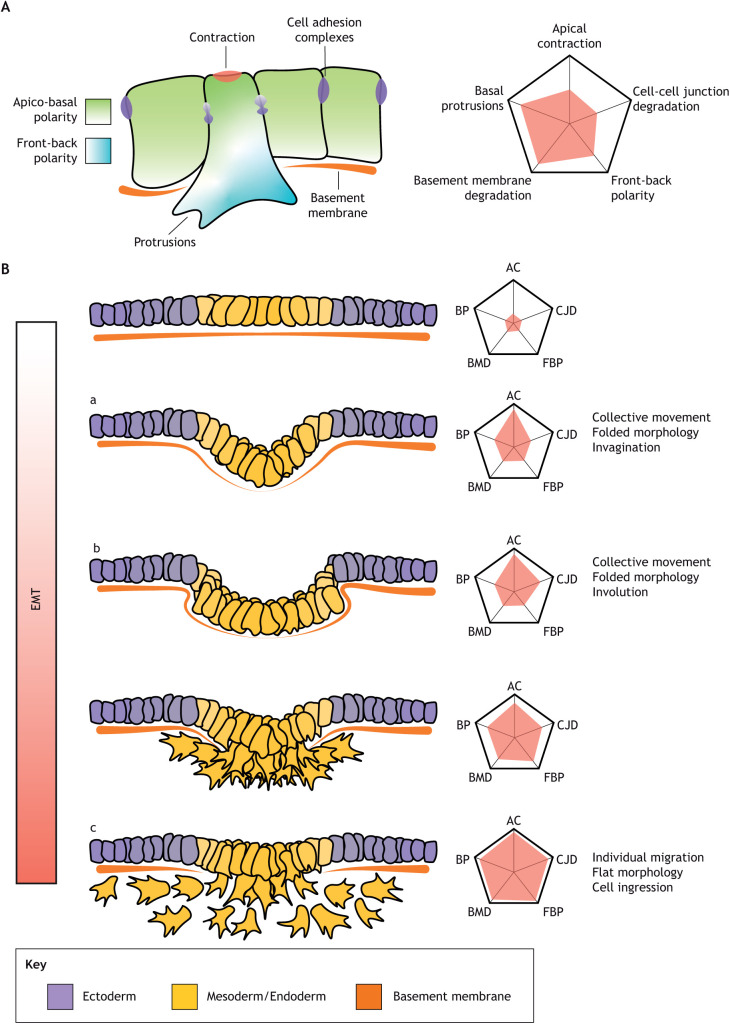
Fig. 1.
Fig. 1.
Different degrees of EMT correlate with different tissue morphologies. (A) EMT is a gradual, multifactorial process in which different cellular requirements can be independently regulated. (B) The degree of EMT in a cell population determines tissue morphology. Slow or incomplete EMT produces tissue folding in the form of invagination (Ba) where cells apically contract, resulting in localised tissue folding in a confined area in which cells do not slide past each other and can maintain junctional contacts. During involution (Bb) cells also remain part of an epithelial layer, but cells slide against each other through successive rows of cells. Fast complete EMT results in flat epithelia and independent cell migration (ingression; Bc), these cells slide past each other until they lose contact.
Fig. 2.
Fig. 2.
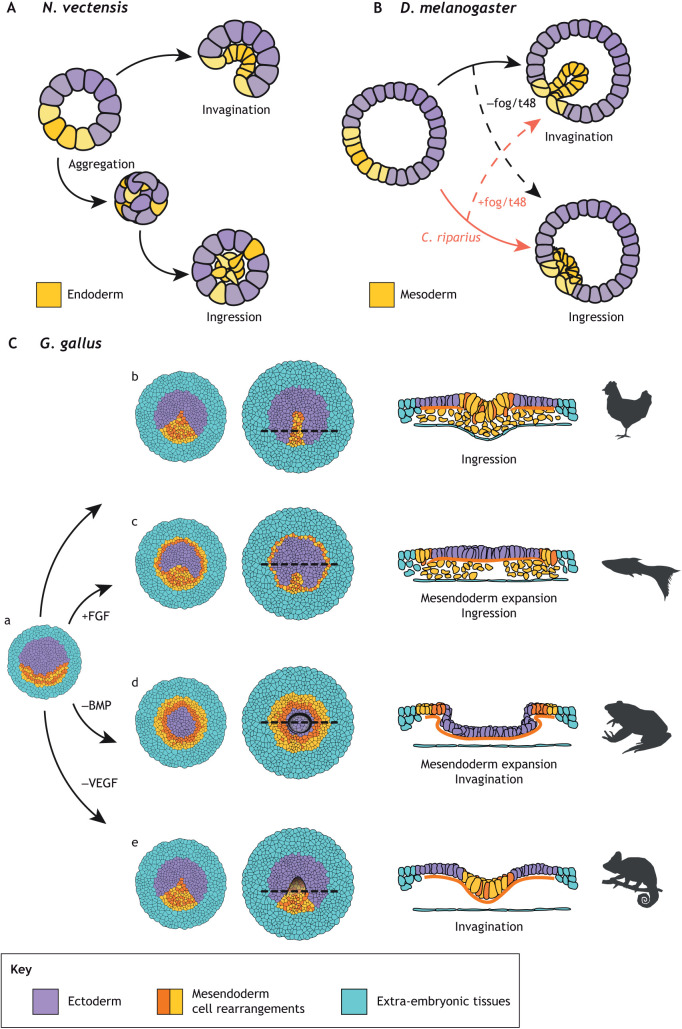
Experimental manipulation of the gastrulation mode in different organisms. (A) The anemone N. vectensis normally gastrulates by invaginating the endoderm. However, when cells are dissociated and reaggregated into a solid ball, it gastrulates by multipolar cell ingression (Kirillova et al., 2018). (B) The fly D. melanogaster has a maternal load of fog/t48 mRNAs and normally gastrulates through invagination, whereas C. riparius is not loaded with fog/t48 mRNAs and gastrulates through cell ingression. Switching the typical fog expression of both species also switches their gastrulation mode (Urbansky et al., 2016). (C) The activation or inhibition of signalling pathways in the chick embryo (Ca) affects the extension of the mesendoderm and the capacity of these cells to ingress (Cb) inducing gastrulation modes that resemble those of other vertebrates such as teleost fish (Cc), anurans (Cd) and reptiles (Ce) (Chuai et al., 2023).
Fig. 3.
Fig. 3.
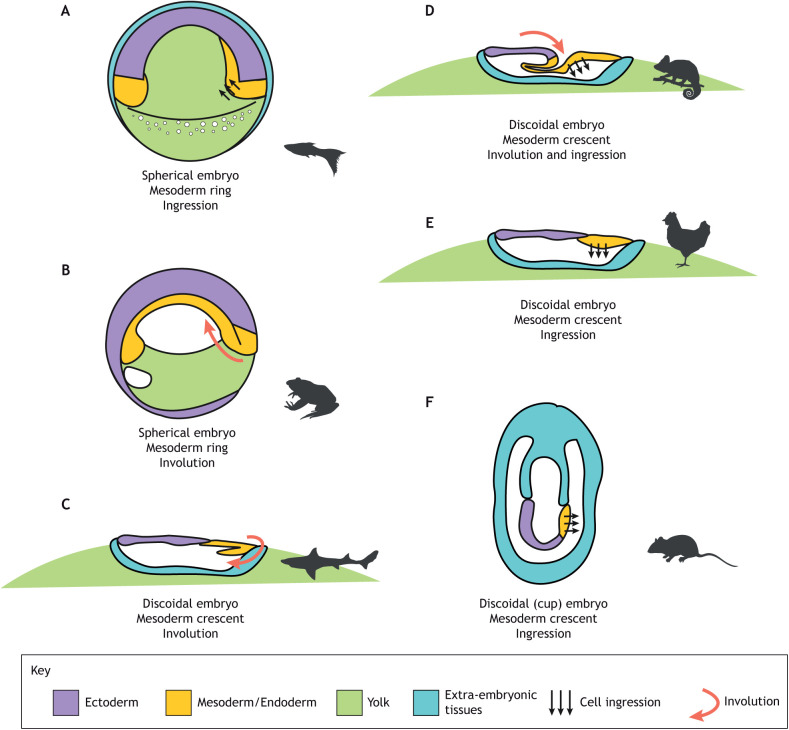
Diversity of vertebrate gastrulation. (A-F) Schematic representations of the main axis of variation in vertebrate gastrulation (geometry of the embryo, shape of the mesoderm/endoderm territory and the main mode of internalisation) in teleost fish (A), anurans (B), cartilaginous fishes (C), reptiles (D), birds (E) and rodents (F). Most mammals, such as human (Molè et al., 2020), cow (van Leeuwen et al., 2015), rabbit (Viebahn et al., 2002) or pigs (Wolf et al., 2011), possess a flat epiblast and primitive streak similar to the early embryos of birds (E); however, mouse presents a more derived gastrulation where the flat epiblast is folded into a cup and the primitive streak is specified in place (Williams et al., 2012) (F).
Fig. 4.
Fig. 4.
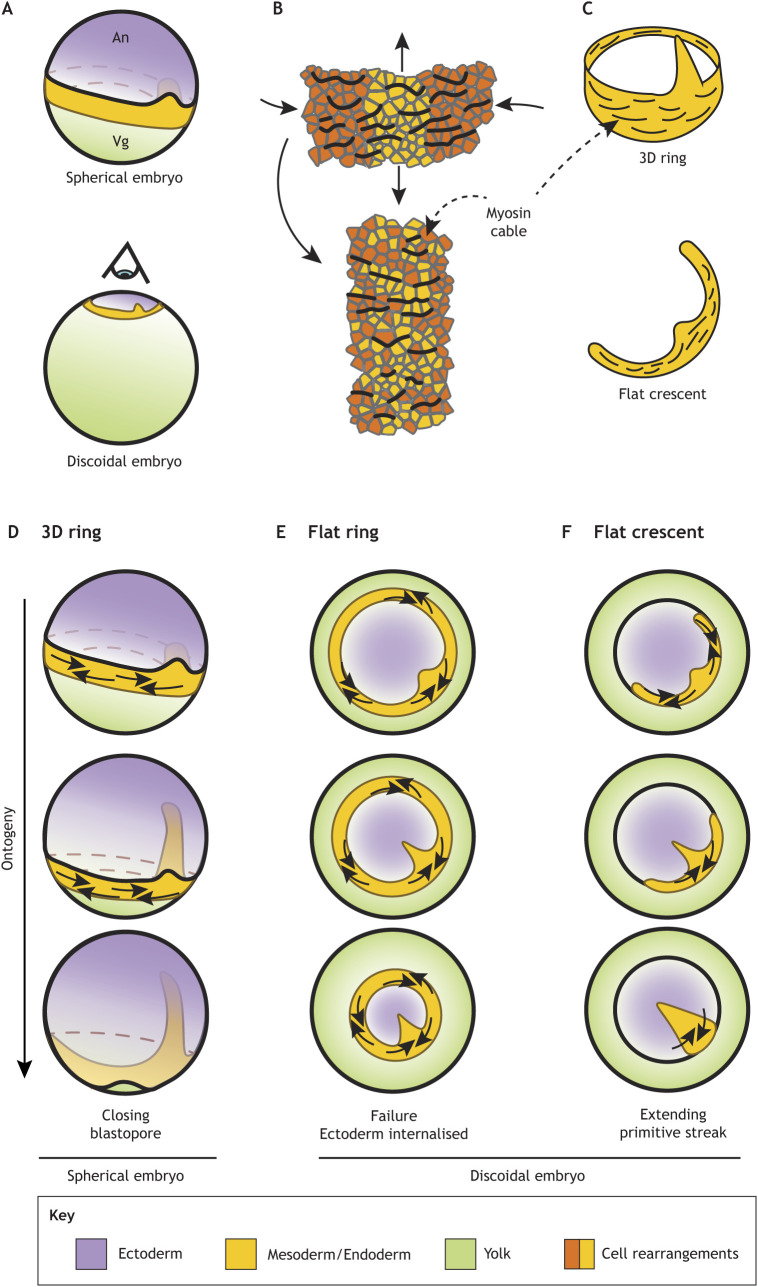
Mesoderm-ring to -crescent transition. (A) The increase in yolk size resulted in the flattening of the embryos during amniote evolution. The eye indicates the direction of the projection in E,F. (B) The direction of actomyosin cables is perpendicular to the direction of intercalation. Directed cell intercalation drives the convergent extension of tissue. (C) Actomyosin cables are organised along the long axis of the prospective mesoderm in tetrapods. (D-F) Mesoderm undergoes convergent extension in three different scenarios. In a 3D ring, the contraction of the ring does not interfere with the ectoderm expansion (D). A flat mesoderm ring undergoing convergent extension traps the ectoderm, which prevents its expansion (E). A flat mesoderm crescent undergoing convergent extension naturally collapses into the midline (F).

References

    1. Alev, C., Wu, Y., Nakaya, Y. and Sheng, G. (2013). Decoupling of amniote gastrulation and streak formation reveals a morphogenetic unity in vertebrate mesoderm induction. Development 140, 2691-2696. 10.1242/dev.094318 - DOI - PubMed
    1. Alvarado, A. S. (2003). The freshwater planarian Schmidtea mediterranea: embryogenesis, stem cells and regeneration. Curr. Opin. Genet. Dev. 13, 438-444. 10.1016/S0959-437X(03)00082-0 - DOI - PubMed
    1. Anlas, K. and Trivedi, V. (2021). Studying evolution of the primary body axis in vivo and in vitro. eLife 10, e69066. 10.7554/eLife.69066 - DOI - PMC - PubMed
    1. Arendt, D. and Nübler-Jung, K. (1999). Rearranging gastrulation in the name of yolk: evolution of gastrulation in yolk-rich amniote eggs. Mech. Dev. 81, 3-22. 10.1016/S0925-4773(98)00226-3 - DOI - PubMed
    1. Arias, C. F., Herrero, M. A., Stern, C. D. and Bertocchini, F. (2017). A molecular mechanism of symmetry breaking in the early chick embryo. Sci. Rep. 7, 15776. 10.1038/s41598-016-0028-x - DOI - PMC - PubMed

Publication types