


TROP-2 is widely expressed in vulvar squamous cell carcinoma and represents a potential new therapeutic target
- PMID: 37067548
- PMCID: PMC10374825
- DOI: 10.1007/s00432-023-04761-8
TROP-2 is widely expressed in vulvar squamous cell carcinoma and represents a potential new therapeutic target
Abstract
Purpose: Vulvar squamous cell carcinoma (VSCC) is a rare malignancy of the female genital tract with increasing incidence rates. Etiologically, HPV-dependent and HPV-independent VSCC are distinguished. Surgical treatment and/or radiotherapy represent the therapeutic mainstay for localized disease. For recurrent or metastatic VSCC, treatment options are limited. Research has identified trophoblast cell surface antigen 2 (TROP-2) to be broadly expressed across different tumor entities. The aim of the present study was to systematically investigate the expression of TROP-2 in VSCC.
Methods: TROP-2 protein expression was investigated by immunohistochemistry in a cohort comprising n = 103 patients with primary VSCC. A four-tier scoring system (0: no staining, 1 + : low staining, 2 + : moderate staining, 3 + : high staining) was applied for quantification of protein expression. For further analyses, two groups (low TROP-2 expression: 0/1 + ; high TROP-2 expression: 2 + /3 +) were generated. The entire study cohort, as well as HPV-dependent and HPV-independent VSCC were considered separately.
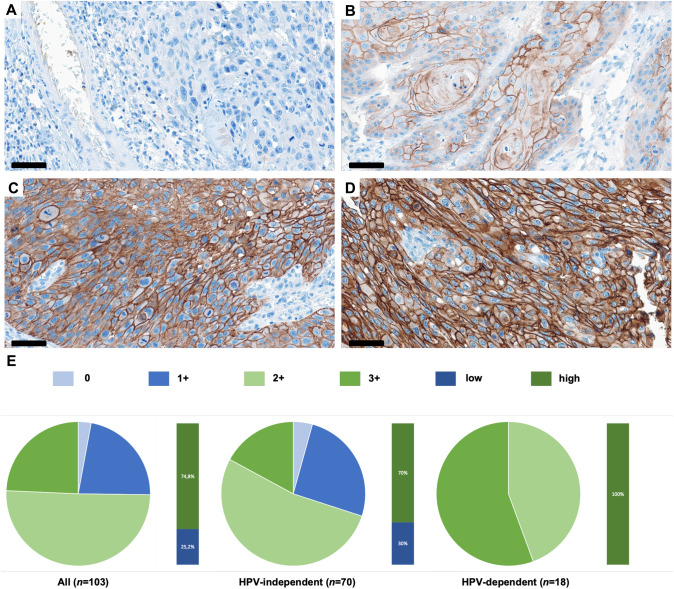
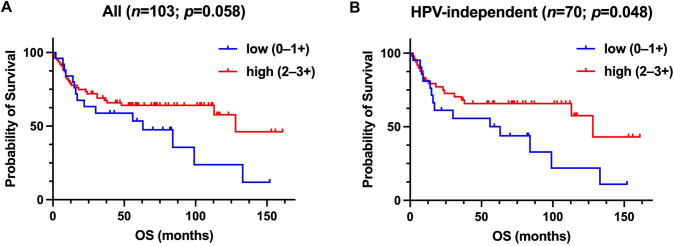
Results: In the entire VSCC study cohort, TROP-2 expression was present in 97.1% of all cases (n = 100) with 74.8% displaying high TROP-2 expression (2 + /3 +). Only 2.9% of tumors showed absent TROP-2 expression. Of note, all HPV-dependent VSCC (n = 18) demonstrated high TROP-2 expression (2 + /3 +). In the subgroup of HPV-independent VSCC (n = 70), high TROP-2 expression was associated with favorable clinical outcomes based on log rank test and univariate cox analysis.
Conclusion: TROP-2 protein expression is of prognostic value in HPV-independent VSCC. The broad expression of TROP-2 in VSCC indicates the TROP-2 directed ADC Sacituzumab govitecan as a potential new therapeutic strategy for VSCC patients.
Keywords: Antibody-drug conjugate; HPV; TROP-2; Vulvar squamous cell carcinoma.
© 2023. The Author(s).
Conflict of interest statement
The authors declare that there are no conflicts of interests.
Figures
References
-
- Bardia A, Mayer IA, Vahdat LT, Tolaney SM, Isakoff SJ, Diamond JR et al (2019) Sacituzumab govitecan-hziy in refractory metastatic triple-negative breast cancer. N Engl J Med 380(8):741–751 - PubMed
-
- Bardia A, Tolaney SM, Punie K, Loirat D, Oliveira M, Kalinsky K et al (2021) Biomarker analyses in the phase III ASCENT study of sacituzumab govitecan versus chemotherapy in patients with metastatic triple-negative breast cancer. Ann Oncol 32(9):1148–1156 - PubMed
-
- Bleeker MC, Visser PJ, Overbeek LI, van Beurden M, Berkhof J (2016) Lichen sclerosus: incidence and risk of vulvar squamous cell carcinoma. Cancer Epidemiol Biomarkers Prev 25(8):1224–1230 - PubMed
-
- Clancy AA, Spaans JN, Weberpals JI (2016) The forgotten woman’s cancer: vulvar squamous cell carcinoma (VSCC) and a targeted approach to therapy. Ann Oncol 27(9):1696–1705 - PubMed
MeSH terms
Grants and funding
LinkOut - more resources
Full Text Sources
Medical
Research Materials
Miscellaneous
