


The longitudinal relation between executive functioning and multilayer network topology in glioma patients
- PMID: 37067658
- PMCID: PMC10435610
- DOI: 10.1007/s11682-023-00770-w
The longitudinal relation between executive functioning and multilayer network topology in glioma patients
Abstract
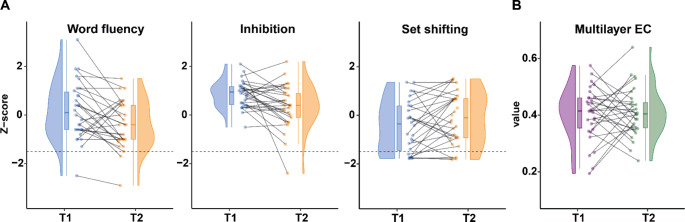
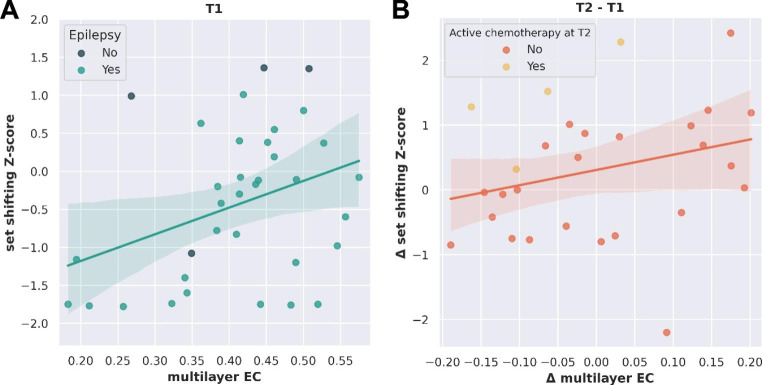
Many patients with glioma, primary brain tumors, suffer from poorly understood executive functioning deficits before and/or after tumor resection. We aimed to test whether frontoparietal network centrality of multilayer networks, allowing for integration across multiple frequencies, relates to and predicts executive functioning in glioma. Patients with glioma (n = 37) underwent resting-state magnetoencephalography and neuropsychological tests assessing word fluency, inhibition, and set shifting before (T1) and one year after tumor resection (T2). We constructed binary multilayer networks comprising six layers, with each layer representing frequency-specific functional connectivity between source-localized time series of 78 cortical regions. Average frontoparietal network multilayer eigenvector centrality, a measure for network integration, was calculated at both time points. Regression analyses were used to investigate associations with executive functioning. At T1, lower multilayer integration (p = 0.017) and epilepsy (p = 0.006) associated with poorer set shifting (adj. R2 = 0.269). Decreasing multilayer integration (p = 0.022) and not undergoing chemotherapy at T2 (p = 0.004) related to deteriorating set shifting over time (adj. R2 = 0.283). No significant associations were found for word fluency or inhibition, nor did T1 multilayer integration predict changes in executive functioning. As expected, our results establish multilayer integration of the frontoparietal network as a cross-sectional and longitudinal correlate of executive functioning in glioma patients. However, multilayer integration did not predict postoperative changes in executive functioning, which together with the fact that this correlate is also found in health and other diseases, limits its specific clinical relevance in glioma.
Keywords: Cognition; Eigenvector centrality; Functional connectivity; Graph theory; Network neuroscience.
© 2023. The Author(s).
Conflict of interest statement
All authors declare that they have no conflict of interest.
Figures

References
-
- Baum GL, Ciric R, Roalf DR, Betzel RF, Moore TM, Shinohara RT, Kahn AE, Vandekar SN, Rupert PE, Quarmley M, Cook PA, Elliott MA, Ruparel K, Gur RE, Gur RC, Bassett DS, Satterthwaite TD. Modular segregation of Structural Brain Networks supports the development of executive function in Youth. Current Biology. 2017;27(11):1561–1572e1568. doi: 10.1016/j.cub.2017.04.051. - DOI - PMC - PubMed
-
- Bianconi, G. (2018). Multilayer networks: Structure and function. Oxford university press. Oxford university press.
MeSH terms
Grants and funding
LinkOut - more resources
Full Text Sources
Research Materials
