. 2023 Jul 7;13(7):1556-1571.
doi: 10.1158/2159-8290.CD-22-1420.

Comutations and KRASG12C Inhibitor Efficacy in Advanced NSCLC

Marcelo V Negrao #  1 Haniel A Araujo #  1 Giuseppe Lamberti #  2 Alissa J Cooper #  3 Neal S Akhave #  1 Teng Zhou  1 Lukas Delasos  4 J Kevin Hicks  5 Mihaela Aldea  6   7 Gabriele Minuti  8 Jacobi Hines  9 Jacqueline V Aredo  10 Michael J Dennis  11 Turja Chakrabarti  12 Susan C Scott  13 Paolo Bironzo  14 Matthias Scheffler  15 Petros Christopoulos  16 Albrecht Stenzinger  17 Jonathan W Riess  18 So Yeon Kim  19 Sarah B Goldberg  19 Mingjia Li  20 Qi Wang  21 Yun Qing  22 Ying Ni  23 Minh Truong Do  1 Richard Lee  1 Biagio Ricciuti  2 Joao Victor Alessi  2 Jing Wang  21 Blerina Resuli  8 Lorenza Landi  8 Shu-Chi Tseng  24 Mizuki Nishino  24 Subba R Digumarthy  25 Waree Rinsurongkawong  1 Vadeerat Rinsurongkawong  1 Ara A Vaporciyan  26 George R Blumenschein  1 Jianjun Zhang  1 Dwight H Owen  20 Collin M Blakely  12 Giannis Mountzios  27 Catherine A Shu  28 Christine M Bestvina  9 Marina Chiara Garassino  9 Kristen A Marrone  13 Jhanelle E Gray  5 Sandip Pravin Patel  11 Amy L Cummings  29 Heather A Wakelee  10 Juergen Wolf  15 Giorgio Vittorio Scagliotti  30 Federico Cappuzzo  8 Fabrice Barlesi  6   7 Pradnya D Patil  4 Leylah Drusbosky  31 Don L Gibbons  1 Funda Meric-Bernstam  32 J Jack Lee  21 John V Heymach  1 David S Hong  32 Rebecca S Heist #  3 Mark M Awad #  2 Ferdinandos Skoulidis #  1
Affiliations

Comutations and KRASG12C Inhibitor Efficacy in Advanced NSCLC

Marcelo V Negrao et al. Cancer Discov. .

Abstract

Molecular modifiers of KRASG12C inhibitor (KRASG12Ci) efficacy in advanced KRASG12C-mutant NSCLC are poorly defined. In a large unbiased clinicogenomic analysis of 424 patients with non-small cell lung cancer (NSCLC), we identified and validated coalterations in KEAP1, SMARCA4, and CDKN2A as major independent determinants of inferior clinical outcomes with KRASG12Ci monotherapy. Collectively, comutations in these three tumor suppressor genes segregated patients into distinct prognostic subgroups and captured ∼50% of those with early disease progression (progression-free survival ≤3 months) with KRASG12Ci. Pathway-level integration of less prevalent coalterations in functionally related genes nominated PI3K/AKT/MTOR pathway and additional baseline RAS gene alterations, including amplifications, as candidate drivers of inferior outcomes with KRASG12Ci, and revealed a possible association between defective DNA damage response/repair and improved KRASG12Ci efficacy. Our findings propose a framework for patient stratification and clinical outcome prediction in KRASG12C-mutant NSCLC that can inform rational selection and appropriate tailoring of emerging combination therapies.

Significance: In this work, we identify co-occurring genomic alterations in KEAP1, SMARCA4, and CDKN2A as independent determinants of poor clinical outcomes with KRASG12Ci monotherapy in advanced NSCLC, and we propose a framework for patient stratification and treatment personalization based on the comutational status of individual tumors. See related commentary by Heng et al., p. 1513. This article is highlighted in the In This Issue feature, p. 1501.


Figures

Figure 1.
Figure 1.
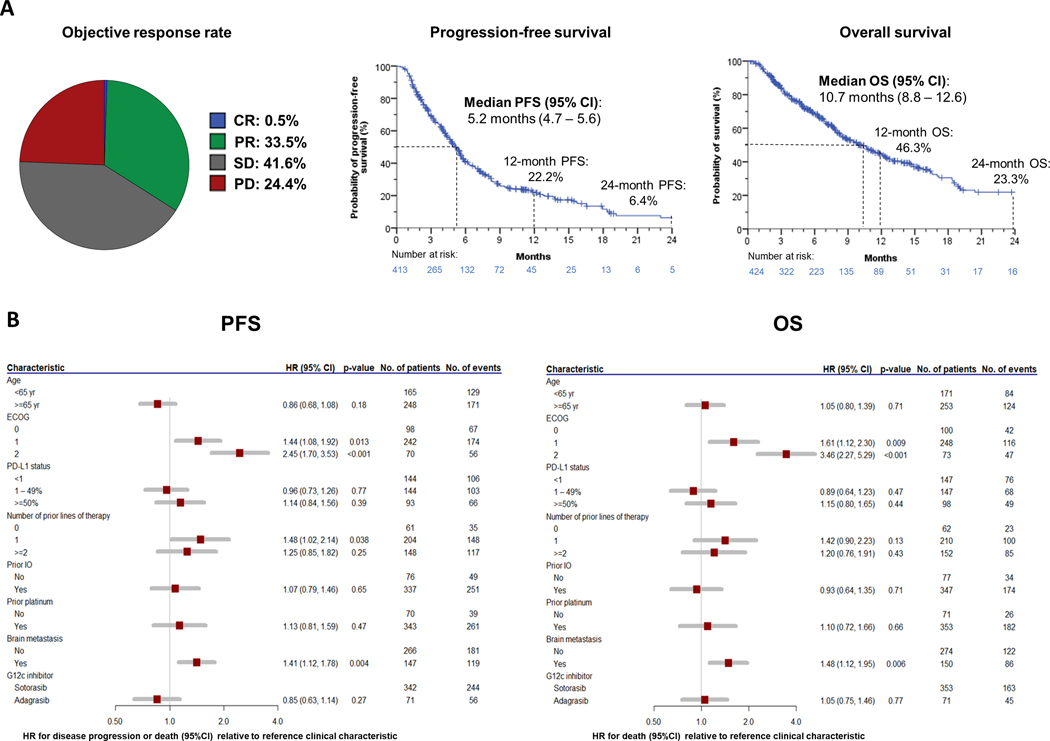
Clinical outcomes with KRAS G12Ci monotherapy in the overall study cohort. A) Objective response, progression-free survival and overall survival upon treatment with KRAS G12Ci in advanced KRASG12C-mutant NSCLC. B) Forest plot representation of clinical characteristics and their impact on progression-free survival and overall survival.
Figure 2.
Figure 2.
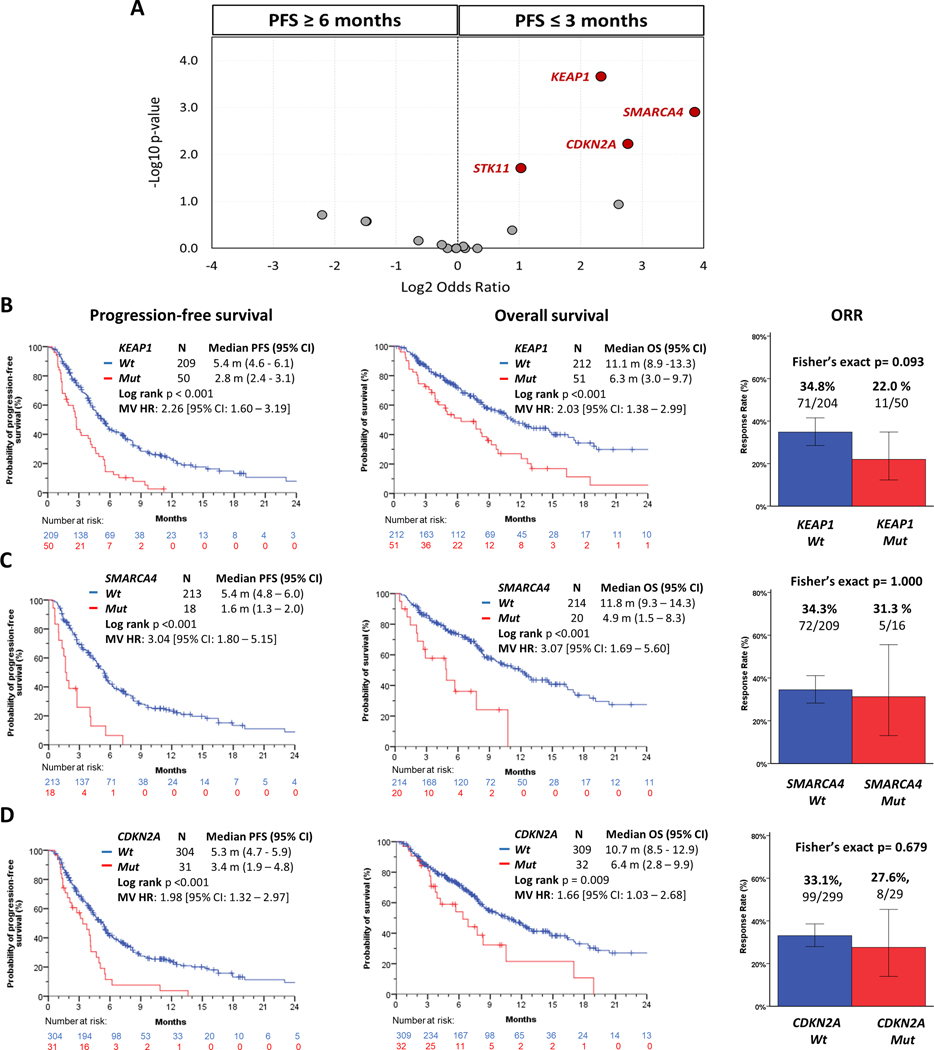
Co-mutations in KEAP1, SMARCA4, and CDKN2A are associated with inferior clinical outcomes with single-agent KRAS G12C inhibitor therapy. A) Volcano plot depicting relative enrichment of co-alterations in distinct clinical outcome subgroups [durable clinical benefit (PFS≥6 months) vs early disease progression (PFS≤3 months)]. Qualified genes were included based on p-value ≤ 0.05 (Fisher’s exact) and FDR q-value ≤ 0.10. Clinical outcomes in the overall study cohort according to co-mutation status of B) KEAP1, C) SMARCA4, and D) CDKN2A.
Figure 3.
Figure 3.
STK11 co-mutations may not impact clinical outcomes with KRAS G12Ci in the absence of concurrent KEAP1 alterations. A) Clinical outcomes with KRAS G12Ci according to STK11 co-mutation status in the overall cohort; B) De-convolution of clinical outcomes with KRAS G12Ci in the KRASG12C/KEAP1MUT/STK11MUT or WT, KRASG12C/KEAP1WT/STK11MUT and KRASG12C/KEAP1WT/STK11WT subgroups.
Figure 4.
Figure 4.
Candidate low-prevalence genomic modifiers of clinical outcomes with KRAS G12Ci. A) Volcano plot of co-mutated genes enriched in the early progression (PFS≤3 months) or durable clinical benefit (PFS≥6 months) groups among patients with KSCWT tumors; B) Objective response rate according to co-mutation status of a group of established DDR genes – BRCA1/2, ATM, ATR, CHEK1/2, PALB2, RAD50/51/51B/51C/51D - in the overall mutation-evaluable population; C-F) Kaplan-Meier estimates of progression-free survival and overall survival with KRAS G12Ci depending on the mutational status of C) DDR genes (overall mutation-evaluable population); D) ATRX/DAXX (overall mutation-evaluable population); E) additional alterations (beyond KRASG12C) in RAS genes (KRAS/NRAS/HRAS; overall mutation-evaluable population); F) PI3K/AKT/MTOR pathway genes (mutation evaluable KSCWT population). Only cases with available comprehensive genomic profiling that included all functionally related genes within a group were considered wild-type for the grouped alterations.
Figure 5.
Figure 5.
Genomic landscape of early disease progression and durable clinical benefit with KRAS G12Ci. This analysis only included patients whose tumor underwent comprehensive NGS profiling (≥400 covered genes). A) OncoPrint illustrating co-alterations in patients with early disease progression (left) and durable clinical benefit (right); B) Pie chart representation of the prevalence of RAS co-alterations (left), co-mutations in PI3K/AKT/MTOR pathway genes (middle), and somatic mutations in ROS1/ALK/NTRK1–3 oncogenes (right) in patients with KSCWT NSCLC and early progression (PFS ≤3 months) with KRAS G12Ci; C) Pie chart representation of the prevalence of co-alterations in ATRX/DAXX (left) and DDR genes (BRCA1/2, ATM, ATR, CHEK1/2, PALB2, RAD50/51/51B/51C/51D) (right) in patients with durable clinical benefit (PFS ≥6 months) with KRAS G12Ci in the mutation-evaluable population.
Figure 6.
Figure 6.
Combined evaluation of KEAP1, SMARCA4 and CDKN2A co-mutations defines a subgroup of KRASG12C-mutant NSCLC (KSCMUT) with poor outcomes with KRAS G12Ci therapy. A) Pie chart depicting the prevalence of KEAP1, SMARCA4, and CDKN2A co-alterations in the mutation-evaluable population for all three genes (N=188) (left) and among patients with early disease progression with KRAS G12Ci (N=63) (right). B) Objective response to KRAS G12Ci in patients with KSCWT and KSCMUT NSCLC in the overall response-evaluable study population. C) PFS (left) and OS (right) with KRAS G12Ci according to KSC co-mutation status in the overall study population.

Comment in

References

    1. Karachaliou N, Mayo C, Costa C, Magrí I, Gimenez-Capitan A, Molina-Vila MA, et al. KRAS Mutations in Lung Cancer. Clin Lung Cancer [Internet]. Elsevier; 2013;14:205–14. Available from: 10.1016/j.cllc.2012.09.007 - DOI - PubMed
    1. Simanshu DK, Nissley D v., McCormick F. RAS Proteins and Their Regulators in Human Disease. Cell [Internet]. Elsevier; 2017;170:17–33. Available from: 10.1016/j.cell.2017.06.009 - DOI - PMC - PubMed
    1. Gimple RC, Wang X. RAS: Striking at the Core of the Oncogenic Circuitry [Internet]. Front Oncol. 2019;9:1–16. Available from: https://www.frontiersin.org/article/10.3389/fonc.2019.00965 - DOI - PMC - PubMed
    1. Canon J, Rex K, Saiki AY, Mohr C, Cooke K, Bagal D, et al. The clinical KRAS(G12C) inhibitor AMG 510 drives anti-tumour immunity. Nature. 2019;575:217–23. - PubMed
    1. Hallin J, Engstrom LD, Hargis L, Calinisan A, Aranda R, Briere DM, et al. The KRAS G12C Inhibitor MRTX849 Provides Insight toward Therapeutic Susceptibility of KRAS-Mutant Cancers in Mouse Models and Patients. Cancer Discov [Internet]. 2020;10:54 LP–71. Available from: http://cancerdiscovery.aacrjournals.org/content/10/1/54.abstract - PMC - PubMed

Publication types

MeSH terms