. 2023 Apr 25;120(17):e2300252120.
doi: 10.1073/pnas.2300252120. Epub 2023 Apr 17.

Spatiotemporally distributed frontotemporal networks for sentence reading

Affiliations

Spatiotemporally distributed frontotemporal networks for sentence reading

Oscar Woolnough et al. Proc Natl Acad Sci U S A. .

Abstract

Reading a sentence entails integrating the meanings of individual words to infer more complex, higher-order meaning. This highly rapid and complex human behavior is known to engage the inferior frontal gyrus (IFG) and middle temporal gyrus (MTG) in the language-dominant hemisphere, yet whether there are distinct contributions of these regions to sentence reading is still unclear. To probe these neural spatiotemporal dynamics, we used direct intracranial recordings to measure neural activity while reading sentences, meaning-deficient Jabberwocky sentences, and lists of words or pseudowords. We isolated two functionally and spatiotemporally distinct frontotemporal networks, each sensitive to distinct aspects of word and sentence composition. The first distributed network engages the IFG and MTG, with IFG activity preceding MTG. Activity in this network ramps up over the duration of a sentence and is reduced or absent during Jabberwocky and word lists, implying its role in the derivation of sentence-level meaning. The second network engages the superior temporal gyrus and the IFG, with temporal responses leading those in frontal lobe, and shows greater activation for each word in a list than those in sentences, suggesting that sentential context enables greater efficiency in the lexical and/or phonological processing of individual words. These adjacent, yet spatiotemporally dissociable neural mechanisms for word- and sentence-level processes shed light on the richly layered semantic networks that enable us to fluently read. These results imply distributed, dynamic computation across the frontotemporal language network rather than a clear dichotomy between the contributions of frontal and temporal structures.

Keywords: electrophysiology; human; intracranial recording; language; reading.


Conflict of interest statement

The authors declare no competing interest.

Figures
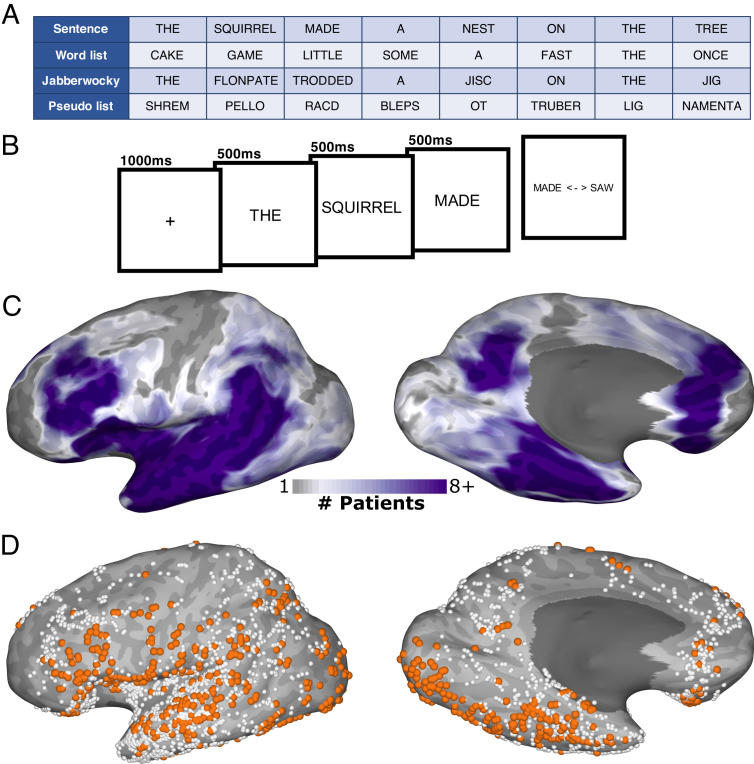
Fig. 1.
Fig. 1.
Experimental design and electrode coverage. (A) Example stimuli and (B) schematic representation of the sentence-reading task. (C) Representative coverage map (36 patients) and (D) individual electrode locations (2,675 electrodes) for the left hemisphere, highlighting electrodes responsive over baseline in orange [536 electrodes; ln(BF10) > 2.3, BGA > 5%].
Fig. 2.
Fig. 2.
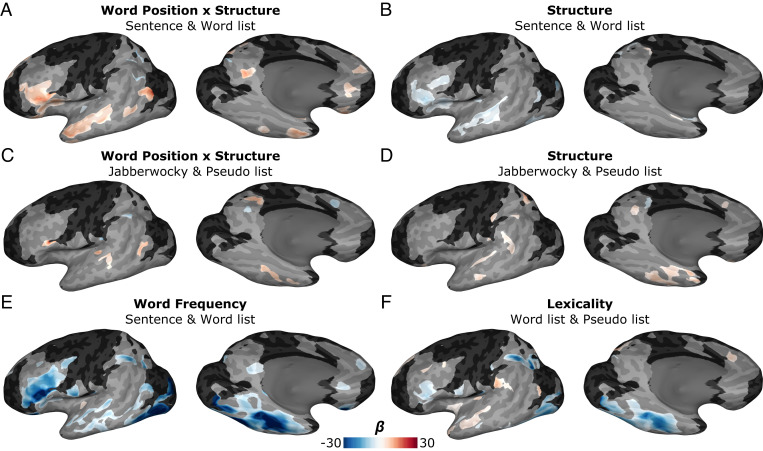
sbLME modeling of sentence reading. Spatial maps of cortical regions showing significant clusters (P < 0.01) of sensitivity to lexical and sentential factors for the 300 to 500 ms window. (A, B) Results from the combined sentence and word list model showing regressors for (A) the interaction between word position and sentence structure and (B) the main effect of the presence of sentence structure. (C, D) Results from the combined Jabberwocky sentence and pseudoword list model showing regressors for (C) the interaction between word position and sentence structure and (D) the main effect of the presence of sentence structure. (E) Word frequency and (F) lexicality regressors are also shown. Regions in black did not have sufficient coverage for reliable sbLME results (<3 patients). Full results of each sbLME model are shown in SI Appendix, Fig. S2.
Fig. 3.
Fig. 3.
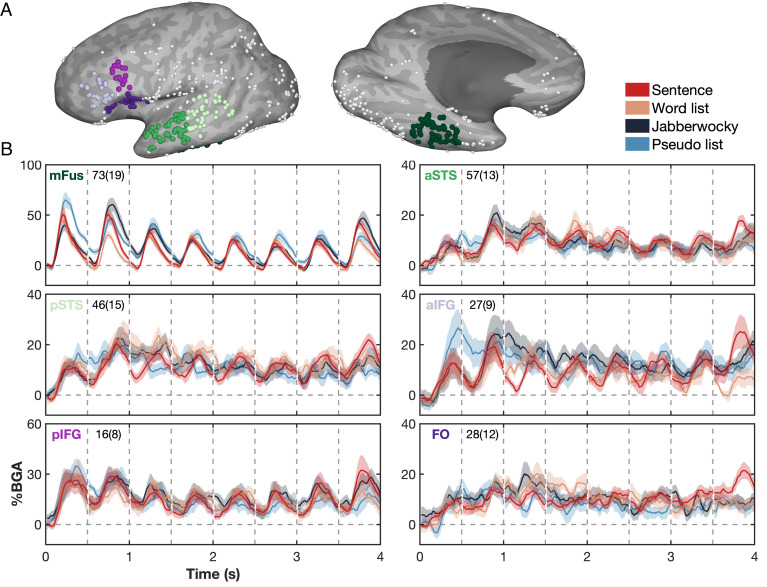
Temporal dynamics of the six selected anatomical ROIs. (A) ROI definitions, using only responsive electrodes. (B) Between-patient average (mean ± SE) BGA responses of each ROI, to the four experimental conditions. Number of electrodes and patients per ROI is shown. mFus, midfusiform cortex; aSTS, anterior superior temporal sulcus; pSTS, posterior superior temporal sulcus; aIFG, anterior inferior frontal gyrus; pIFG, posterior inferior frontal gyrus; FO, frontal operculum.
Fig. 4.
Fig. 4.
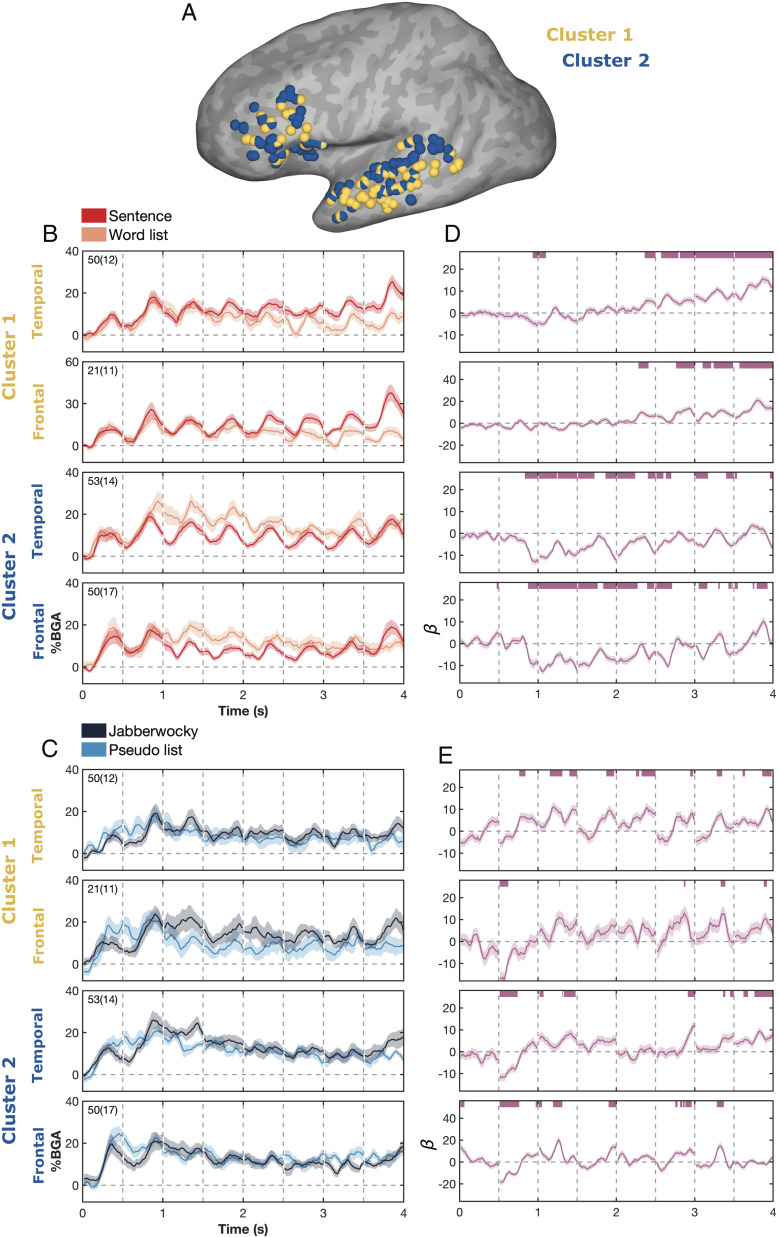
Functional clustering of responses to sentence structure vs. word lists. (A) Spatial map of electrode membership to the two derived functional clusters. (B and C) Mean BGA (± across-patient SE) for (B) sentences and word lists, and (C) Jabberwocky and pseudoword lists, and (D and E) LME beta values (β ± SE) for the structure regressor-contrasting (D) sentences and word lists, and (E) Jabberwocky and pseudoword lists, for electrodes in each cluster in lateral temporal or frontal ROIs. Word length and frequency effects were regressed out of the real-word LME, and word length and orthographic neighborhood were regressed out of the Jabberwocky LME. Responses to real-words and function words were removed from the LME for Jabberwocky sentences. Number of electrodes and patients per cluster is shown. Colored bars represent regions of significance from the LME analyses (q < 0.01).
Fig. 5.
Fig. 5.
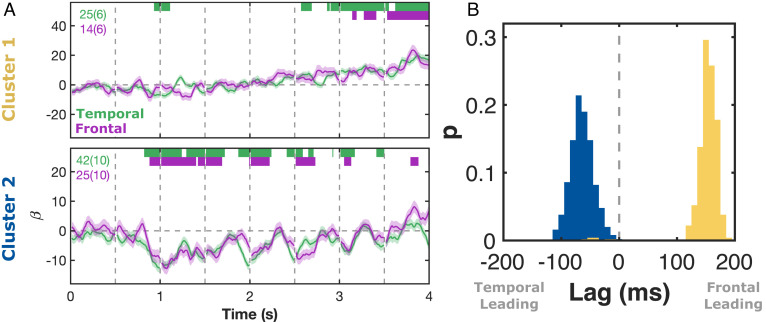
Temporal interactions of structure-based functional clusters. (A) LME beta values (β ± SE) for the structure regressor-contrasting sentences and word lists, for patients with electrodes within each cluster in both frontal and temporal cortices. Word length and frequency effects were regressed out of the LME. Number of electrodes and patients per cluster is shown. Colored bars represent regions of significance from the LME analyses (q < 0.01). (B) Probability distribution of the time lag of maximum likelihood crosscorrelation of the structure responses between pairs of electrodes (500 iterations), within-patients, within-clusters, across regions.

References

    1. Fedorenko E., Hsieh P. J., Nieto-Castañón A., Whitfield-Gabrieli S., Kanwisher N., New method for fMRI investigations of language: Defining ROIs functionally in individual subjects. J. Neurophysiol. 104, 1177–1194 (2010). - PMC - PubMed
    1. Hagoort P., The neurobiology of language beyond single-word processing. Science 366, 55–58 (2019). - PubMed
    1. Pallier C., Devauchelle A.-D., Dehaene S., Cortical representation of the constituent structure of sentences. Proc. Natl. Acad. Sci. U.S.A. 108, 2522–2527 (2011). - PMC - PubMed
    1. Hodgson V. J., Ralph M. A. L., Jackson R. L., Multiple dimensions underlying the functional organisation of the language network. NeuroImage 241, 118444 (2021). - PMC - PubMed
    1. Friederici A. D., Language in Our Brain (The MIT Press, 2017), 10.7551/mitpress/11173.001.0001. - DOI

Publication types