High-Contrast PET Imaging with [18F]NT160, a Class-IIa Histone Deacetylase Probe for In Vivo Imaging of Epigenetic Machinery in the Central Nervous System
- PMID: 37068265
- PMCID: PMC10150721
- DOI: 10.1021/acs.jmedchem.2c02064
High-Contrast PET Imaging with [18F]NT160, a Class-IIa Histone Deacetylase Probe for In Vivo Imaging of Epigenetic Machinery in the Central Nervous System
Abstract
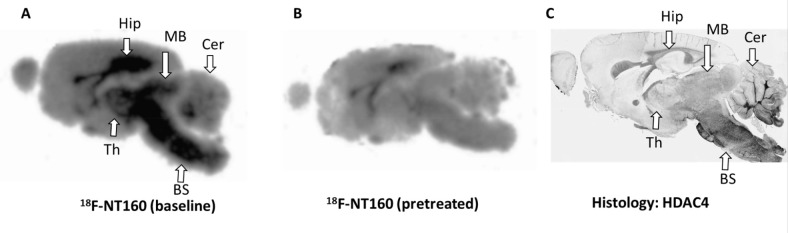
We utilized positron emission tomography (PET) imaging in vivo to map the spatiotemporal biodistribution/expression of class-IIa histone deacetylases (class-IIa HDACs) in the central nervous system (CNS). Herein we report an improved radiosynthesis of [18F]NT160 using 4-hydroxy-TEMPO which led to a significant improvement in radiochemical yield and molar activity. PET imaging with [18F]NT160, a highly potent class-IIa HDAC inhibitor, led to high-quality and high-contrast images of the brain. [18F]NT160 displayed excellent pharmacokinetic and imaging characteristics: brain uptake is high in gray matter regions, tissue kinetics are appropriate for a 18F-tracer, and specific binding for class-IIa HDACs is demonstrated by self-blockade. Higher uptake with [18F]NT160 was observed in the hippocampus, thalamus, and cortex while the uptake in the cerebellum was relatively low. Overall, our current studies with [18F]NT160 will likely facilitate the development and clinical translation of PET tracers for imaging of class-IIa HDACs biodistribution/expression in cancer and the CNS.
Conflict of interest statement
The authors declare no competing financial interest.
Figures




References
-
- Faraco G.; Pancani T.; Formentini L.; Mascagni P.; Fossati G.; Leoni F.; Moroni F.; Chiarugi A. Pharmacological inhibition of histone deacetylases by suberoylanilide hydroxamic acid specifically alters gene expression and reduces ischemic injury in the mouse brain. Molecular pharmacology 2006, 70 (6), 1876–1884. 10.1124/mol.106.027912. - DOI - PubMed
-
- Ren M.; Leng Y.; Jeong M.; Leeds P. R.; Chuang D. M. Valproic acid reduces brain damage induced by transient focal cerebral ischemia in rats: potential roles of histone deacetylase inhibition and heat shock protein induction. Journal of neurochemistry 2004, 89 (6), 1358–1367. 10.1111/j.1471-4159.2004.02406.x. - DOI - PubMed
-
- Kim H. J.; Rowe M.; Ren M.; Hong J. S.; Chen P. S.; Chuang D. M. Histone deacetylase inhibitors exhibit anti-inflammatory and neuroprotective effects in a rat permanent ischemic model of stroke: multiple mechanisms of action. J. Pharmacol Exp Ther 2007, 321 (3), 892–901. 10.1124/jpet.107.120188. - DOI - PubMed
Publication types
MeSH terms
Substances
Grants and funding
LinkOut - more resources
Full Text Sources