. 2023 May 11;41(20):3204-3214.
doi: 10.1016/j.vaccine.2023.03.057. Epub 2023 Mar 31.

Factors associated with COVID-19 vaccination during June-October 2021: A multi-site prospective study

Affiliations

Factors associated with COVID-19 vaccination during June-October 2021: A multi-site prospective study

Reva S Datar et al. Vaccine. .

Abstract

Introduction: Vaccine hesitancy presents a challenge to COVID-19 control efforts. To identify beliefs associated with delayed vaccine uptake, we developed and implemented a vaccine hesitancy survey for the COVID-19 Community Research Partnership.

Methods: In June 2021, we assessed attitudes and beliefs associated with COVID-19 vaccination using an online survey. Self-reported vaccination data were requested daily through October 2021. We compared responses between vaccinated and unvaccinated respondents using absolute standardized mean differences (ASMD). We assessed validity and reliability using exploratory factor analysis and identified latent factors associated with a subset of survey items. Cox proportional hazards models and mediation analyses assessed predictors of subsequent vaccination among those initially unvaccinated.

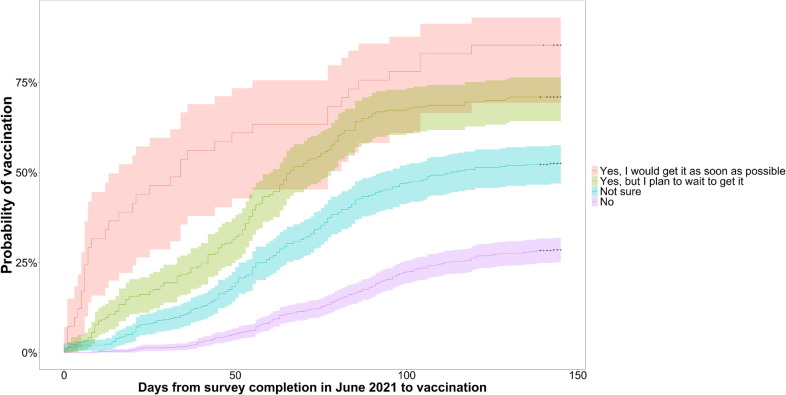
Results: In June 2021, 29,522 vaccinated and 1,272 unvaccinated participants completed surveys. Among those unvaccinated in June 2021, 559 (43.9 %) became vaccinated by October 31, 2021. In June, unvaccinated participants were less likely to feel "very concerned" about getting COVID-19 than vaccinated participants (10.6 % vs. 43.3 %, ASMD 0.792). Among those initially unvaccinated, greater intent to become vaccinated was associated with getting vaccinated and shorter time to vaccination. However, even among participants who reported no intention to become vaccinated, 28.5 % reported vaccination before study end. Two latent factors predicted subsequent vaccination-being 'more receptive' was derived from motivation to protect one's own or others' health and resume usual activities; being 'less receptive' was derived from concerns about COVID-19 vaccines. In a Cox model, both factors were partially mediated by vaccination intention.

Conclusion: This study characterizes vaccine hesitant individuals and identifies predictors of eventual COVID-19 vaccination through October 31, 2021. Even individuals with no intention to be vaccinated can shift to vaccine uptake. Our data suggest factors of perceived severity of COVID-19 disease, vaccine safety, and trust in the vaccine development process are predictive of vaccination and may be important opportunities for ongoing interventions.

Keywords: COVID-19; COVID-19 vaccine hesitancy; COVID-19 vaccines; SARS-CoV-2.


Conflict of interest statement

Declaration of Competing Interest The authors declare that they have no known competing financial interests or personal relationships that could have appeared to influence the work reported in this paper.

Figures

Fig. 1
Fig. 1
Inclusion flow diagram showing numbers of vaccinated and unvaccinated participants who completed the COVID-19 Community Research Partnership Vaccine Hesitancy Survey in June 2021, and the numbers of unvaccinated survey respondents who subsequently received vaccination between June 2021 and October 31, 2021Notes: Vaccinated, self-reported at least one dose of a COVID-19 vaccine. Vaccination status was confirmed with electronic health record data when available .
Fig. 2
Fig. 2
Kaplan-Meyer estimates of subsequent vaccination among respondents of the COVID-19 Community Research Partnership Vaccine Hesitancy Survey with varying levels of intention to receive a COVID-19 vaccineNotes: Kaplan- Meier estimates of the probability of vaccination among COVID-19 Community Research Partnership (CCRP) participants who were unvaccinated in June 2021 and who completed the COVID-19 Community Research Partnership Vaccine Hesitancy Survey (CCRP-VHS). Probability of vaccination is stratified by intention to become vaccinated based on the CCRP-VHS question: “If a COVID-19 vaccine were available to you, would you get it?” The outcome is time to receipt of at least one dose of a COVID-19 vaccine from June 2021 through October 2021. Vaccination was captured by self-report on daily surveys administered until the end of the study in October 2021. Sample sizes: “Yes, I would get it as soon as possible”: N = 41; “Yes, but I plan to wait to get it”: N = 217; “Not sure”: N = 337; “No”: N = 677.
Fig. 3
Fig. 3
Forest plots from Cox regression models showing hazard ratios and 95 % confidence intervals for subsequent vaccination for respondents who were unvaccinated at the time of completion of the COVID-19 Community Research Partnership Vaccine Hesitancy SurveyNotes: Model 1 (left panel) excludes the variable for intention to become vaccinated while Model 2 (right panel) includes intention to become vaccinated. “More receptive” and “less receptive” factors identified from EFA indicate favorable and unfavorable attitudes toward COVID-19 vaccines, respectively. Each factor was categorized into tertiles (i.e., low, moderate, high). Intention to vaccinate (i.e., “Would you get a vaccine”) had a 40.3 % mediation effect on the “more receptive” factor and a 42.9 % mediation effect on the “less receptive” factor. The “motivators” variable categorized responses to the question “What would motivate you the most to get vaccinated?” dichotomously (i.e., a response of “yes” in the model is defined as a selection of any 1, 2, or 3 motivators). Intention to vaccinate had a 61.7 % mediation effect on the “motivators” variable. Complete data can be found in Supplementary Table S4. *Participants were permitted to choose one option for race/ethnicity: American Indian or Alaskan Native, Asian or Pacific Islander, Black or African American, Hispanic or Latino, Mixed Ethnicity, or White (not Hispanic/Latino) For the current study, the included race/ethnicity variables were Hispanic, Black, non-Hispanic White, and Other, which included the remaining options and the non-responses. ** Region was classified by a participant’s health system as “South East” (Wake Forest Baptist Health, Atrium Health, Wake Med, New Hanover Regional Medical Center, Vidant Health, Campbell University), “Deep South,” (Tulane University, University of Mississippi) or “Mid-Atlantic” (University of Maryland Medical System, Medstar Health).

References

    1. Polack F.P., et al. Safety and Efficacy of the BNT162b2 mRNA Covid-19 Vaccine. N Engl J Med. 2020;383(27):2603–2615. - PMC - PubMed
    1. Baden L.R., et al. Efficacy and Safety of the mRNA-1273 SARS-CoV-2 Vaccine. N Engl J Med. 2021;384(5):403–416. - PMC - PubMed
    1. Sadoff J., et al. Safety and Efficacy of Single-Dose Ad26.COV2.S Vaccine against Covid-19. N Engl J Med. 2021;384(23):2187–2201. - PMC - PubMed
    1. Scobie HM, et al., Monitoring Incidence of COVID-19 Cases, Hospitalizations, and Deaths, by Vaccination Status - 13 U.S. Jurisdictions, April 4-July 17, 2021. MMWR Morb Mortal Wkly Rep, 2021. 70(37): p. 1284-1290. - PMC - PubMed
    1. Prevention CfDCa. COVID-19 Vaccinations in the United States. 2022 [cited 2022; Available from: https://covid.cdc.gov/covid-data-tracker/#vaccinations.

Publication types

Substances