


Primary, allied health, geriatric, pain and palliative healthcare service utilisation by aged care residents, 2012-2017
- PMID: 37070244
- PMCID: PMC10947441
- DOI: 10.1111/ajag.13199
Primary, allied health, geriatric, pain and palliative healthcare service utilisation by aged care residents, 2012-2017
Abstract
Objectives: To examine the incidence and trends in primary care, allied health, geriatric, pain and palliative care service use by permanent residential aged care (PRAC) residents and the older Australian population.
Methods: Repeated cross-sectional analyses on PRAC residents (N = 318,484) and the older (≥65 years) Australian population (N ~ 3.5 million). Outcomes were Medicare Benefits Schedule (MBS) subsidised primary care, allied health, geriatric, pain and palliative services between 2012-13 and 2016-17. GEE Poisson models estimated incidence rates and incidence rate ratios (IRR).
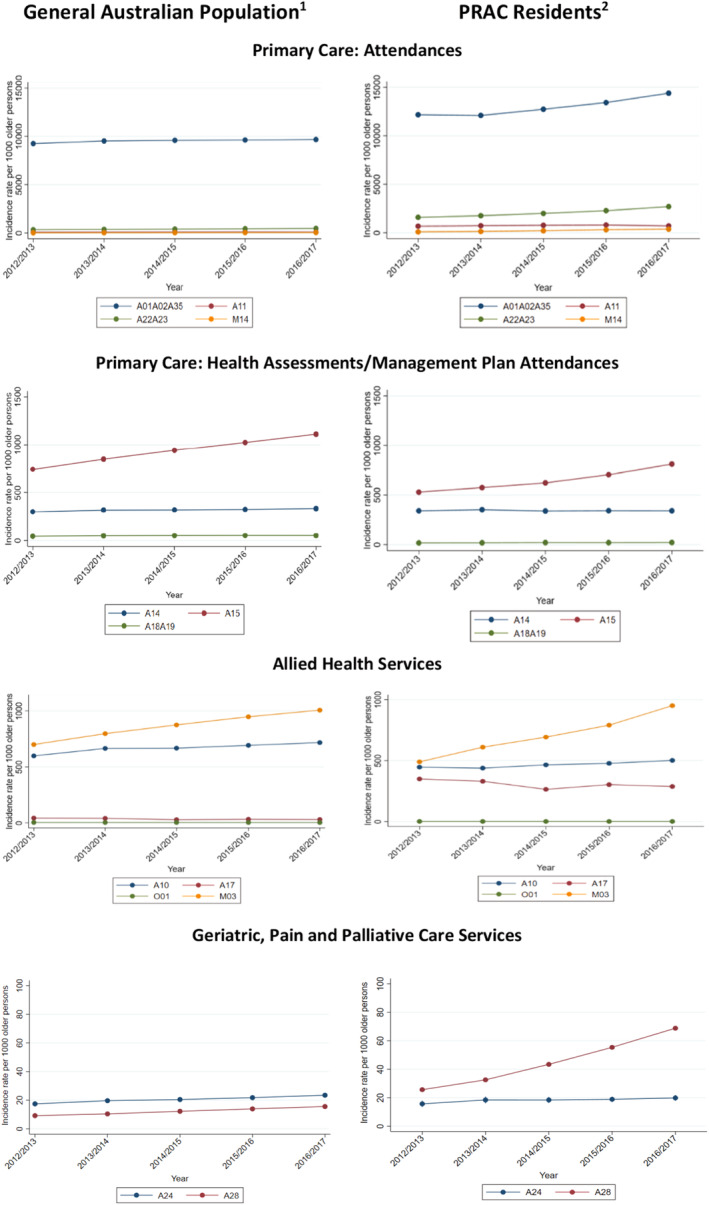
Results: In 2016-17, PRAC residents had a median of 13 (interquartile range [IQR] 5-19) regular general medical practitioner (GP) attendances, 3 (IQR 1-6) after-hours attendances and 5% saw a geriatrician. Highlights of utilisation changes from 2012-13 to 2016-17 include the following: GP attendances increased by 5%/year (IRR = 1.05, 95% confidence interval [CI] 1.05-1.05) for residents compared to 1%/year (IRR = 1.01, 95%CI 1.01-1.01) for the general population. GP after-hours attendances increased by 15%/year (IRR = 1.15, 95%CI 1.14-1.15) for residents and 9%/year (IRR = 1.08, 95%CI 1.07-1.20) for the general population. GP management plans increased by 12%/year (IRR = 1.12, 95%CI 1.11-1.12) for residents and 10%/year (IRR = 1.10, 95%CI 1.09-1.11) for the general population. Geriatrician consultations increased by 28%/year (IRR = 1.28, 95%CI 1.27-1.29) for residents compared to 14%/year (IRR = 1.14, 95%CI 1.14-1.15) in the general population.
Conclusions: The utilisation of most examined services increased in both cohorts over time. Preventive and management care, by primary care and allied health care providers, was low and likely influences the utilisation of other attendances. PRAC residents' access to pain, palliative and geriatric medicine services is low and may not address the residents' needs.
Keywords: epidemiology; health services for the aged; palliative care; primary health care; residential facilities.
© 2023 The Authors. Australasian Journal on Ageing published by John Wiley & Sons Australia, Ltd on behalf of AJA Inc’.
Conflict of interest statement
Dr Janet K Sluggett is a pharmacist who is accredited to perform comprehensive medicine review. All other authors have no conflict of interest to declare.
Figures
References
-
- Australian Government. Department of Health . 2020–21 Report on the Operation of the Aged Care Act 1997. Accessed March 23, 2023. https://www.gen‐agedcaredata.gov.au/www_aihwgen/media/ROACA/21520‐Health...
-
- Australian Government . Australian Institute of Health and Welfare. Interfaces between the aged care and health systems in Australia—GP use by people living in permanent residential aged care 2012–13 to 2016–17. Accessed March 23, 2023. https://www.aihw.gov.au/reports/aged‐care/gp‐use‐by‐people‐in‐permanent‐...
-
- Australian Institute of Health and Welfare . Medicare‐subsidised GP, allied health and specialist health care across local areas: 2013–14 to 2018–19. Accessed March 23, 2023. https://www.aihw.gov.au/reports/primary‐health‐care/medicare‐subsidised‐...
-
- Australian Bureau of Statistics . Patient experiences in Australia: summary of findings. Accessed March 23, 2023. https://www.abs.gov.au/statistics/health/health‐services/patient‐experie...
MeSH terms
Grants and funding
LinkOut - more resources
Full Text Sources
