


A Phenome-Wide Association Study (PheWAS) of Late Onset Alzheimer Disease Genetic Risk in Children of European Ancestry at Middle Childhood: Results from the ABCD Study
- PMID: 37071275
- PMCID: PMC10309061
- DOI: 10.1007/s10519-023-10140-3
A Phenome-Wide Association Study (PheWAS) of Late Onset Alzheimer Disease Genetic Risk in Children of European Ancestry at Middle Childhood: Results from the ABCD Study
Abstract
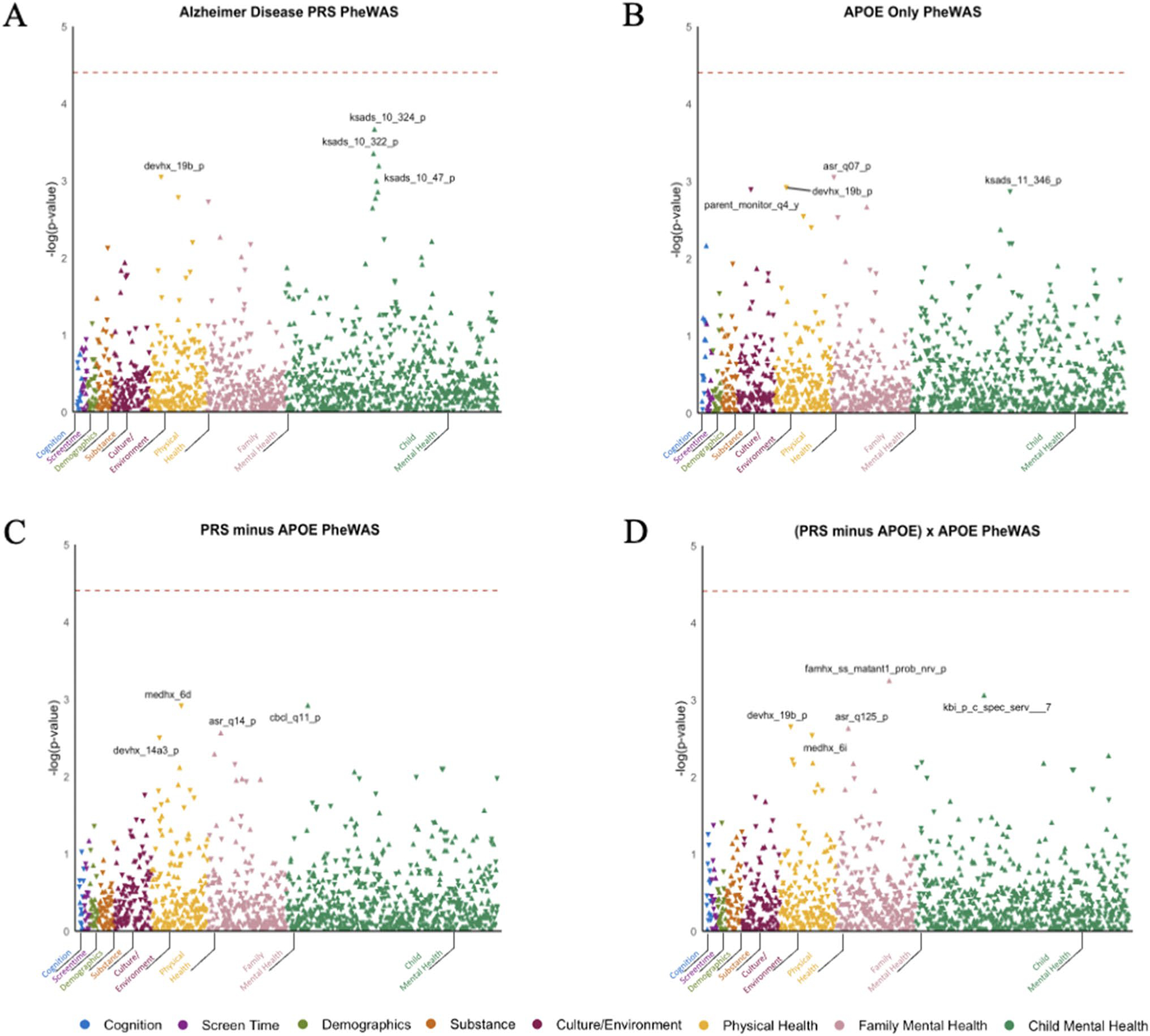
Genetic risk for Late Onset Alzheimer Disease (AD) has been associated with lower cognition and smaller hippocampal volume in healthy young adults. However, whether these and other associations are present during childhood remains unclear. Using data from 5556 genomically-confirmed European ancestry youth who completed the baseline session of the ongoing the Adolescent Brain Cognitive DevelopmentSM Study (ABCD Study®), our phenome-wide association study estimating associations between four indices of genetic risk for late-onset AD (i.e., AD polygenic risk scores (PRS), APOE rs429358 genotype, AD PRS with the APOE region removed (ADPRS-APOE), and an interaction between ADPRS-APOE and APOE genotype) and 1687 psychosocial, behavioral, and neural phenotypes revealed no significant associations after correction for multiple testing (all ps > 0.0002; all pfdr > 0.07). These data suggest that AD genetic risk may not phenotypically manifest during middle-childhood or that effects are smaller than this sample is powered to detect.
Keywords: APOE; Alzheimer disease; Imaging; Middle childhood; Phenome-wide association study; Polygenic risk scores.
© 2023. The Author(s), under exclusive licence to Springer Science+Business Media, LLC, part of Springer Nature.
Conflict of interest statement
Figures
References
-
- Albert MS, DeKosky ST, Dickson D et al. (2011) The diagnosis of mild cognitive impairment due to Alzheimer’s disease: recommendations from the National Institute on Aging-Alzheimer’s Association workgroups on diagnostic guidelines for Alzheimer’s disease. Alzheimers Dement 7:270–279. 10.1016/j.jalz.2011.03.008 - DOI - PMC - PubMed
-
- Bartoń K (2009) MuMIn: multi-model inference
Publication types
MeSH terms
Substances
Grants and funding
- U24 DA041147/DA/NIDA NIH HHS/United States
- U01 DA041120/DA/NIDA NIH HHS/United States
- K23 MH121792/MH/NIMH NIH HHS/United States
- R01 DA054750/DA/NIDA NIH HHS/United States
- U01 DA041093/DA/NIDA NIH HHS/United States
- U24 DA041123/DA/NIDA NIH HHS/United States
- F31 AA029934/AA/NIAAA NIH HHS/United States
- U01 DA041156/DA/NIDA NIH HHS/United States
- K01 DA051759/DA/NIDA NIH HHS/United States
- K01 AA030083/AA/NIAAA NIH HHS/United States
- U01 DA041025/DA/NIDA NIH HHS/United States
- U01 DA041089/DA/NIDA NIH HHS/United States
- U01 DA041106/DA/NIDA NIH HHS/United States
- U01 DA041117/DA/NIDA NIH HHS/United States
- U01 DA041148/DA/NIDA NIH HHS/United States
- U01 DA041174/DA/NIDA NIH HHS/United States
- U01 DA041134/DA/NIDA NIH HHS/United States
- U01 DA041022/DA/NIDA NIH HHS/United States
- U01 DA041028/DA/NIDA NIH HHS/United States
- U01 DA041048/DA/NIDA NIH HHS/United States
LinkOut - more resources
Full Text Sources
Medical
Miscellaneous
