


Relationship between measures of adiposity, blood pressure and arterial stiffness in adolescents. The MACISTE study
- PMID: 37071447
- PMCID: PMC10241423
- DOI: 10.1097/HJH.0000000000003433
Relationship between measures of adiposity, blood pressure and arterial stiffness in adolescents. The MACISTE study
Abstract
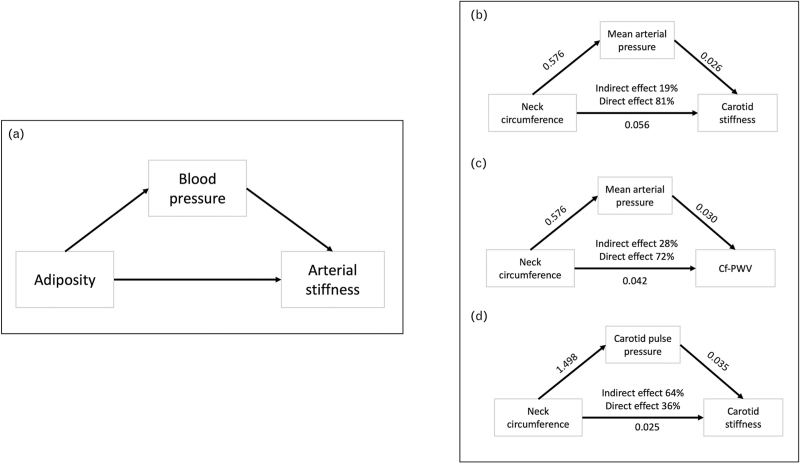
Objective: Children and adolescents with adiposity excess are at increased risk of future cardiovascular (CV) disease. Fat accumulation promotes the development of elevated blood pressure (BP) and arterial stiffness, two main determinants of CV risk which are strongly inter-related. We aimed at investigating whether the association between overweight and arterial stiffness, taken at different arterial segments, is mediated by increased BP or is BP-independent.
Methods: Three hundred and twenty-two Italian healthy adolescents (mean age 16.9±1.4 years, 12% with overweight) attending the "G. Donatelli" High School in Terni, Italy, underwent measurement of arterial stiffness by arterial tonometry (aortic stiffness) and semiautomatical detection of pressure-volume ratio of the common carotid (carotid stiffness). The mediator effect of BP was tested for each anthropometric or biochemical measure of fat excess related to arterial stiffness.
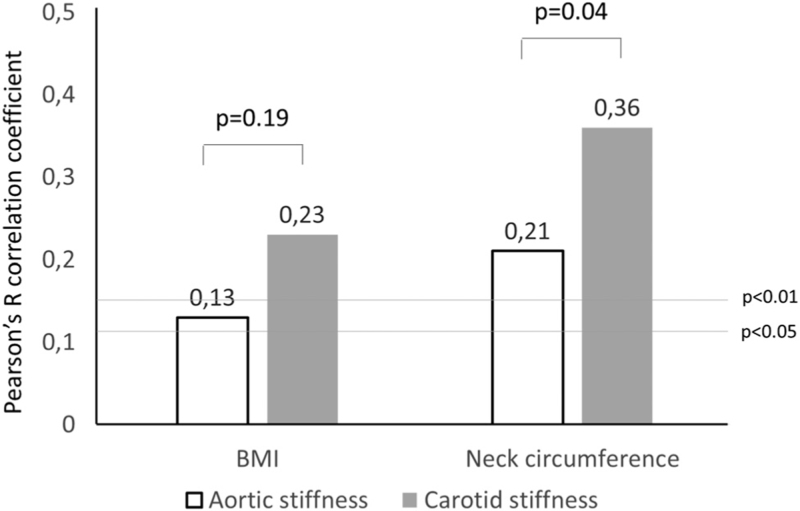
Results: Both carotid and aortic stiffness showed positive correlations with body mass index, waist, hip, and neck circumferences (NC). Only carotid stiffness, but not aortic stiffness, was associated with serum markers of fat accumulation and metabolic impairment such as insulin, homeostatic model of insulin resistance (HOMA-IR), serum gamma-glutamyl transferase (sGGT) and uric acid. The association with NC was stronger for carotid than for aortic stiffness (Fisher z -to- R 2.07, P = 0.04), and independent from BP.
Conclusions: In healthy adolescents, fat accumulation is associated with arterial stiffness. The degree of this association differs by arterial segments, since carotid stiffness is more strongly associated to adipose tissue excess than aortic stiffness and shows a BP-independent association with NC whereas aortic stiffness does not.
Copyright © 2023 The Author(s). Published by Wolters Kluwer Health, Inc.
Conflict of interest statement
E.B. and V.G. are co-founders of QUIPU s.r.l., Pisa, Italy, a spin-off company of the Italian National Research Council and the University of Pisa developing software medical devices.
Figures
References
-
- Twig G, Yaniv G, Levine H, Leiba A, Goldberger N, Derazne E, et al. . Body-mass index in 2.3 million adolescents and cardiovascular death in adulthood. N Engl J Med 2016; 374:2430–2440. - PubMed
-
- Wilson PWF, D’Agostino RB, Parise H, Sullivan L, Meigs JB. Metabolic syndrome as a precursor of cardiovascular disease and type 2 diabetes mellitus. Circulation 2005; 112:3066–3072. - PubMed
-
- Skinner AC, Perrin EM, Moss LA, Skelton JA. Cardiometabolic risks and severity of obesity in children and young adults. N Engl J Med 2015; 373:1307–1317. - PubMed
Publication types
MeSH terms
LinkOut - more resources
Full Text Sources
