. 2023 Apr 18;13(1):6281.
doi: 10.1038/s41598-023-33460-0.

Improving the efficiency of aerosolized insecticide testing against mosquitoes

Affiliations

Improving the efficiency of aerosolized insecticide testing against mosquitoes

Walter Fabricio Silva Martins et al. Sci Rep. .

Abstract

Developing robust and standardised approaches for testing mosquito populations against insecticides is vital for understanding the effectiveness of new active ingredients or formulations. Methods for testing mosquito susceptibility against contact insecticides or products, such as those delivered through public health programmes, are well-established and standardised. Nevertheless, approaches for testing volatile or aerosolized insecticides used in household products can be challenging to implement efficiently. We adapted WHO guidelines for household insecticides to develop a standardised and higher-throughput methodology for testing aerosolized products in a Peet Grady test chamber (PG-chamber) using caged mosquitoes and an efficient decontamination method. The new approach was validated using insecticide resistant and susceptible Aedes and Anopheles mosquito colonies. An added feature is the inclusion of cage-facing cameras to allow real-time quantification of knockdown following insecticide exposure. The wipe-based decontamination method was highly effective for removing pyrethroids' aerosolized oil-based residues from chamber surfaces, with < 2% mortality recorded for susceptible mosquitoes tested directly on the surfaces. There was no spatial heterogeneity for knockdown or mortality of caged mosquitoes within the PG chamber. The dual-cage approach we implement yields eight-times the throughput compared to a free-flight protocol, allows simultaneous testing of different mosquito strains and effectively discriminates susceptible and resistant mosquito colonies tested side-by-side.


Conflict of interest statement

The authors declare no competing interests.

Figures
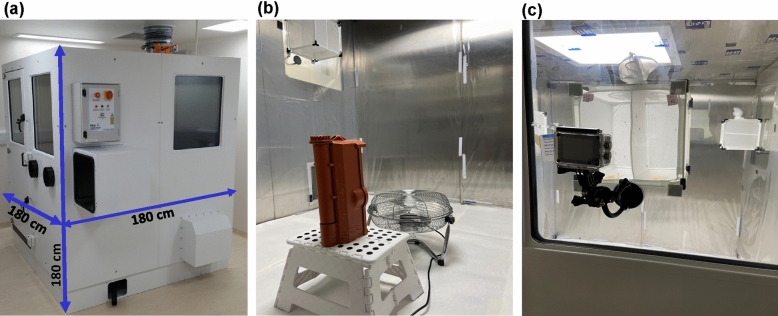
Figure 1
Figure 1
Peet-Grady chamber’s external and internal overview. (a) Chamber lateral profile showing glass observation windows, electrical control panel and extraction duct at the ceiling’s rear. (b) Set-up of the automatic aerosol dispenser and a 30-cm diameter fan in the chamber centre. (c) View through a chamber’s glass observation window with a camera to assist with the scoring of mosquito knockdown.
Figure 2
Figure 2
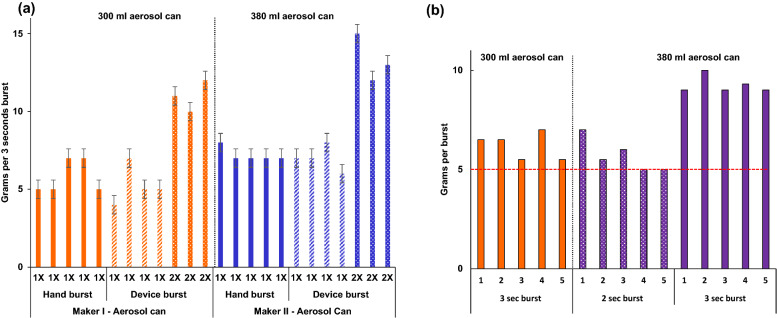
Validation and calibration of the remote-controlled aerosol dispenser (RCAD). (a) Comparison of spraying reproducibility within and between manual and automatic burst deployment. (b) RCAD burst length calibration to normalise spraying density across aerosol cans. The red dashed line is a baseline concentration to calibrate spraying burst length across variable spray can weights.
Figure 3
Figure 3
Variability in dose delivery and impacts on mosquito’s knockdown. (a) Change in spraying burst density deployed by automatic dispenser number of bursts, each of 3 s. (b) Dose–response curve of knockdown-exposure time relationships in pyrethroid-resistant colonies of Aedes aegypti – Cayman and Anopheles gambiae – Tiassale.
Figure 4
Figure 4
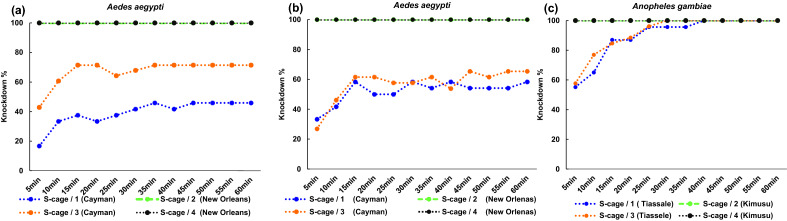
Impact of fan positioning on knockdown in relation to exposure time for Aedes aegypti and Anopheles gambiae resistant (Cayman or Tiassale) and susceptible (New Orleans or Kisumu) colonies. (a) fan without calibration using a spirity level (b and c) fan with spirit level calibration.
Figure 5
Figure 5
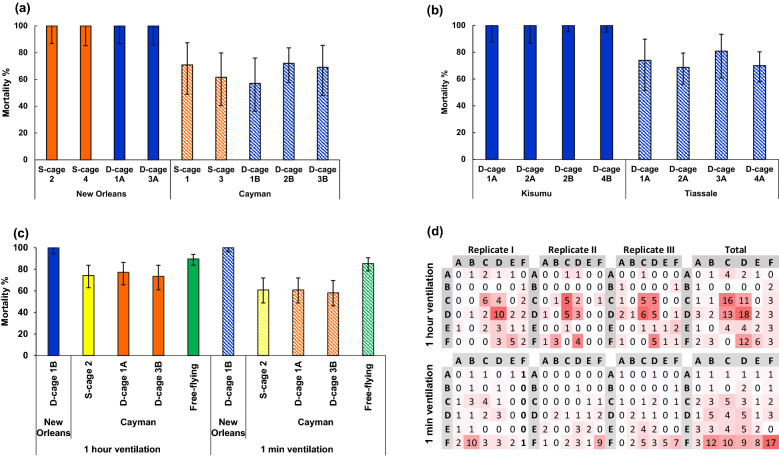
Dual-cage approach validation for screening mosquito against aerosolized insecticides. Dependence of mortality rates of susceptible and resistant (a) Ae. aegypti, (b) An. gambiae on cage structure and location in the chamber. (c) Impact of fan airflow duration on mortality in dual-cage and free-flying assays. (d) Summary of the space grid mapping of mosquito knockdown distribution in the presence/absence of fan airflow. Error bars represent 95% confidence intervals. S-cage (Standard cage) and D-cage (Dual-cage) are cages with and without an internal wall, respectively. Cage—number and letter; numbers represent the cage's clockwise location in the Peet-Grady windows and letters—A and B, dual-cage left or right half.

References

    1. Dusfour I, et al. Management of insecticide resistance in the major Aedes vectors of arboviruses: Advances and challenges. PLoS Negl. Trop. Dis. 2019;13:e0007615. doi: 10.1371/journal.pntd.0007615. - DOI - PMC - PubMed
    1. Lindsay SW, Thomas MB, Kleinschmidt I. Threats to the effectiveness of insecticide-treated bednets for malaria control: Thinking beyond insecticide resistance. Lancet Glob. Health. 2021;9:e1325–e1331. doi: 10.1016/S2214-109X(21)00216-3. - DOI - PubMed
    1. Devine GJ, et al. The entomological impact of passive metofluthrin emanators against indoor Aedes aegypti: A randomized field trial. PLoS Negl. Trop. Dis. 2021;15:e0009036. doi: 10.1371/journal.pntd.0009036. - DOI - PMC - PubMed
    1. Tambwe MM, et al. Semi-field evaluation of freestanding transfluthrin passive emanators and the BG sentinel trap as a “push-pull control strategy” against Aedes aegypti mosquitoes. Parasit. Vectors. 2020;13:1–11. doi: 10.1186/s13071-020-04263-3. - DOI - PMC - PubMed
    1. Ogoma SB, Moore SJ, Maia MF. A systematic review of mosquito coils and passive emanators: defining recommendations for spatial repellency testing methodologies. Parasit. Vectors. 2012;5:1–10. doi: 10.1186/1756-3305-5-287. - DOI - PMC - PubMed

Publication types