Meta-Analysis
. 2023 Apr 18;42(1):36.
doi: 10.1186/s41043-023-00369-3.

Global prevalence of Clostridioides difficile in 17,148 food samples from 2009 to 2019: a systematic review and meta-analysis

Affiliations
Meta-Analysis

Global prevalence of Clostridioides difficile in 17,148 food samples from 2009 to 2019: a systematic review and meta-analysis

Soroush Borji et al. J Health Popul Nutr. .

Abstract

Background: Clostridioides (Clostridium) difficile is an important infectious pathogen, which causes mild-to-severe gastrointestinal infections by creating resistant spores and producing toxins. Spores contaminated foods might be one of the most significant transmission ways of C. difficile-associated infections. This systematic review and meta-analysis study were conducted to investigate the prevalence of C. difficile in food.

Methods: Articles that published the prevalence of C. difficile in food in PubMed, Web of Science, and Scopus databases were retrieved using selected keywords between January 2009 and December 2019. Finally, 17,148 food samples from 60 studies from 20 countries were evaluated.

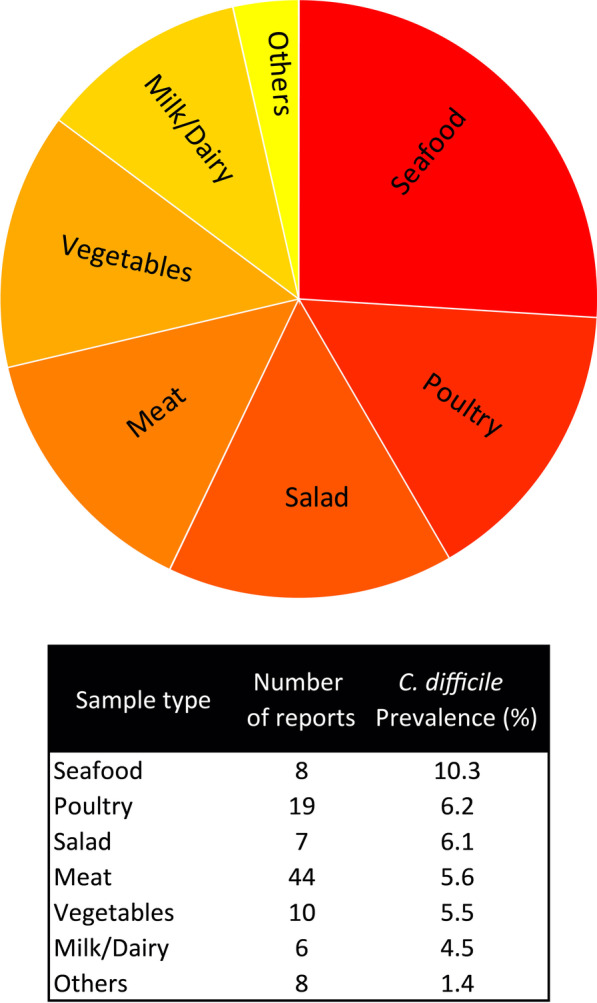
Results: The overall prevalence of C. difficile in various foods was 6.3%. The highest and lowest levels of C. difficile contamination were detected to seafood (10.3%) and side dishes (0.8%), respectively. The prevalence of C. difficile was 4% in cooked food, 6.2% in cooked chicken and 10% in cooked seafood.

Conclusions: There is still little known concerning the food-borne impact of C. difficile, but the reported contamination might pose a public health risk. Therefore, to improve the food safety and prevent contamination with C. difficile spores, it is necessary to observe hygienic issues during foods preparation, cooking and transfer.

Keywords: Clostridioides (Clostridium) difficile; Food; Prevalence; Public health.


Conflict of interest statement

The authors have declared that no competing interests exist.

Figures

Fig. 1
Fig. 1
PRISMA flow diagram of study selection
Fig. 2
Fig. 2
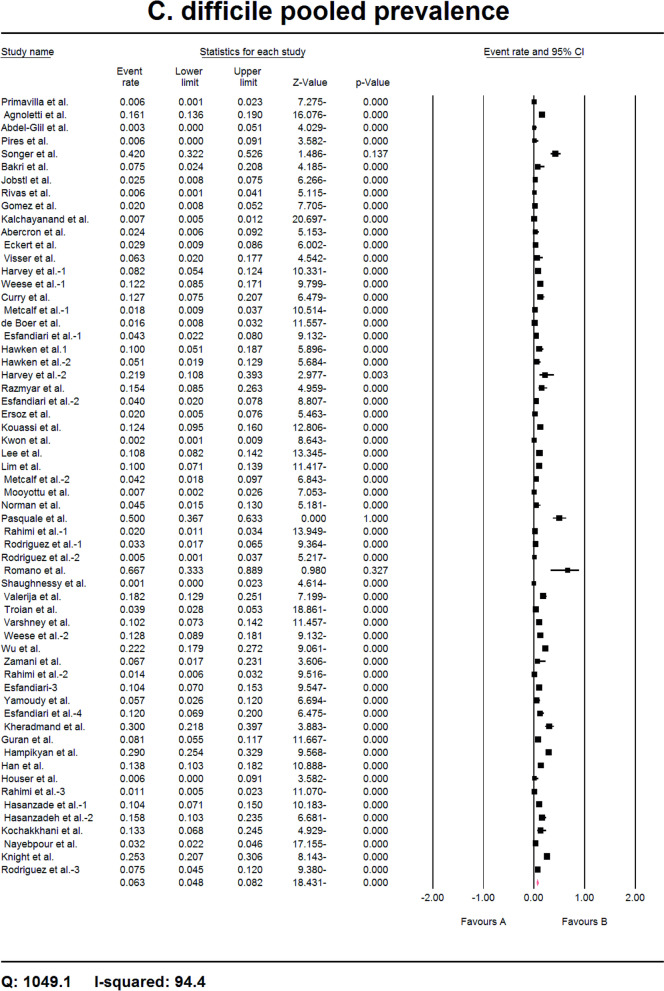
C. difficile pooled prevalence. The overall pooled prevalence of C. difficile in food samples was estimated to be 6.3% (CI 95%: 4.8–8.2). The lowest and highest C. difficile prevalence was observed in Shaughnessy et al. and Romano et al. reports with 0.1% and 66.7% prevalence, respectively
Fig. 3
Fig. 3
The prevalence of C. difficile in different sample types
Fig. 4
Fig. 4
The prevalence of C. difficile in different sample types in each country. Each sample type is shown in a separate box. The overall prevalence of C. difficile in each country is presented with circles, and the real numbers of prevalence (in percentage) are also presented in parenthesis. EG Egypt, CI Cote d'Ivoire, AT Austria, IR Iran, SK South Korea, TA Taiwan, NZ New Zealand, CA Canada, CR Costa Rica, USA United States of America, AT Austria, BL Belgium, FR France, IT Italy, NE Netherland, Slovenia, SW Sweden, TU Turkey, UK United Kingdom, BR Brazil
Fig. 5
Fig. 5
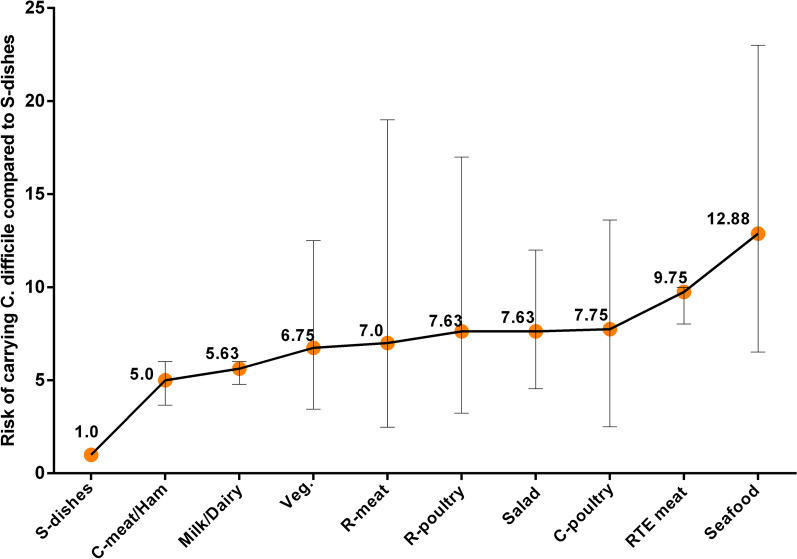
Ranking of C. difficile prevalence risk ratio per food type

References

    1. Moono P, Foster NF, Hampson DJ, Knight DR, Bloomfield LE, Riley TV. Clostridium difficile infection in production animals and avian species: a review. Foodborne Pathog Dis. 2016;13(12):647–655. doi: 10.1089/fpd.2016.2181. - DOI - PubMed
    1. Freeman J, Bauer M, Baines SD, Corver J, Fawley W, Goorhuis B, et al. The changing epidemiology of Clostridium difficile infections. Clin Microbiol Rev. 2010;23(3):529–549. doi: 10.1128/CMR.00082-09. - DOI - PMC - PubMed
    1. Dinleyici M, Vandenplas Y. Clostridium difficile colitis prevention and treatment. Adv Exp Med Biol. 2019;1125:139–146. doi: 10.1007/5584_2018_322. - DOI - PubMed
    1. Bartlett JG, Chang TW, Gurwith M, Gorbach SL, Onderdonk AB. Antibiotic-associated pseudomembranous colitis due to toxin-producing clostridia. N Engl J Med. 1978;298(10):531–534. doi: 10.1056/NEJM197803092981003. - DOI - PubMed
    1. Lawson PA, Citron DM, Tyrrell KL, Finegold SM. Reclassification of clostridium difficile as Clostridioides difficile (Hall and O’Toole 1935) Prévot 1938. Anaerobe. 2016;40:95–99. doi: 10.1016/j.anaerobe.2016.06.008. - DOI - PubMed

Publication types

LinkOut - more resources