Review
. 2023 Feb 22;5(1):1-11.
doi: 10.1007/s42995-023-00163-4. eCollection 2023 Feb.

Evolution of sex determination in crustaceans

Affiliations
Review

Evolution of sex determination in crustaceans

Zhiqiang Ye et al. Mar Life Sci Technol. .

Abstract

Sex determination (SD) involves mechanisms that determine whether an individual will develop into a male, female, or in rare cases, hermaphrodite. Crustaceans harbor extremely diverse SD systems, including hermaphroditism, environmental sex determination (ESD), genetic sex determination (GSD), and cytoplasmic sex determination (e.g., Wolbachia controlled SD systems). Such diversity lays the groundwork for researching the evolution of SD in crustaceans, i.e., transitions among different SD systems. However, most previous research has focused on understanding the mechanism of SD within a single lineage or species, overlooking the transition across different SD systems. To help bridge this gap, we summarize the understanding of SD in various clades of crustaceans, and discuss how different SD systems might evolve from one another. Furthermore, we review the genetic basis for transitions between different SD systems (i.e., Dmrt genes) and propose the microcrustacean Daphnia (clade Branchiopoda) as a model to study the transition from ESD to GSD.

Keywords: Crustacean; Daphnia; Dmrt; Sex determination; Sexual differentiation.


Conflict of interest statement

Conflict of interestThe authors confirm that there are no known conflicts of interest associated with this publication.

Figures
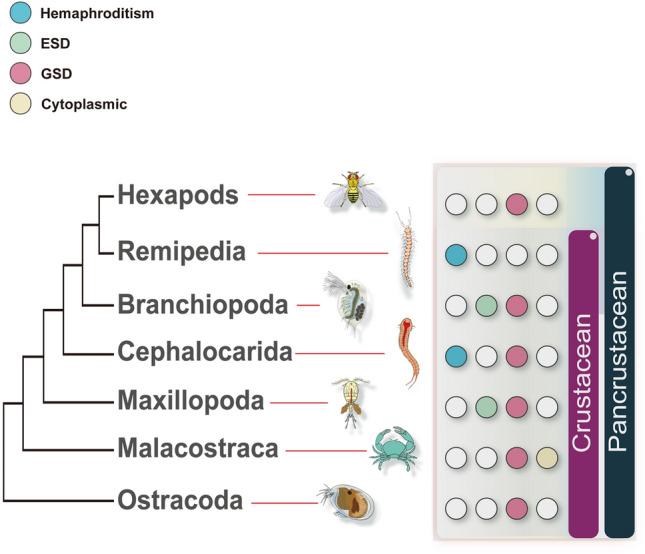
Fig. 1
Fig. 1
Phylogeny of extant crustaceans and modes of sex determination for each clade. The original phylogenetic tree was generated by Schwentner et al. (2017) based on the PhyloBayes analysis of 1077 decisive orthogroups and 301,748 amino acid positions with the Site-Heterogeneous CAT-GTR Model. We modified the tree to show only the major Pancrustacean clades. ESD environmental sex determination, GSD genetic sex determination; cytoplasmic (e.g., Wolbachia controlled SD system)
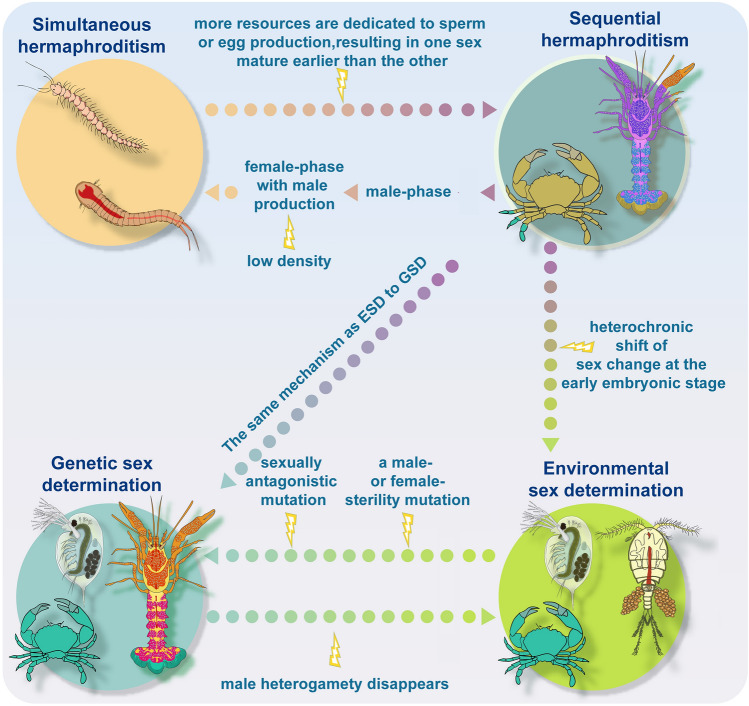
Fig. 2
Fig. 2
Evolutionary routes of sex determination systems in crustaceans. The flash arrow indicates the trigger required for each transition. GSD genetic sex determination, ESD environmental sex determination
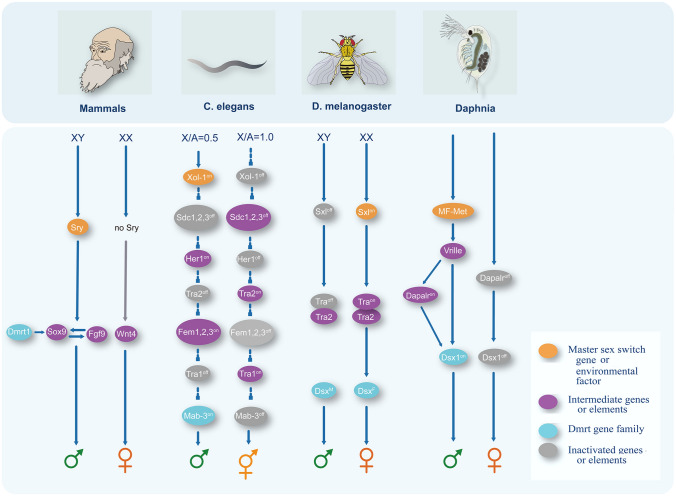
Fig. 3
Fig. 3
Sex switch and Dmrt genes in the sex determination pathways in diverse model species. DMRT doublesex and male abnormal-3-related transcription factors gene family, Sry sex-determining Region Y, Sox9 sry-related box 9, Xol-1 XO lethal protein 1, Tra transformer; Sxl sex lethal, MF methyl farnesoate, Dapalr doublesex1 alpha promoter-associated long non-coding RNA, Mab-3 male abnormal-3. Wtn4 Wnt family member 4. Arrows indicate positive regulation, and crossbars indicate repressive regulation
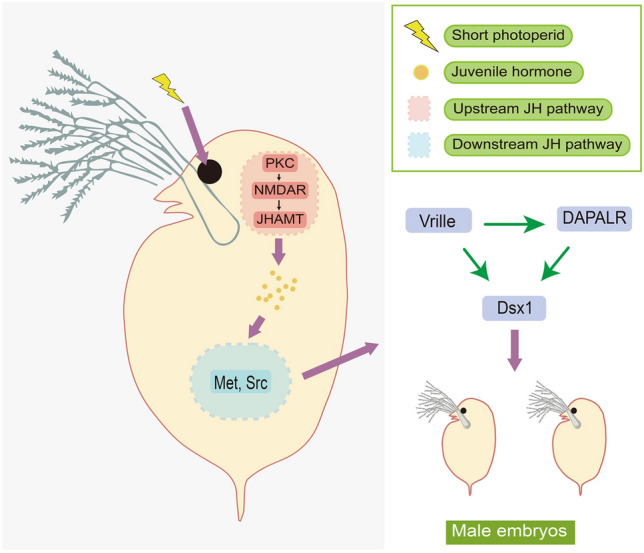
Fig. 4
Fig. 4
Signaling cascades of the sex determination pathway in Daphnia (Branchiopoda). JH juvenile hormone, PKC protein kinase C, NMDAR N-methyl-D-aspartic acid receptor, JHAMT juvenile hormone acid O-methyltransferase, Met methoprene-tolerant, SRC steroid receptor coactivator, DAPALR doublesex1 alpha promoter-associated long non-coding RNA, Dsx doublesex. Regulation of DAPALR, Vrille, Dsx1 happened in embryos

References

    1. Abe M, Fukuhara H. Protogynous hermaphroditism in the brackish and freshwater isopod, Gnorimosphaeroma naktongense (Crustacea: Isopoda, Sphaeromatidae) Zoolog Sci. 1996;13:325–329. doi: 10.2108/zsj.13.325. - DOI
    1. Abe R, Toyota K, Miyakawa H, Watanabe H, Oka T, Miyagawa S, Nishide H, Uchiyama I, Tollefsen KE, Iguchi T. Diofenolan induces male offspring production through binding to the juvenile hormone receptor in Daphnia magna. Aquat Toxicol. 2015;159:44–51. doi: 10.1016/j.aquatox.2014.11.015. - DOI - PubMed
    1. Alexander H, Richardson J, Edmands S, Anholt B. Sex without sex chromosomes: genetic architecture of multiple loci independently segregating to determine sex ratios in the copepod Tigriopus californicus. J Evol Biol. 2015;28:2196–2207. doi: 10.1111/jeb.12743. - DOI - PubMed
    1. Bachtrog D. Y-chromosome evolution: emerging insights into processes of Y-chromosome degeneration. Nat Rev Genet. 2013;14:113–124. doi: 10.1038/nrg3366. - DOI - PMC - PubMed
    1. Bachtrog D, Mank JE, Peichel CL, Kirkpatrick M, Otto SP, Ashman T-L, Hahn MW, Kitano J, Mayrose I, Ming R. Sex determination: why so many ways of doing it? PLoS Biol. 2014;12:e1001899. doi: 10.1371/journal.pbio.1001899. - DOI - PMC - PubMed

LinkOut - more resources