Review
. 2023 Jul;80(7):1384-1392.
doi: 10.1161/HYPERTENSIONAHA.123.20617. Epub 2023 Apr 19.

Noise and Air Pollution as Risk Factors for Hypertension: Part II-Pathophysiologic Insight

Affiliations
Review

Noise and Air Pollution as Risk Factors for Hypertension: Part II-Pathophysiologic Insight

Omar Hahad et al. Hypertension. 2023 Jul.

Abstract

Traffic noise and air pollution are environmental stressors found to increase risk for cardiovascular events. The burden of disease attributable to environmental stressors and cardiovascular disease globally is substantial, with a need to better understand the contribution of specific risk factors that may underlie these effects. Epidemiological observations and experimental evidence from animal models and human controlled exposure studies suggest an essential role for common mediating pathways. These include sympathovagal imbalance, endothelial dysfunction, vascular inflammation, increased circulating cytokines, activation of central stress responses, including hypothalamic and limbic pathways, and circadian disruption. Evidence also suggests that cessation of air pollution or noise through directed interventions alleviates increases in blood pressure and intermediate surrogate pathways, supporting a causal link. In the second part of this review, we discuss the current understanding of mechanisms underlying and current gaps in knowledge and opportunities for new research.

Keywords: air pollution; cardiovascular diseases; cytokines; inflammation; noise; oxidative stress.


Conflict of interest statement

Disclosures None.

Figures

Figure 1.
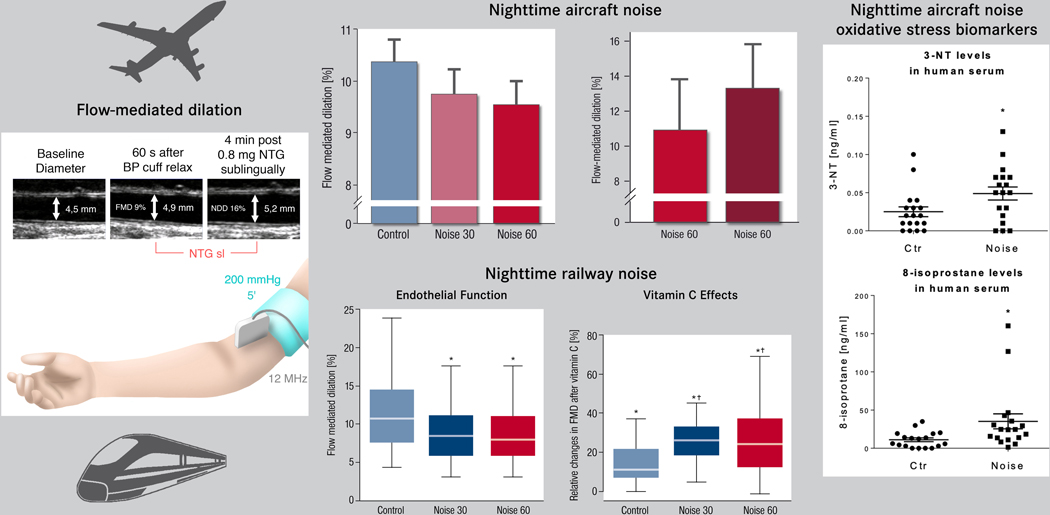
Figure 1.. Selected results from human field studies on nighttime aircraft/railway noise exposure for one night and endothelial function and oxidative stress markers.
Data on flow-mediated dilation after exposure to aircraft noise is based on 75 healthy non-smokers (FLUG study) , exposure to railway noise is based on 70 healthy non-smokers (ZUG study) and all exposures were applied in a randomized cross-over design. Vitamin C effects were assessed in a subgroup of the cohort. Oxidative stress markers (3-nitroytosine [3-NT] and 8-isoprostane) were measured in the remaining samples of the FLUG study and published in . Data summarized from ,, with permission.
Figure 2.
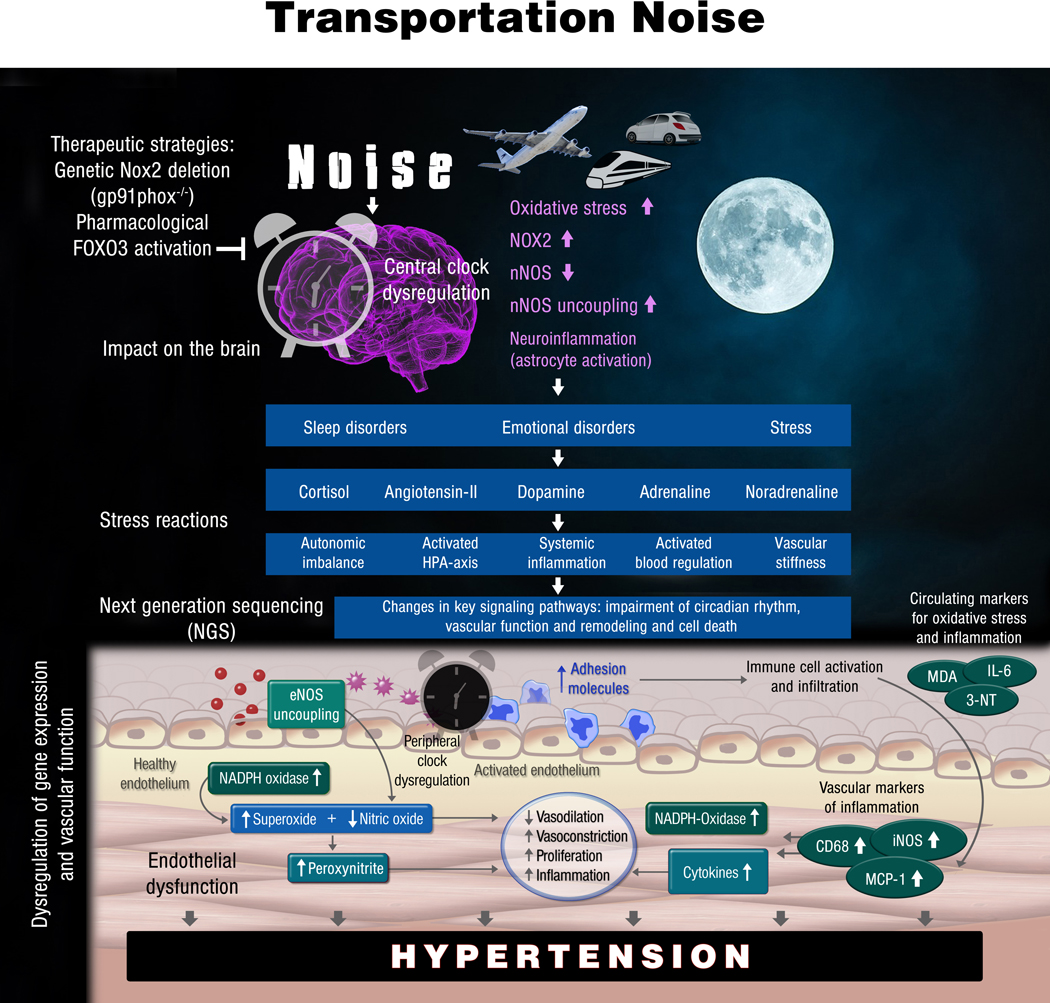
Figure 2.
Pathophysiology of nighttime noise-induced arterial hypertension. Genetic Nox2 deficiency and pharmacological FOXO3 activation by bepridil prevented the adverse noise effects. 3-NT, 3-nitrotyrosine; CD68, macrosialin; eNOS, endothelial nitric oxide synthase; HPA, hypothalamic pituitary adrenal; IL-6, interleukin 6; iNOS, inducible nitric oxide synthase; MCP-1, monocyte chemoattractant protein-1; MDA, malondialdehyde. Figure adapted from reference with permission.
Figure 3.
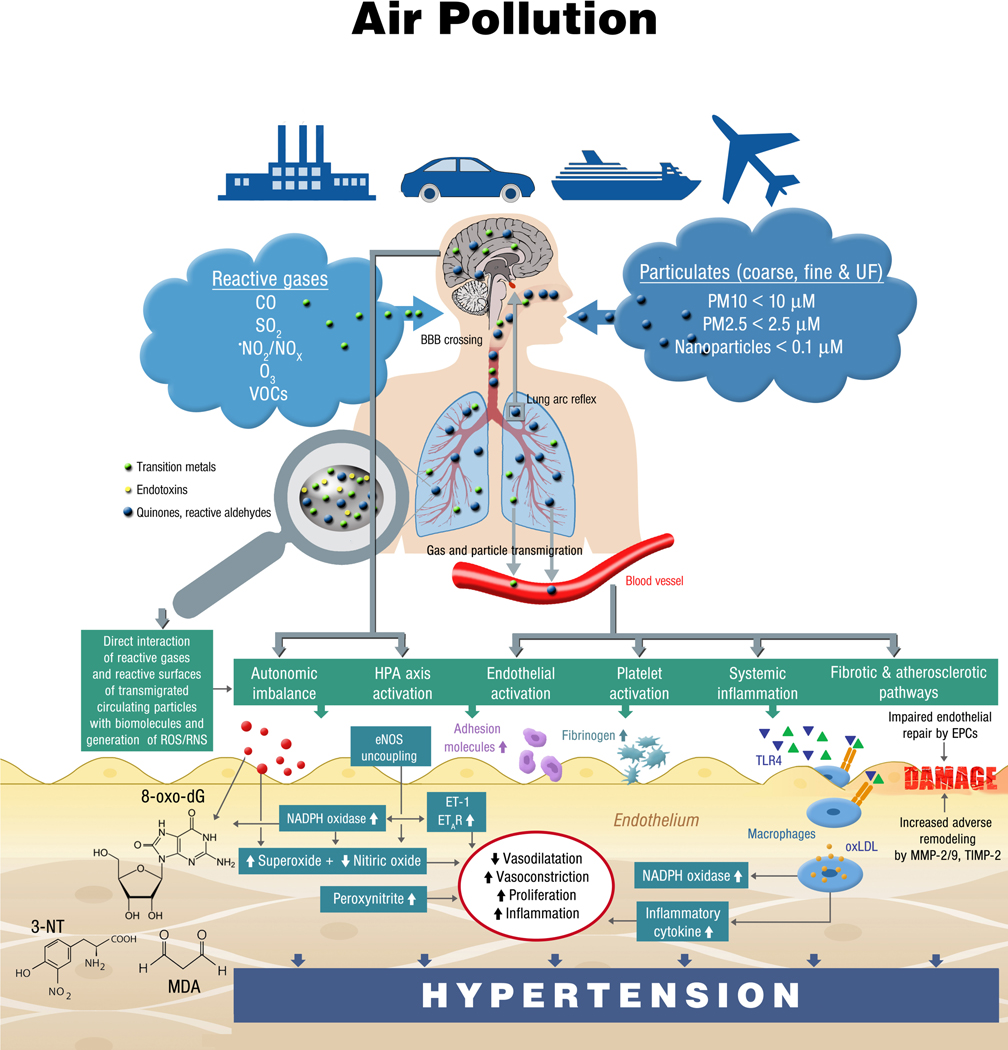
Figure 3.
Pathophysiology of air pollution-induced endothelial dysfunction, increased oxidative stress, inflammation, and subsequently arterial hypertension. Green and blue triangles are damage- and pathogen-associated molecular patterns (e.g., free DNA fragments, hyaluronan, 7-ketocholesterol, oxidized 1-palmitoyl-2-arachidonyl-sn-glycero-3-phosphorylcholine, lipopolysaccharide) as well as soluble heavy/transition metals. HPA, hypothalamic pituitary adrenal; EPCs, endothelial progenitor cells; eNOS, endothelial nitric oxide synthase; ET-1, endothelin-1; ETAR, endothelin type A receptor; MMP, metalloproteinase; 8-oxo-dG, 8-oxo-deoxyguanosine; 3-NT, 3-nitrotyrosine; MDA, malondialdehyde; TIMP, tissue inhibitor of metalloproteinases; TLR4, toll-like receptor 4; VOCs, volatile organic compounds. Figure adapted from reference with permission.

References

    1. Munzel T, Sorensen M, Daiber A. Transportation noise pollution and cardiovascular disease. Nat Rev Cardiol. 2021;18:619–636. doi: 10.1038/s41569-021-00532-5 - DOI - PubMed
    1. Munzel T, Sorensen M, Gori T, Schmidt FP, Rao X, Brook FR, Chen LC, Brook RD, Rajagopalan S. Environmental stressors and cardio-metabolic disease: part II-mechanistic insights. Eur Heart J. 2017;38:557–564. doi: 10.1093/eurheartj/ehw294 - DOI - PMC - PubMed
    1. Kuntic M, Kuntic I, Krishnankutty R, Gericke A, Oelze M, Junglas T, Bayo Jimenez MT, Stamm P, Nandudu M, Hahad O, et al. Co-exposure to urban particulate matter and aircraft noise adversely impacts the cerebro-pulmonary-cardiovascular axis in mice. Redox Biol. 2023;59:102580. doi: 10.1016/j.redox.2022.102580 - DOI - PMC - PubMed
    1. Al-Kindi SG, Brook RD, Biswal S, Rajagopalan S. Environmental determinants of cardiovascular disease: lessons learned from air pollution. Nat Rev Cardiol. 2020;17:656–672. doi: 10.1038/s41569-020-0371-2 - DOI - PMC - PubMed
    1. Munzel T, Schmidt FP, Steven S, Herzog J, Daiber A, Sorensen M. Environmental Noise and the Cardiovascular System. J Am Coll Cardiol. 2018;71:688–697. doi: 10.1016/j.jacc.2017.12.015 - DOI - PubMed

Publication types

MeSH terms