. 2023 Jun 1;109(6):1688-1698.
doi: 10.1097/JS9.0000000000000417.

Local excision as a viable alternative to hysterectomy for early-stage cervical cancer in women of reproductive age: a population-based cohort study

Affiliations

Local excision as a viable alternative to hysterectomy for early-stage cervical cancer in women of reproductive age: a population-based cohort study

Ying Chen et al. Int J Surg. .

Abstract

Background: Local excision as the main alternative for fertility-sparing surgery (FSS) has been widely used in patients with early-stage cervical cancer to achieve fertility preservation, but its safety and practicability are still questioned. Therefore, The authors evaluated the current application of local excision in early-stage cervical cancer with this population-based study and compared its efficacy with hysterectomy.

Materials and methods: Women diagnosed with International Federation of Gynecology and Obstetrics (FIGO) stage I cervical cancer at childbearing age (18-49 years) recorded in the Surveillance, Epidemiology and End Results (SEER) database from 2000 to 2017 were included. Overall survival (OS) and disease-specific survival (DSS) rates were compared between local excision and hysterectomy.

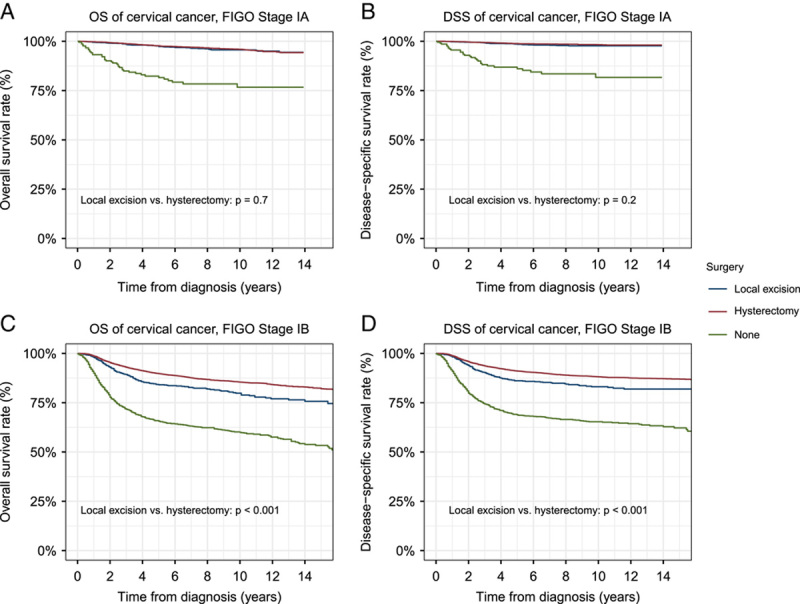
Results: A total of 18 519 patients of reproductive age with cervical cancer were included, and 2268 deaths were observed. 17.0% of patients underwent FSS via local excision, and 70.1% underwent hysterectomy. Among patients younger than 39 years, OS and DSS of local excision were comparable to those of hysterectomy, whereas, in patients older than 40 years, OS and DSS of local excision were significantly worse than those of hysterectomy. In addition, OS and DSS of local excision were similar to hysterectomy in patients with stage IA cervical cancer, but OS and DSS were inferior to hysterectomy in patients with stage IB cervical cancer who underwent local excision.

Conclusion: For patients without fertility requirements, hysterectomy remains the best therapeutic option. However, for patients under 40 years of age diagnosed with stage IA cervical cancer, FSS via local excision is a viable option that can achieve a well-balanced outcome between tumour control and fertility preservation.


Conflict of interest statement

The authors declare no conflicts of interest.

Sponsorships or competing interests that may be relevant to content are disclosed at the end of this article.

Figures

Figure 1
Figure 1
Inclusion and exclusion criteria for patients included in this study. FIGO, International Federation of Gynecology and Obstetrics.
Figure 2
Figure 2
Rates of patients aged 18–49 years receiving different types of surgical interventions.
Figure 3
Figure 3
Outcomes of patients aged 18–49 years with FIGO stage I cervical cancer who underwent different types of surgical interventions. (A) Overall survival (OS) of patients with stage I cervical cancer by surgical interventions. (B) Disease-specific survival (DSS) of patients with stage I cervical cancer by surgical interventions. FIGO, International Federation of Gynecology and Obstetrics.
Figure 4
Figure 4
Outcomes of surgical interventions in patients with different stages of cervical cancer. (A) Overall survival (OS) of patients with stage IA cervical cancer. (B) Disease-specific survival (DSS) of patients with stage IA cervical cancer. (C) OS of patients with stage IB cervical cancer. (D) DSS of patients with stage IB cervical cancer. FIGO, International Federation of Gynecology and Obstetrics.
Figure 5
Figure 5
Multivariate Cox analysis of overall survival (OS) and disease-specific survival (DSS) in patients with stage I cervical cancer. (A) Hazard ratios (HRs) for unadjusted OS in patients with stage I cervical cancer undergoing local excision in comparison with hysterectomy by cancer stage; (B) HRs for unadjusted DSS in patients with stage I cervical cancer undergoing local excision in comparison with hysterectomy by cancer stage. (C) HRs for adjusted OS in patients with stage I cervical cancer undergoing local excision in comparison with hysterectomy by cancer stage; (D) HRs for adjusted DSS in patients with stage I cervical cancer undergoing local excision in comparison with hysterectomy by cancer stage.
Figure 6
Figure 6
Surgical intervention outcomes in patients with FIGO stage I cervical cancer in different age groups. (A) Overall survival (OS) in patients aged 18–24 years with stage I cervical cancer. (B) OS in patients aged 25–29 years with stage I cervical cancer. (C) OS in patients aged 30–34 years with stage I cervical cancer. (D) OS in patients aged 35–39 years with stage I cervical cancer. (E) OS in patients aged 40–44 years with stage I cervical cancer. (F) OS in patients aged 45–49 years with stage I cervical cancer. FIGO, International Federation of Gynecology and Obstetrics.
Figure 7
Figure 7
Surgical intervention outcomes in patients with FIGO stage I cervical cancer in different age groups. (A) Disease-specific survival (DSS) in patients aged 18–24 years with stage I cervical cancer. (B) DSS in patients aged 25–29 years with stage I cervical cancer. (C) DSS in patients aged 30–34 years with stage I cervical cancer. (D) DSS in patients aged 35–39 years with stage I cervical cancer. (E) DSS in patients aged 40–44 years with stage I cervical cancer. (F) DSS in patients aged 45–49 years with stage I cervical cancer. FIGO, International Federation of Gynecology and Obstetrics.
Figure 8
Figure 8
The 5-year survival rate of patients aged 18–49 years with FIGO stage I cervical cancer who underwent surgical intervention. (A) Five-year overall survival (OS) of patients with cervical cancer undergoing local excision compared with hysterectomy; (B) Five-year disease-specific survival (DSS) of patients with cervical cancer undergoing local excision compared with hysterectomy. FIGO, International Federation of Gynecology and Obstetrics.
Figure 9
Figure 9
Cumulative mortality rate (CMR) in patients with FIGO stage I cervical cancer who underwent surgical intervention. (A) CMR of patients with stage I cervical cancer receiving local excision and hysterectomy who died from cancer-related diseases; (B) CMR of patients with stage I cervical cancer receiving local excision and hysterectomy who died from infectious diseases; (C) CMR of patients with stage I cervical cancer receiving local excision and hysterectomy who died from cardiovascular diseases; (D) CMR of patients with stage I cervical cancer receiving local excision and hysterectomy who died from respiratory diseases; (E) CMR of patients with stage I cervical cancer receiving local excision and hysterectomy who died from gastrointestinal diseases; (F) CMR of patients with stage I cervical cancer receiving local excision and hysterectomy who died from renal diseases; (G) CMR of patients with stage I cervical cancer receiving local excision and hysterectomy who died from external injuries (H) CMR of patients with stage I cervical cancer receiving local excision and hysterectomy who died from other causes of death. FIGO, International Federation of Gynecology and Obstetrics.

References

    1. Isla-Ortiz D, Palomares-Castillo E, Mille-Loera JE, et al. Cervical cancer in young women: do they have a worse prognosis? A retrospective cohort analysis in a population of Mexico. Oncologist 2020;25:e1363–e71. - PMC - PubMed
    1. Arbyn M, Castellsagué X, de Sanjosé S, et al. Worldwide burden of cervical cancer in 2008. Ann Oncol 2011;22:2675–86. - PubMed
    1. Sung H, Ferlay J, Siegel RL, et al. Global Cancer Statistics 2020: GLOBOCAN Estimates of incidence and mortality worldwide for 36 cancers in 185 countries. CA Cancer J Clin 2021;71:209–249. - PubMed
    1. World Health Organization. IAfRoCI. Global Cancer Observatory (GCO); Accessed 17 November 2020. https://gco.iarc.fr
    1. Rob L, Skapa P, Robova H. Fertility-sparing surgery in patients with cervical cancer. Lancet Oncol 2011;12:192–200. - PubMed