


Residential proximity to unconventional oil and gas development and birth defects in Ohio
- PMID: 37076028
- PMCID: PMC10198955
- DOI: 10.1016/j.envres.2023.115937
Residential proximity to unconventional oil and gas development and birth defects in Ohio
Abstract
Background: Chemicals used or emitted by unconventional oil and gas development (UOGD) include reproductive/developmental toxicants. Associations between UOGD and certain birth defects were reported in a few studies, with none conducted in Ohio, which experienced a thirty-fold increase in natural gas production between 2010 and 2020.
Methods: We conducted a registry-based cohort study of 965,236 live births in Ohio from 2010 to 2017. Birth defects were identified in 4653 individuals using state birth records and a state surveillance system. We assigned UOGD exposure based on maternal residential proximity at birth to active UOG wells and a metric specific to the drinking-water exposure pathway that identified UOG wells hydrologically connected to a residence ("upgradient UOG wells"). We estimated odds ratios (ORs) and 95% confidence intervals (CIs) for all structural birth defects combined and specific birth defect types using binary exposure metrics (presence/absence of any UOG well and presence/absence of an upgradient UOG well within 10 km), adjusting for confounders. Additionally, we conducted analyses stratified by urbanicity, infant sex, and social vulnerability.
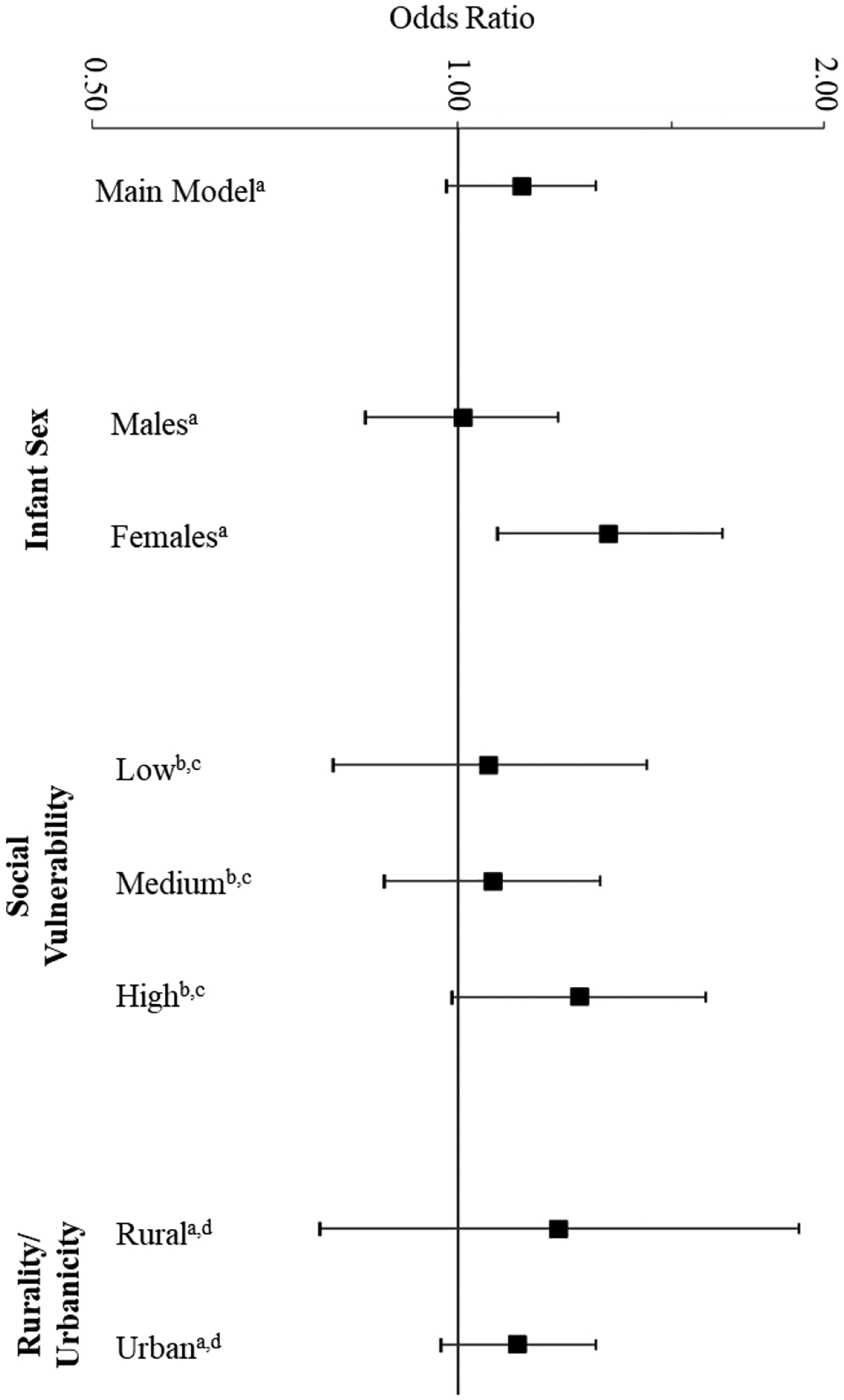
Results: The odds of any structural defect were 1.13 times higher in children born to mothers living within 10 km of UOGD than those born to unexposed mothers (95%CI: 0.98-1.30). Odds were elevated for neural tube defects (OR: 1.57, 95%CI: 1.12-2.19), limb reduction defects (OR: 1.99, 95%CI: 1.18-3.35), and spina bifida (OR 1.93; 95%CI 1.25-2.98). Hypospadias (males only) was inversely related to UOGD exposure (OR: 0.62, 95%CI: 0.43-0.91). Odds of any structural defect were greater in magnitude but less precise in analyses using the hydrological-specific metric (OR: 1.30; 95%CI: 0.85-1.90), in areas with high social vulnerability (OR: 1.27, 95%CI: 0.99-1.60), and among female offspring (OR: 1.28, 95%CI: 1.06-1.53).
Conclusions: Our results suggest a positive association between UOGD and certain birth defects, and findings for neural tube defects corroborate results from prior studies.
Keywords: Birth defects; Congenital anomalies; Congenital malformations; Epidemiology; Fracking; Hydraulic fracturing; Ohio; Oil and gas.
Copyright © 2023 Elsevier Inc. All rights reserved.
Conflict of interest statement
Declaration of competing interest The authors declare that they have no known competing financial interests or personal relationships that could have appeared to influence the work reported in this paper.
Figures
References
-
- U.S. Environmental Protection Agency. Hydraulic Fracturing for Oil and Gas: Impacts from the Hydraulic Fracturing Water Cycle on Drinking Water Resources in the United States (Final Report). 2016. https://cfpub.epa.gov/ncea/hfstudy/recordisplay.cfm?deid=332990
-
- U.S. Department of Energy. How is Shale Gas Produced?. Accessed June 29, 2022. https://www.energy.gov/sites/prod/files/2013/04/f0/how_is_shale_gas_prod...
-
- Fukui R, Greenfield C, Pogue K, van der Zwaan B. Experience curve for natural gas production by hydraulic fracturing. Energy Policy. 2017/06/01/ 2017;105:263–268. doi:10.1016/j.enpol.2017.02.027 - DOI
-
- U.S. Energy Information Administration. Natural gas explained. Accessed April 11, 2022. https://www.eia.gov/energyexplained/natural-gas/where-our-natural-gas-co...
-
- Wang Q, Chen X, Jha AN, Rogers H. Natural gas from shale formation – The evolution, evidences and challenges of shale gas revolution in United States. Renewable and Sustainable Energy Reviews. 2014/02/01/2014;30:1–28. doi:10.1016/j.rser.2013.08.065 - DOI
Publication types
MeSH terms
Substances
Grants and funding
LinkOut - more resources
Full Text Sources
Medical
