


Applications to medical and surgical specialist training in the UK National Health Service, 2021-2022: a cross-sectional observational study to characterise the diversity of successful applicants
- PMID: 37076164
- PMCID: PMC10186087
- DOI: 10.1136/bmjopen-2022-069846
Applications to medical and surgical specialist training in the UK National Health Service, 2021-2022: a cross-sectional observational study to characterise the diversity of successful applicants
Abstract
Objectives: To compare success of applicants to specialty training posts in the UK by gender, ethnicity and disability status.
Design: Cross-sectional observational study.
Setting: National Health Service, UK.
Participants: All specialty training post applications to Health Education England, UK, during the 2021-2022 recruitment cycle.
Intervention: Nil.
Primary and secondary outcome measures: Comparison of success at application to specialty training posts by gender, ethnicity, country of qualification (UK vs non-UK) and disability. The influence of ethnicity on success was investigated using a logistic regression model, where country of qualification was included as a covariate.
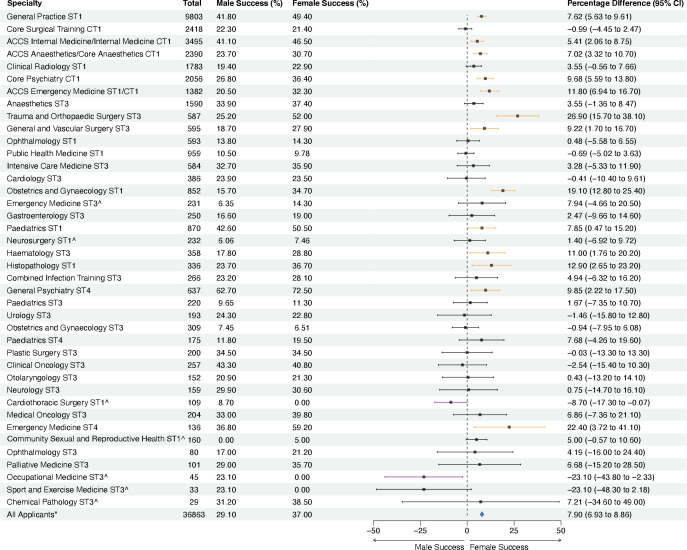
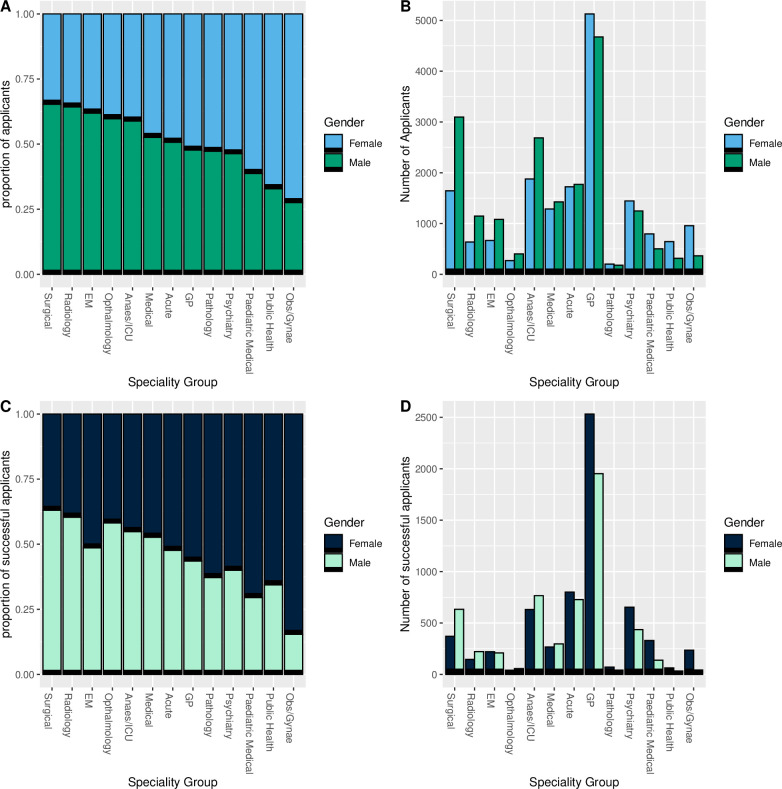
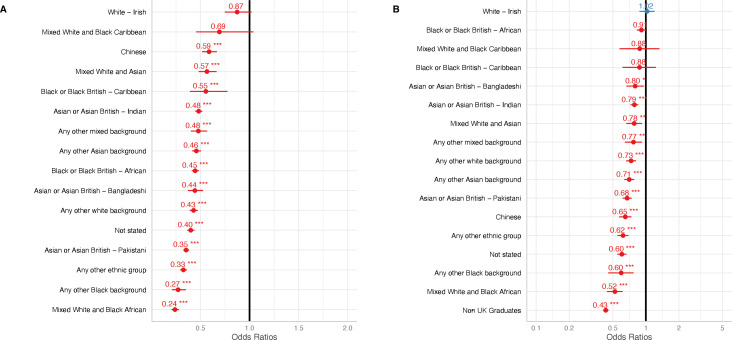
Results: 12 419/37 971 (32.7%) of applicants to specialty training posts were successful, representing 58 specialties. The difference in percentage of successful females (6480/17 523, 37.0%) and males (5625/19 340, 29.1%) was 7.9% (95% CI 6.93% to 8.86%), in favour of females. Segregation of applications to specialties by gender was observed; surgical specialties had the highest proportion of male applicants, while obstetrics and gynaecology had the highest proportion of female applicants. The proportion of successful recruits to specialties largely reflected the number of applications. 11/15 minority ethnic groups (excluding 'not stated') had significantly lower adjusted ORs for success compared with white-British applicants. 'Mixed white and black African' (OR 0.52, 95% CI 0.44 to 0.61, p≤0.001) were the least successful minority group in our study, while non-UK graduates had an adjusted ORs for success of 0.43 (95% CI 0.41 to 0.46, p≤0.001) compared with UK graduates. The difference in percentage of success by disabled applicants (179/464, 38.6%) and non-disabled applicants (11 940/36 418, 32.8%) was 5.79% (95% CI 1.23% to 10.4%), in favour of disabled applicants. No disabled applicants were accepted to 21/58 (36.2%) of specialties.
Conclusions: Despite greater success by female applicants overall, there is an attraction issue to specialties by gender. Further, most ethnic minority groups are less successful at application when compared with white-British applicants. This requires continuous monitoring and evaluation of the reasons behind observed differences.
Trial registration: Not applicable.
Keywords: EDUCATION & TRAINING (see Medical Education & Training); GENERAL MEDICINE (see Internal Medicine); Health Equity; Health policy; Organisational development; SURGERY.
© Author(s) (or their employer(s)) 2023. Re-use permitted under CC BY. Published by BMJ.
Conflict of interest statement
Competing interests: None declared. Employers and/or funders had no role in study design, data collection and analysis, decision to publish, or preparation of the manuscript.
Figures
References
-
- Committee HaSC . Workforce: recruitment, training and retention in health and social care: UK parliament. 2022. Available: https://publications.parliament.uk/pa/cm5803/cmselect/cmhealth/115/repor...
-
- Association BM . NHS medical staffing data analysis. 2022. Available: https://www.bma.org.uk/advice-and-support/nhs-delivery-and-workforce/wor...
-
- Shembavnekar NB, Bazeer N, Kelly E, et al. NHS workforce projections 2022. The Health Foundation 2022.
Publication types
MeSH terms
Grants and funding
LinkOut - more resources
Full Text Sources
