


Direct correction of haemoglobin E β-thalassaemia using base editors
- PMID: 37076455
- PMCID: PMC10115876
- DOI: 10.1038/s41467-023-37604-8
Direct correction of haemoglobin E β-thalassaemia using base editors
Abstract
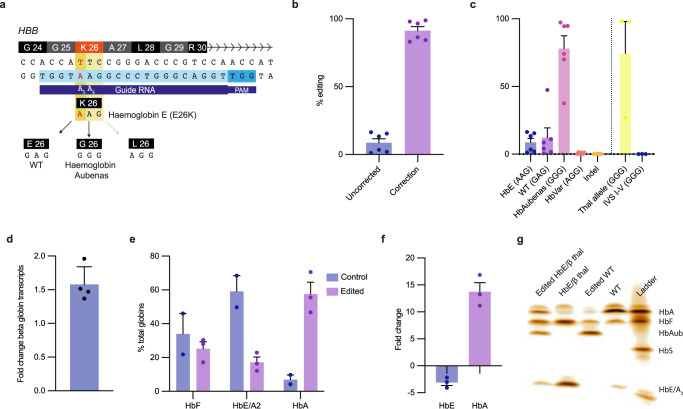
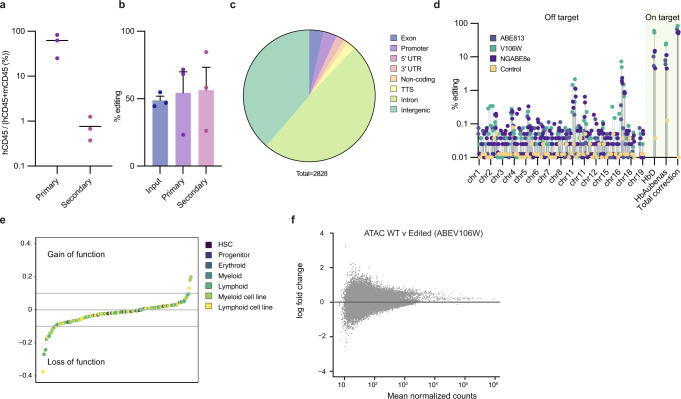
Haemoglobin E (HbE) β-thalassaemia causes approximately 50% of all severe thalassaemia worldwide; equating to around 30,000 births per year. HbE β-thalassaemia is due to a point mutation in codon 26 of the human HBB gene on one allele (GAG; glutamatic acid → AAG; lysine, E26K), and any mutation causing severe β-thalassaemia on the other. When inherited together in compound heterozygosity these mutations can cause a severe thalassaemic phenotype. However, if only one allele is mutated individuals are carriers for the respective mutation and have an asymptomatic phenotype (β-thalassaemia trait). Here we describe a base editing strategy which corrects the HbE mutation either to wildtype (WT) or a normal variant haemoglobin (E26G) known as Hb Aubenas and thereby recreates the asymptomatic trait phenotype. We have achieved editing efficiencies in excess of 90% in primary human CD34 + cells. We demonstrate editing of long-term repopulating haematopoietic stem cells (LT-HSCs) using serial xenotransplantation in NSG mice. We have profiled the off-target effects using a combination of circularization for in vitro reporting of cleavage effects by sequencing (CIRCLE-seq) and deep targeted capture and have developed machine-learning based methods to predict functional effects of candidate off-target mutations.
© 2023. The Author(s).
Conflict of interest statement
J.D., M.B. and D.H. have filed a patent application on this work, which has been licensed to BEAM therapeutics. J.D. and M.B. receive revenue from this licence and hold personal shares in BEAM therapeutics. J.D. and J.H. are co-founders of Nucleome Therapeutics Ltd. and provide consultancy to the company. The remaining authors declare no competing interests.
Figures
References
Publication types
MeSH terms
Substances
Grants and funding
- MC_UU_00029/7/MRC_/Medical Research Council/United Kingdom
- NIHR203339/DH_/Department of Health/United Kingdom
- MR/T014067/1/MRC_/Medical Research Council/United Kingdom
- MC_PC_18059/MRC_/Medical Research Council/United Kingdom
- MC_UU_00029/3/MRC_/Medical Research Council/United Kingdom
- MC_UU_00016/1/MRC_/Medical Research Council/United Kingdom
- MC_UU_00016/14/MRC_/Medical Research Council/United Kingdom
- MR/R008108/1/MRC_/Medical Research Council/United Kingdom
- MR/T030410/1/MRC_/Medical Research Council/United Kingdom
- NIHR203311/DH_/Department of Health/United Kingdom
- WT_/Wellcome Trust/United Kingdom
- MC_PC_15069/MRC_/Medical Research Council/United Kingdom
- MR/R008108/MRC_/Medical Research Council/United Kingdom
- MR/P019633/1/MRC_/Medical Research Council/United Kingdom
- MC_UU_00029/4/MRC_/Medical Research Council/United Kingdom
- MR/X001210/1/MRC_/Medical Research Council/United Kingdom
- MR/N027930/1/MRC_/Medical Research Council/United Kingdom
- 211122/Z/18/WT_/Wellcome Trust/United Kingdom
- R24 DK106766/DK/NIDDK NIH HHS/United States
- MC_UU_00029/04/MRC_/Medical Research Council/United Kingdom
- 102176/B/13/Z/WT_/Wellcome Trust/United Kingdom
- MR/N00969X/1/MRC_/Medical Research Council/United Kingdom
- MC_PC_17174/MRC_/Medical Research Council/United Kingdom
- MR/R006237/1/MRC_/Medical Research Council/United Kingdom
- 225220/Z/22/Z/WT_/Wellcome Trust/United Kingdom
LinkOut - more resources
Full Text Sources
Medical
Research Materials
