


Individualized prediction of survival benefit from postoperative radiotherapy for patients with malignant pleural mesothelioma
- PMID: 37076977
- PMCID: PMC10278470
- DOI: 10.1002/cam4.5955
Individualized prediction of survival benefit from postoperative radiotherapy for patients with malignant pleural mesothelioma
Abstract
Objectives: The role of postoperative radiotherapy (PORT) in malignant pleural mesothelioma (MPM) remains controversial and the eighth edition TNM staging scheme for MPM has not been fully verified. We aimed to develop an individualized prediction model for identifying optimal candidates for PORT among MPM patients who received surgery plus chemotherapy and externally validate the performance of the new TNM staging scheme.
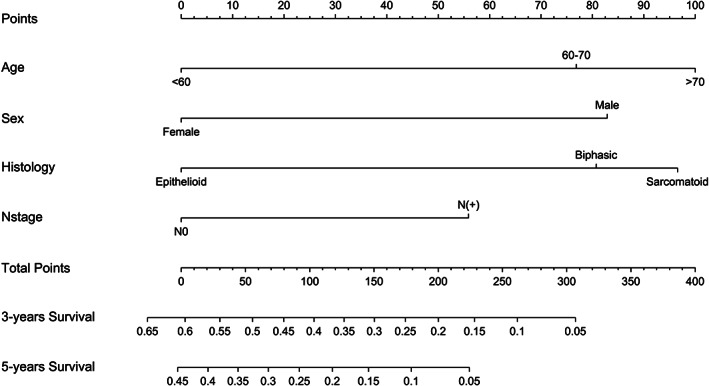
Materials and methods: Detailed characteristics of MPM patients during 2004-2015 were retrieved from SEER registries. Propensity score matching (PSM) was conducted to reduce disparities of baseline characteristics (age, sex, histologic type, stage, and type of surgery) between the PORT group and no-PORT group. A novel nomogram was constructed based on independent prognosticators identified by multivariate Cox regression model. The discriminatory performance and degree of calibration were evaluated. We stratified patients into different risk groups according to nomogram total scores and estimated the survival benefit of PORT in different subgroups in order to identify the optimal candidates.
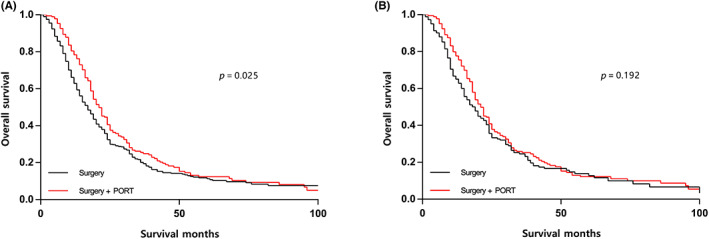
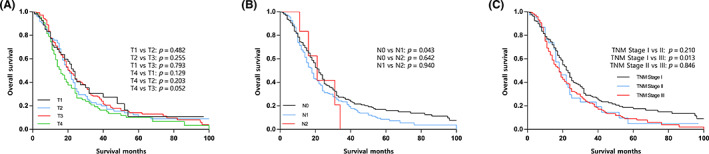
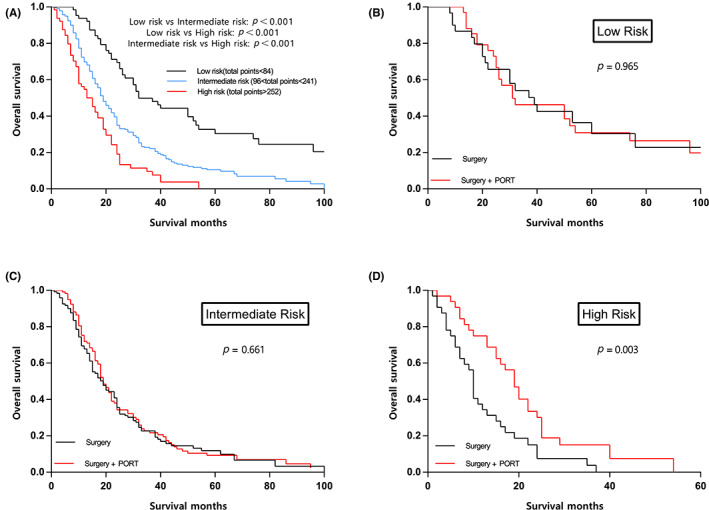
Results: We identified 596 MPM patients, among which 190 patients (31.9%) received PORT. PORT conferred significant survival benefit in the unmatched population, while there was no significant survival difference favoring PORT in the matched population. The C-index of the new TNM staging scheme was closed to 0.5, which represented a poor discriminatory ability. A novel nomogram was constructed based on clinicopathological factors, including age, sex, histology, and N stage. We stratified patients into three risk groups. Subgroup analyses indicated that PORT was beneficial for high-risk group (p = 0.003) rather than low-risk group (p = 0.965) and intermediate-risk group (p = 0.661).
Conclusion: We established a novel predictive model, which could make individualized prediction of survival benefit of PORT for MPM and could compensate for weakness in TNM staging system.
Keywords: SEER; nomogram; prognostic factor; radiotherapy.
© 2023 The Authors. Cancer Medicine published by John Wiley & Sons Ltd.
Conflict of interest statement
None.
Figures
References
-
- Andujar P, Lacourt A, Brochard P, Pairon JC, Jaurand MC, Jean D. Five years update on relationships between malignant pleural mesothelioma and exposure to asbestos and other elongated mineral particles. J Toxicol Environ Health B Crit Rev. 2016;19(5–6):151‐172. - PubMed
-
- Nowak AK, Chansky K, Rice DC, et al. The IASLC mesothelioma staging project: proposals for revisions of the T descriptors in the forthcoming eighth edition of the TNM classification for pleural mesothelioma. J Thorac Oncol. 2016;11(12):2089‐2099. - PubMed
Publication types
MeSH terms
LinkOut - more resources
Full Text Sources
Medical
Miscellaneous
