


Expansin-mediated developmental and adaptive responses: A matter of cell wall biomechanics?
- PMID: 37077967
- PMCID: PMC10095946
- DOI: 10.1017/qpb.2022.6
Expansin-mediated developmental and adaptive responses: A matter of cell wall biomechanics?
Abstract
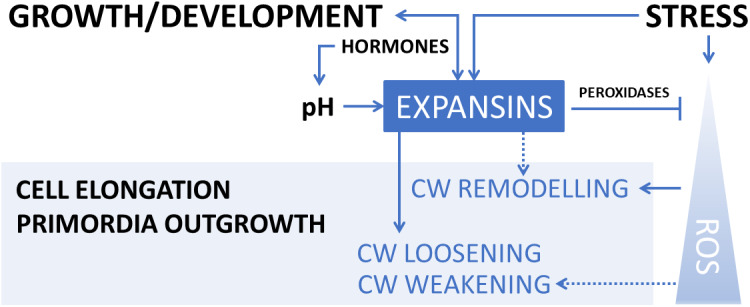
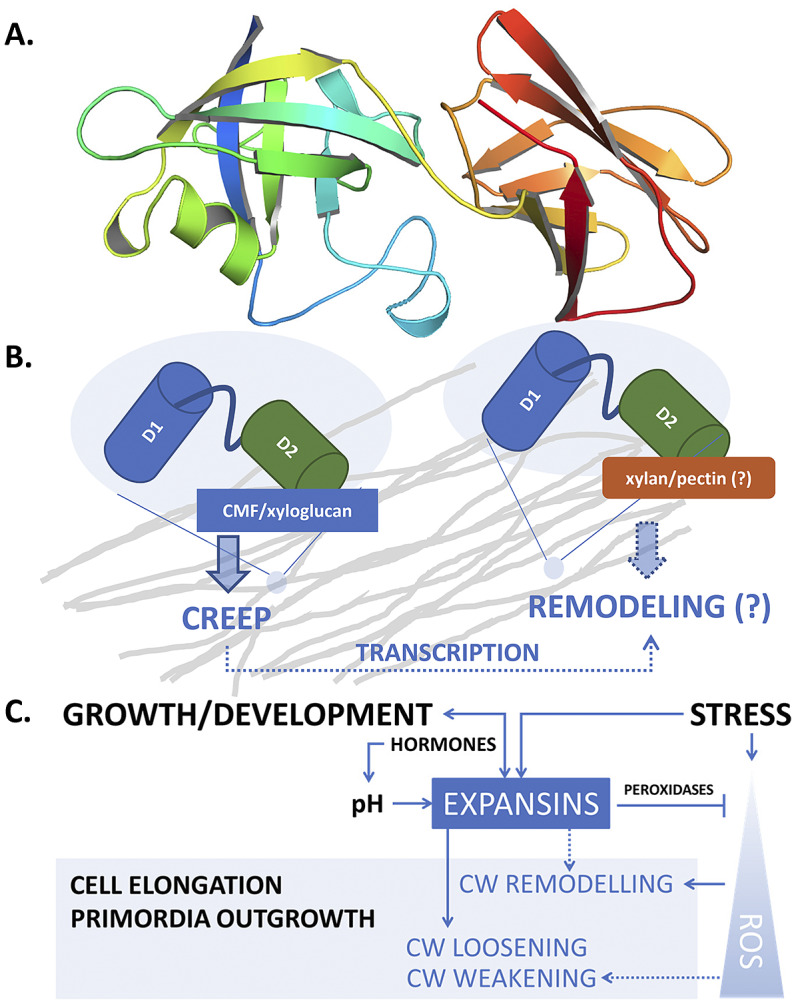
Biomechanical properties of the cell wall (CW) are important for many developmental and adaptive responses in plants. Expansins were shown to mediate pH-dependent CW enlargement via a process called CW loosening. Here, we provide a brief overview of expansin occurrence in plant and non-plant species, their structure and mode of action including the role of hormone-regulated CW acidification in the control of expansin activity. We depict the historical as well as recent CW models, discuss the role of expansins in the CW biomechanics and address the developmental importance of expansin-regulated CW loosening in cell elongation and new primordia formation. We summarise the data published so far on the role of expansins in the abiotic stress response as well as the rather scarce evidence and hypotheses on the possible mechanisms underlying expansin-mediated abiotic stress resistance. Finally, we wrap it up by highlighting possible future directions in expansin research.
Keywords: biomechanics; cell wall loosening; cell wall remodelling; development; expansin; plant.
© The Author(s) 2022.
Conflict of interest statement
The authors declare no conflict of interest.
Figures
References
-
- Armezzani, A. , Abad, U. , Ali, O. , Andres Robin, A. , Vachez, L. , Larrieu, A. , Mellerowicz, E. J. , Taconnat, L. , Battu, V. , Stanislas, T. , Liu, M. , Vernoux, T. , Traas, J. , & Sassi, M. (2018). Transcriptional induction of cell wall remodelling genes is coupled to microtubule-driven growth isotropy at the shoot apex in Arabidopsis . Development, 145, dev162255. - PubMed
-
- Arsuffi, G. , & Braybrook, S. A. (2018). Acid growth: An ongoing trip. Journal of Experimental Botany, 2, 137–146. - PubMed
-
- Bootten, T. J. , Harris, P. J. , Melton, L. D. , & Newman, R. H. (2004). Solid-state 13C-NMR spectroscopy shows that the xyloglucans in the primary cell walls of mung bean (Vigna radiata L.) occur in different domains: A new model for xyloglucan–cellulose interactions in the cell wall. Journal of Experimental Botany, 55, 571–583. - PubMed
-
- Boraston, A. B. , Creagh, A. L. , Alam, M. M. , Kormos, J. M. , Tomme, P. , Haynes, C. A. , Warren, R. A. , & Kilburn, D. G. (2001). Binding specificity and thermodynamics of a family 9 carbohydrate-binding module from Thermotoga maritima xylanase 10A. Biochemistry, 40, 6240–6247. - PubMed
Publication types
LinkOut - more resources
Full Text Sources