


Breastfeeding Among People With Human Immunodeficiency Virus in North America: A Multisite Study
- PMID: 37078712
- PMCID: PMC10654886
- DOI: 10.1093/cid/ciad235
Breastfeeding Among People With Human Immunodeficiency Virus in North America: A Multisite Study
Abstract
Background: In North American countries, national guidelines have strongly recommended formula over breastmilk for people with human immunodeficiency virus (HIV) because of concern for HIV transmission. However, data from resource-limited settings suggest the risk is <1% among virally suppressed people. Information regarding breastfeeding experience in high-resource settings is lacking.
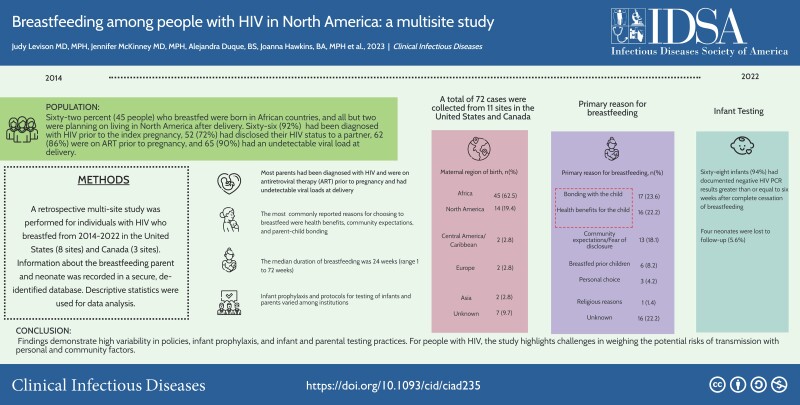
Methods: A retrospective multisite study was performed for individuals with HIV who breastfed during 2014-2022 in the United States (8 sites) and Canada (3 sites). Descriptive statistics were used for data analysis.
Results: Among the 72 cases reported, most had been diagnosed with HIV and were on antiretroviral therapy prior to the index pregnancy and had undetectable viral loads at delivery. Most commonly reported reasons for choosing to breastfeed were health benefits, community expectations, and parent-child bonding. Median duration of breastfeeding was 24 weeks (range, 1 day to 72 weeks). Regimens for infant prophylaxis and protocols for testing of infants and birthing parents varied widely among institutions. No neonatal transmissions occurred among the 94% of infants for whom results were available ≥6 weeks after weaning.
Conclusions: This study describes the largest cohort to date of people with HIV who breastfed in North America. Findings demonstrate high variability among institutions in policies, infant prophylaxis, and infant and parental testing practices. The study describes challenges in weighing the potential risks of transmission with personal and community factors. Finally, this study highlights the relatively small numbers of patients with HIV who chose to breastfeed at any 1 location, and the need for further multisite studies to identify best care practices.
Keywords: HIV; breastfeeding; institutional practices; prenatal care.
© The Author(s) 2023. Published by Oxford University Press on behalf of Infectious Diseases Society of America. All rights reserved. For permissions, please e-mail: journals.permissions@oup.com.
Conflict of interest statement
Potential conflicts of interest. A. W. reports research funding from NIH and GlaxoSmithKline; consulting fees for advisory board roles with GlaxoSmithKline, Seqirus, and Merck; and payment or honoraria from GlaxoSmithKline (for a podcast) and Merck (meeting presentation). I. B. reports grants or contracts with the Canadian Institutes for Health Research, NIH, Altona, Moderna, and Ferring; consulting fees from Pfizer; and a role with the Society of Obstetricians and Gynecologists of Canada. J. D. reports travel support from the American College of Obstetricians and Gynecologists for the national conference. A. P. reports support from NIAID (grant number K23AI155296) and royalties from UpToDate. K. K. reports meeting honoraria from Takeda Canada. L. A. reports grants or contracts from NIH and the Colorado Department of Public Health and Environment. L. R. reports consulting fees from the University of California, San Francisco Clinicians Consultation Center National Perinatal HIV Hotline. F. K. reports salary support from FRQS and research infrastructure support from the Quebec government (Ministère de la Santé et des Services Sociaux/Service de lutte contre infections transmissibles sexuellement et par le sang). All other authors report no potential conflicts. All authors have submitted the ICMJE Form for Disclosure of Potential Conflicts of Interest. Conflicts that the editors consider relevant to the content of the manuscript have been disclosed.
Figures
Similar articles
-
Treatment acceleration program and the experience of the DREAM program in prevention of mother-to-child transmission of HIV.AIDS. 2007 Jul;21 Suppl 4:S65-71. doi: 10.1097/01.aids.0000279708.09180.f5. AIDS. 2007. PMID: 17620755
-
Complementary feeding adequacy in relation to nutritional status among early weaned breastfed children who are born to HIV-infected mothers: ANRS 1201/1202 Ditrame Plus, Abidjan, Cote d'Ivoire.Pediatrics. 2006 Apr;117(4):e701-10. doi: 10.1542/peds.2005-1911. Pediatrics. 2006. PMID: 16585284 Free PMC article.
-
Triple antiretroviral compared with zidovudine and single-dose nevirapine prophylaxis during pregnancy and breastfeeding for prevention of mother-to-child transmission of HIV-1 (Kesho Bora study): a randomised controlled trial.Lancet Infect Dis. 2011 Mar;11(3):171-80. doi: 10.1016/S1473-3099(10)70288-7. Epub 2011 Jan 13. Lancet Infect Dis. 2011. PMID: 21237718 Clinical Trial.
-
[Breastfeeding in Africa: will positive trends be challenged by the AIDS epidemic?].Sante. 2002 Jan-Mar;12(1):64-72. Sante. 2002. PMID: 11943640 Review. French.
-
HIV transmission through breastfeeding: problems and prevention.Ann Trop Paediatr. 2003 Jun;23(2):91-106. doi: 10.1179/027249303235002161. Ann Trop Paediatr. 2003. PMID: 12803739 Review.
Cited by
-
A Study on AIDS Self-Management Status and Its Influencing Factors.J Multidiscip Healthc. 2024 Sep 7;17:4373-4382. doi: 10.2147/JMDH.S466797. eCollection 2024. J Multidiscip Healthc. 2024. PMID: 39262823 Free PMC article.
-
How women living with HIV in the UK manage infant-feeding decisions and vertical transmission risk - a qualitative study.BMC Public Health. 2024 Aug 6;24(1):2130. doi: 10.1186/s12889-024-19581-9. BMC Public Health. 2024. PMID: 39107773 Free PMC article.
-
Overcoming Challenges during Breastfeeding to Prevent Perinatal HIV Transmission in Canada: A Case Series.Can J Hosp Pharm. 2024 Nov 13;77(4):e3572. doi: 10.4212/cjhp.3572. eCollection 2024. Can J Hosp Pharm. 2024. PMID: 39539609 Free PMC article. No abstract available.
-
Hearing the Silence and Silenced: Co-Producing Research on Infant-Feeding Experiences and Practices With Black Women With HIV.Sociol Health Illn. 2025 Jan;47(1):e13871. doi: 10.1111/1467-9566.13871. Sociol Health Illn. 2025. PMID: 39743738 Free PMC article.
-
2023 updated guidelines on infant feeding and HIV in the United States: what are they and why have recommendations changed.Top Antivir Med. 2023 Dec 5;31(5):576-586. Top Antivir Med. 2023. PMID: 38198669 Free PMC article.
References
-
- Nduati R, John G, Mbori-Ngacha D, et al. . Effect of breastfeeding and formula feeding on transmission of HIV-1: a randomized clinical trial. JAMA 2000; 283:1167–74. - PubMed
-
- Flynn PM, Taha TE, Cababasay M, et al. . Prevention of HIV-1 transmission through breastfeeding: efficacy and safety of maternal antiretroviral therapy versus infant nevirapine prophylaxis for duration of breastfeeding in HIV-1-infected women with high CD4 cell count (IMPAACT PROMISE): a randomized, open-label, clinical trial. J Acquir Immune Defic Syndr 2018; 77:383–92. - PMC - PubMed
