


Sequential repeated tibial tubercle osteotomy in a two-stage exchange strategy: a superior approach to treating a chronically infected knee arthroplasty?
- PMID: 37079110
- PMCID: PMC10651709
- DOI: 10.1007/s00590-023-03548-4
Sequential repeated tibial tubercle osteotomy in a two-stage exchange strategy: a superior approach to treating a chronically infected knee arthroplasty?
Abstract
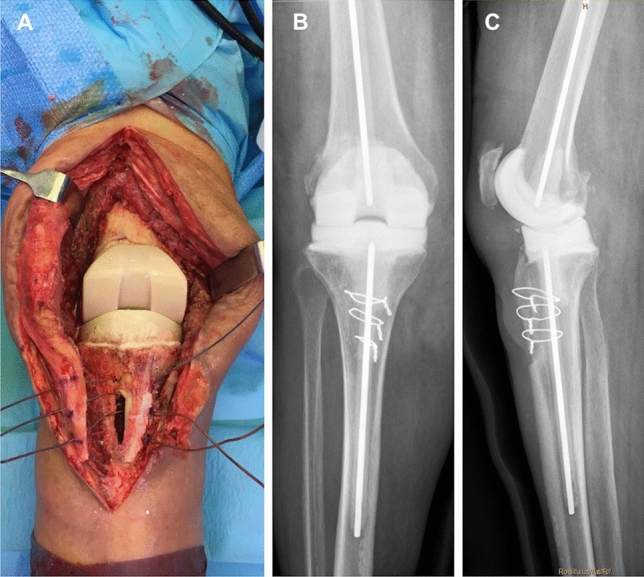
Purpose: Surgical approach can impact the reliability of the debridement after a chronic total knee periprosthetic joint infection (PJI), a factor of utmost importance to eradicate the infection. The most adequate knee surgical approach in cases of PJI is a matter of debate. The purpose of this study was to determine the influence of performing a tibial tubercle osteotomy (TTO) in a two-stage exchange protocol for knee PJI treatment.
Methods: Retrospective cohort study examining patients managed with two-stage arthroplasty due to chronic knee PJI (2010-2019). Performance and timing of the TTO were collected. Primary end-point was infection control with a minimum FU of 12 months and according to internationally accepted criteria. Correlation between TTO timing and reinfection rate was reviewed.
Results: Fifty-two cases were finally included. Overall success (average follow-up: 46.2 months) was 90.4%. Treatment success was significantly higher among cases addressed using TTO during the second stage (97.1% vs. 76.5%, p value 0.03). Only 4.8% of the patients relapsed after performing a sequential repeated TTO, that is, during both first and second stages, compared to 23.1% cases in which TTO was not done (p value 0.28). No complications were observed among patients in the TTO group with a significant decrease in soft tissue necrosis (p: 0.052).
Conclusion: Sequential repeated tibial tubercle osteotomy during a two-stage strategy is a reasonable option and offers high rates of infection control in complex cases of knee PJI with a low rate of complications.
Keywords: Infection control; Periprosthetic joint infection; Tibial tubercle osteotomy; Two-stage revision arthroplasty.
© 2023. The Author(s).
Conflict of interest statement
All Authors: None of the authors received payments or services, either directly or indirectly (i.e., via his or her institution), from a third party in support of any aspect of this work. One of the authors (Pablo S. Corona) has done paid speaking engagements at scientific conferences during the thirty-six months prior to submission of this work, to an entity in the biomedical arena (Tecres SpA, Sommacampagna–VR, Italy and Waldemar Link GmbH & Co.; Germany) whose products have been mentioned in the article. The author does not have any other conflict of interest with said companies. No author has had any other relationships, or has engaged in any other activities that could be perceived to influence or have the potential to influence what is written in this work.
Figures


References
-
- Insall JN. Infection in total knee arthroplasty. Instr Course Lect. 1982;31:42–48. - PubMed
-
- Corró S, Vicente M, Rodríguez-Pardo D, Pigrau C, Lung M, Corona PS. Vancomycin-Gentamicin prefabricated spacers in 2-stage revision arthroplasty for chronic hip and knee periprosthetic joint infection: insights into reimplantation microbiology and outcomes. J Arthroplasty. 2020;35(1):247–254. doi: 10.1016/j.arth.2019.07.043. - DOI - PubMed
MeSH terms
LinkOut - more resources
Full Text Sources
Medical
