


Whole exome sequencing analysis of canine urothelial carcinomas without BRAF V595E mutation: Short in-frame deletions in BRAF and MAP2K1 suggest alternative mechanisms for MAPK pathway disruption
- PMID: 37079639
- PMCID: PMC10153751
- DOI: 10.1371/journal.pgen.1010575
Whole exome sequencing analysis of canine urothelial carcinomas without BRAF V595E mutation: Short in-frame deletions in BRAF and MAP2K1 suggest alternative mechanisms for MAPK pathway disruption
Abstract
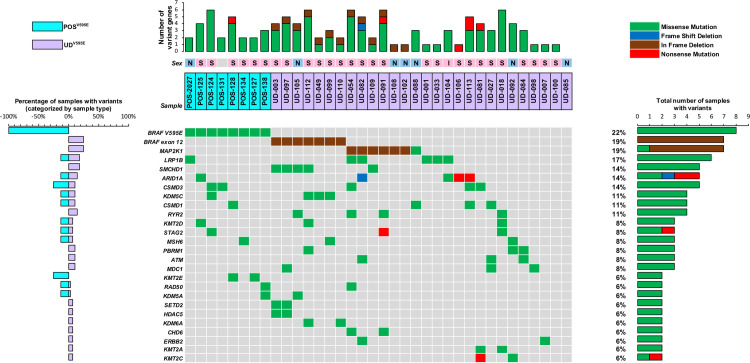
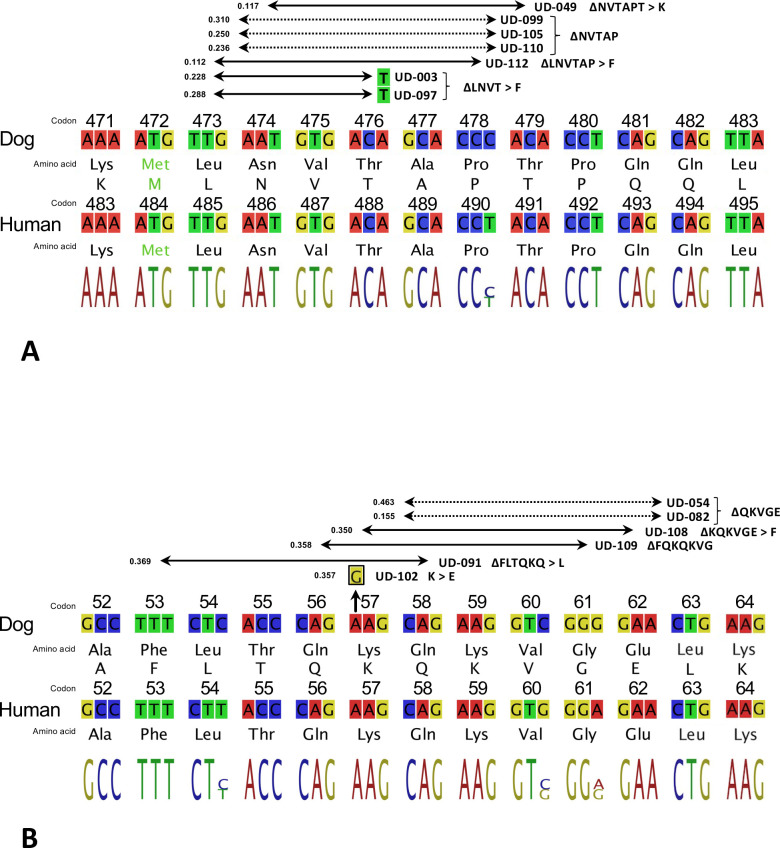
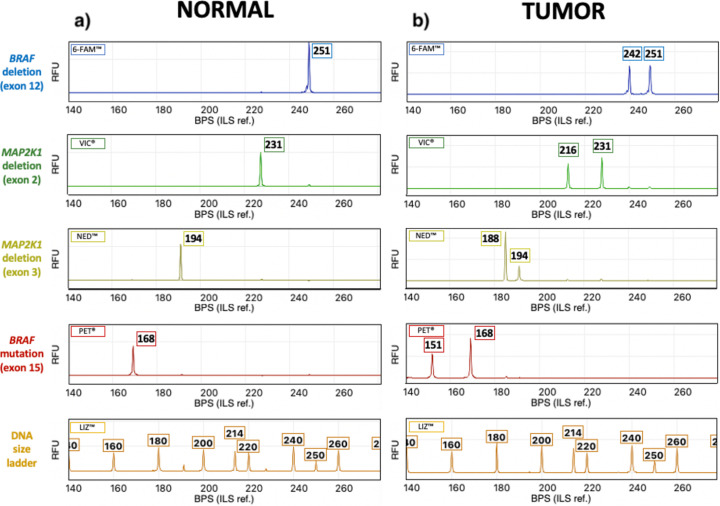
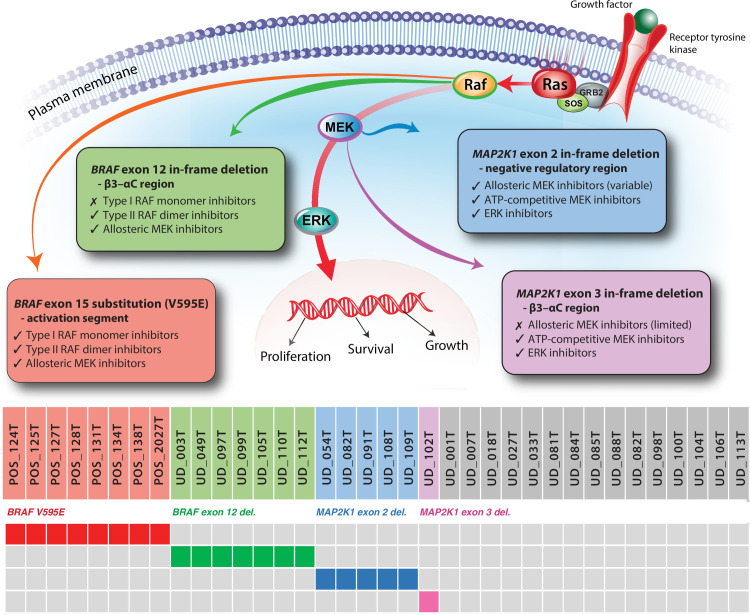
Molecular profiling studies have shown that 85% of canine urothelial carcinomas (UC) harbor an activating BRAF V595E mutation, which is orthologous to the V600E variant found in several human cancer subtypes. In dogs, this mutation provides both a powerful diagnostic marker and a potential therapeutic target; however, due to their relative infrequency, the remaining 15% of cases remain understudied at the molecular level. We performed whole exome sequencing analysis of 28 canine urine sediments exhibiting the characteristic DNA copy number signatures of canine UC, in which the BRAF V595E mutation was undetected (UDV595E specimens). Among these we identified 13 specimens (46%) harboring short in-frame deletions within either BRAF exon 12 (7/28 cases) or MAP2K1 exons 2 or 3 (6/28 cases). Orthologous variants occur in several human cancer subtypes and confer structural changes to the protein product that are predictive of response to different classes of small molecule MAPK pathway inhibitors. DNA damage response and repair genes, and chromatin modifiers were also recurrently mutated in UDV595E specimens, as were genes that are positive predictors of immunotherapy response in human cancers. Our findings suggest that short in-frame deletions within BRAF exon 12 and MAP2K1 exons 2 and 3 in UDV595E cases are alternative MAPK-pathway activating events that may have significant therapeutic implications for selecting first-line treatment for canine UC. We developed a simple, cost-effective capillary electrophoresis genotyping assay for detection of these deletions in parallel with the BRAF V595E mutation. The identification of these deletion events in dogs offers a compelling cross-species platform in which to study the relationship between somatic alteration, protein conformation, and therapeutic sensitivity.
Copyright: © 2023 Thomas et al. This is an open access article distributed under the terms of the Creative Commons Attribution License, which permits unrestricted use, distribution, and reproduction in any medium, provided the original author and source are credited.
Conflict of interest statement
The authors have declared that no competing interests exist.
Figures
References
-
- Knapp DW, Dhawan D, Ramos-Vara JA, Ratliff TL, Cresswell GM, Utturkar S, et al.. Naturally-Occurring Invasive Urothelial Carcinoma in Dogs, a Unique Model to Drive Advances in Managing Muscle Invasive Bladder Cancer in Humans. Front Oncol. 2019;9:1493. Epub 2020/02/11. doi: 10.3389/fonc.2019.01493 ; PubMed Central PMCID: PMC6985458. - DOI - PMC - PubMed
-
- Decker B, Parker HG, Dhawan D, Kwon EM, Karlins E, Davis BW, et al.. Homologous Mutation to Human BRAF V600E Is Common in Naturally Occurring Canine Bladder Cancer—Evidence for a Relevant Model System and Urine-Based Diagnostic Test. Mol Cancer Res. 2015;13(6):993–1002. Epub 2015/03/15. doi: 10.1158/1541-7786.MCR-14-0689 ; PubMed Central PMCID: PMC4470794. - DOI - PMC - PubMed
Publication types
MeSH terms
Substances
LinkOut - more resources
Full Text Sources
Medical
Research Materials
Miscellaneous
