


Dissociation of Cognitive Effort-Based Decision Making and Its Associations With Symptoms, Cognition, and Everyday Life Function Across Schizophrenia, Bipolar Disorder, and Depression
- PMID: 37080416
- PMCID: PMC10755814
- DOI: 10.1016/j.biopsych.2023.04.007
Dissociation of Cognitive Effort-Based Decision Making and Its Associations With Symptoms, Cognition, and Everyday Life Function Across Schizophrenia, Bipolar Disorder, and Depression
Abstract
Background: Anhedonia and amotivation are symptoms of many different mental health disorders that are frequently associated with functional disability, but it is not clear whether the same processes contribute to motivational impairments across disorders. This study focused on one possible factor, the willingness to exert cognitive effort, referred to as cognitive effort-cost decision making.
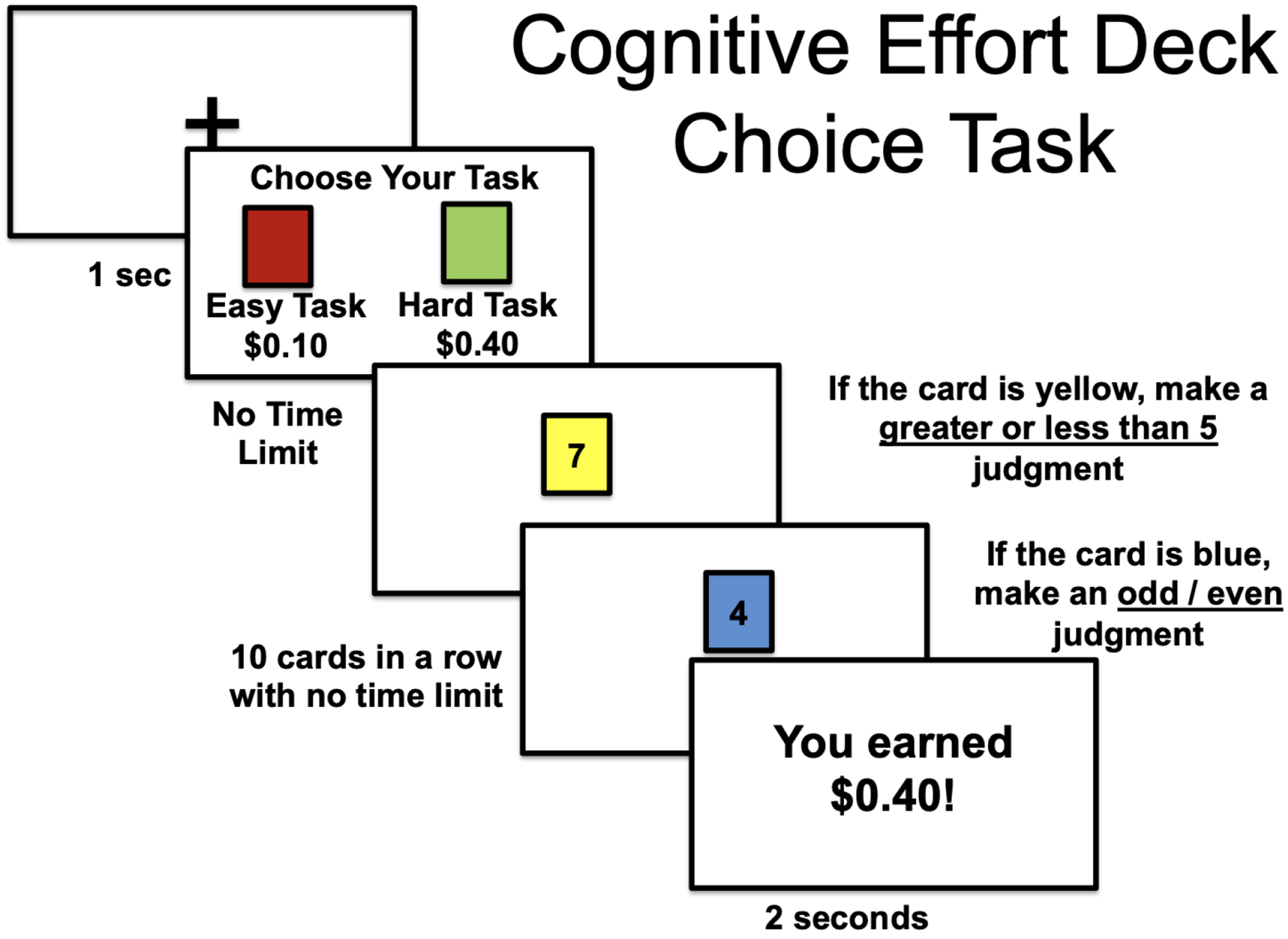
Methods: We examined performance on the deck choice task as a measure of cognitive effort-cost decision making, in which people choose to complete an easy task for a small monetary reward or a harder task for larger rewards, in 5 groups: healthy control (n = 80), schizophrenia/schizoaffective disorder (n = 50), bipolar disorder with psychosis (n = 58), current major depression (n = 60), and past major depression (n = 51). We examined cognitive effort-cost decision making in relation to clinician and self-reported motivation symptoms, working memory and cognitive control performance, and life function measured by ecological momentary assessment and passive sensing.
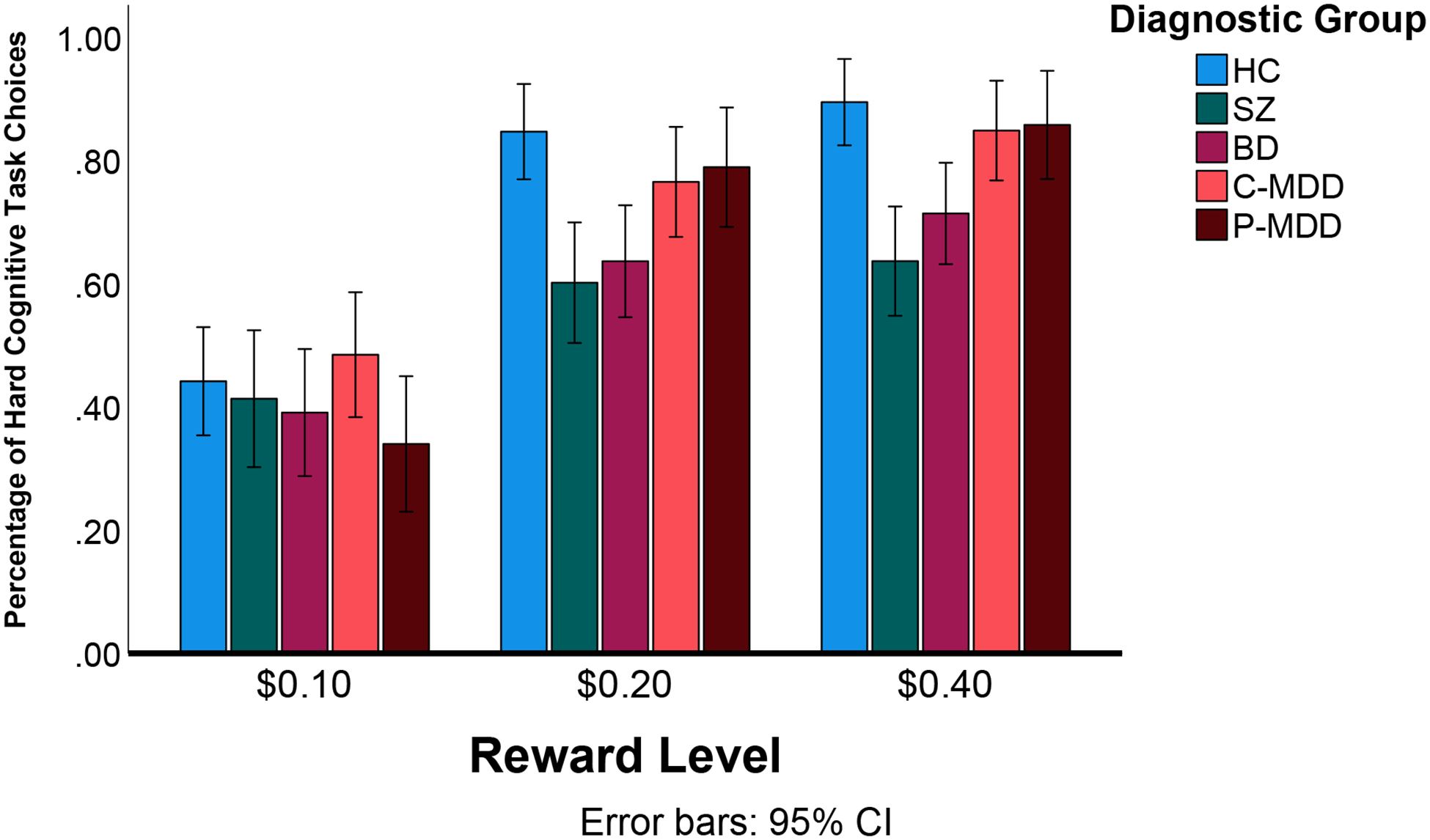
Results: We found a significant diagnostic group × reward interaction (F8,588 = 4.37, p < .001, ηp2 = 0.056). Compared with the healthy control group, the schizophrenia/schizoaffective and bipolar disorder groups, but not the current or past major depressive disorder groups, showed a reduced willingness to exert effort at the higher reward values. In the schizophrenia/schizoaffective and bipolar disorder groups, but not the major depressive disorder groups, reduced willingness to exert cognitive effort for higher rewards was associated with greater clinician-rated motivation impairments, worse working memory and cognitive control performance, and less engagement in goal-directed activities measured by ecological momentary assessment.
Conclusions: These findings suggest that the mechanisms contributing to motivational impairments differ among individuals with psychosis spectrum disorders versus depression.
Keywords: Anhedonia; Depression; Ecological momentary assessment; Effort; Function; Motivation; Psychosis.
Copyright © 2023 Society of Biological Psychiatry. Published by Elsevier Inc. All rights reserved.
Conflict of interest statement
DMB, EKM and SN, DBN, and AC’s work on this project was supported by NIMH R01MH066031. AJC’s work on this project was support by NIMH K23126986.
Aside from funding for this project, DMB receives funding from NIDA and the American Foundation for Suicide Prevention, and consults for Cerevance. Dr. Ben-Zeev has financial interests in Merlin LLC, FOCUS technology, and CORE technology. He has an intervention content licensing agreement with Pear Therapeutics and has provided consultation services to Trusst Health, K Health, Boehringer Ingelheim, eQuility, Deep Valley Labs, and Otsuka Pharmaceuticals. All other authors report no biomedical financial interests or potential conflicts of interest.
Figures
References
-
- Craske MG, Meuret AE, Ritz T, Treanor M, Dour HJ (2016): Treatment for Anhedonia: A Neuroscience Driven Approach. Depress Anxiety. 33:927–938. - PubMed
Publication types
MeSH terms
Grants and funding
LinkOut - more resources
Full Text Sources
Medical
Miscellaneous
