


Measurement properties of 72 movement biomarkers aiming to discriminate non‑specific chronic low back pain patients from an asymptomatic population
- PMID: 37081110
- PMCID: PMC10119171
- DOI: 10.1038/s41598-023-33504-5
Measurement properties of 72 movement biomarkers aiming to discriminate non‑specific chronic low back pain patients from an asymptomatic population
Abstract
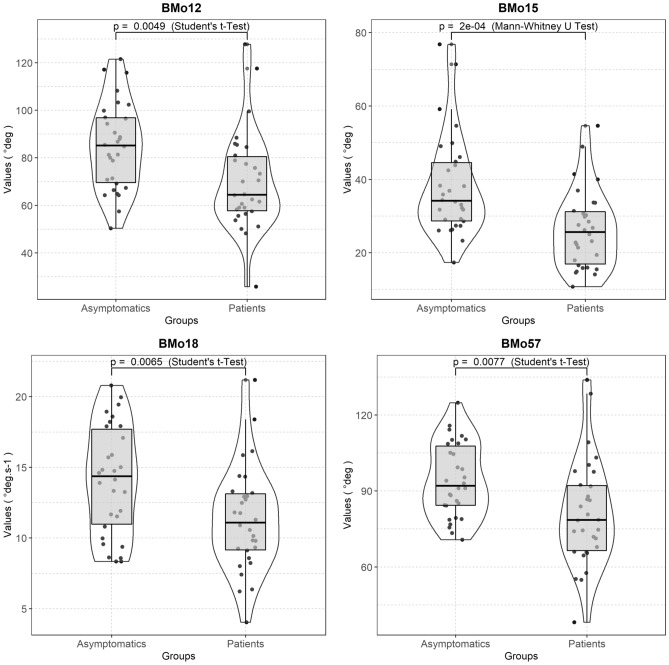
The identification of relevant and valid biomarkers to distinguish patients with non-specific chronic low back pain (NSCLBP) from an asymptomatic population in terms of musculoskeletal factors could contribute to patient follow-up and to evaluate therapeutic strategies. Several parameters related to movement impairments have been proposed in the literature in that respect. However, most of them were assessed in only one study, and only 8% were evaluated in terms of reliability, validity and interpretability. The aim of this study was to consolidate the current knowledge about movement biomarkers to discriminate NSCLBP patients from an asymptomatic population. For that, an experimental protocol was established to assess the reliability, validity and interpretability of a set of 72 movement biomarkers on 30 asymptomatic participants and 30 NSCLBP patients. Correlations between the biomarkers and common patient reported outcome measures were also analysed. Four biomarkers reached at least a good level in reliability (ICC ≥ 0.75) and validity (significant difference between asymptomatic participants and NSCLBP patients, p ≤ 0.01) domains and could thus be possibly considered as valuable biomarkers: maximal lumbar sagittal angle, lumbar sagittal angle range of motion, mean lumbar sagittal angular velocity, and maximal upper lumbar sagittal angle during trunk sagittal bending. These four biomarkers demonstrated typically larger values in asymptomatic participants than in NSCLBP patients. They are in general weakly correlated with patient reported outcome measures, arguing for a potential interest in including related musculoskeletal factors in the establishment of a valuable diagnosis and in guiding treatment response.
© 2023. The Author(s).
Conflict of interest statement
The authors declare no competing interests.
Figures
Similar articles
-
A systematic review of movement and muscular activity biomarkers to discriminate non-specific chronic low back pain patients from an asymptomatic population.Sci Rep. 2021 Mar 12;11(1):5850. doi: 10.1038/s41598-021-84034-x. Sci Rep. 2021. PMID: 33712658 Free PMC article.
-
Flexion-Relaxation Ratio Asymmetry and Its Relation With Trunk Lateral ROM in Individuals With and Without Chronic Nonspecific Low Back Pain.Spine (Phila Pa 1976). 2020 Jan 1;45(1):E1-E9. doi: 10.1097/BRS.0000000000003196. Spine (Phila Pa 1976). 2020. PMID: 31415455
-
Lumbar Axial Rotation Kinematics in an Upright Sitting and With Forward Bending Positions in Men With Nonspecific Chronic Low Back Pain.Spine (Phila Pa 1976). 2020 Mar 1;45(5):E244-E251. doi: 10.1097/BRS.0000000000003265. Spine (Phila Pa 1976). 2020. PMID: 32032339
-
Between/within-session reliability of spinal kinematic and lumbar muscle activity measures in patients with chronic low back pain and asymptomatic individuals.Gait Posture. 2022 Jun;95:100-108. doi: 10.1016/j.gaitpost.2022.04.008. Epub 2022 Apr 14. Gait Posture. 2022. PMID: 35468488
-
Lumbar movement control in non-specific chronic low back pain: Evaluation of a direction-specific battery of tests using item response theory.Musculoskelet Sci Pract. 2021 Oct;55:102406. doi: 10.1016/j.msksp.2021.102406. Epub 2021 Jun 4. Musculoskelet Sci Pract. 2021. PMID: 34139514 Review.
Cited by
-
Exploring the Real-Time Variability and Complexity of Sitting Patterns in Office Workers with Non-Specific Chronic Spinal Pain and Pain-Free Individuals.Sensors (Basel). 2024 Jul 22;24(14):4750. doi: 10.3390/s24144750. Sensors (Basel). 2024. PMID: 39066146 Free PMC article.
-
Musculoskeletal biomarkers in health and disease: implications for the aging spine-a review for spinal surgeons by the SRS adult spinal deformity task force on senescence.Spine Deform. 2025 Jun 4. doi: 10.1007/s43390-025-01124-w. Online ahead of print. Spine Deform. 2025. PMID: 40465097 Review.
References
-
- Dubois J-D, Abboud J, St-Pierre C, Piché M, Descarreaux M. Neuromuscular adaptations predict functional disability independently of clinical pain and psychological factors in patients with chronic non-specific low back pain. J. Electromyogr. Kinesiol. 2014;24:550–557. doi: 10.1016/j.jelekin.2014.04.012. - DOI - PubMed
Publication types
MeSH terms
LinkOut - more resources
Full Text Sources
Medical
