. 2023 Apr 20;15(1):84.
doi: 10.1186/s13195-023-01225-6.

Higher performance for women than men in MRI-based Alzheimer's disease detection

Affiliations

Higher performance for women than men in MRI-based Alzheimer's disease detection

Malte Klingenberg et al. Alzheimers Res Ther. .

Abstract

Introduction: Although machine learning classifiers have been frequently used to detect Alzheimer's disease (AD) based on structural brain MRI data, potential bias with respect to sex and age has not yet been addressed. Here, we examine a state-of-the-art AD classifier for potential sex and age bias even in the case of balanced training data.

Methods: Based on an age- and sex-balanced cohort of 432 subjects (306 healthy controls, 126 subjects with AD) extracted from the ADNI data base, we trained a convolutional neural network to detect AD in MRI brain scans and performed ten different random training-validation-test splits to increase robustness of the results. Classifier decisions for single subjects were explained using layer-wise relevance propagation.

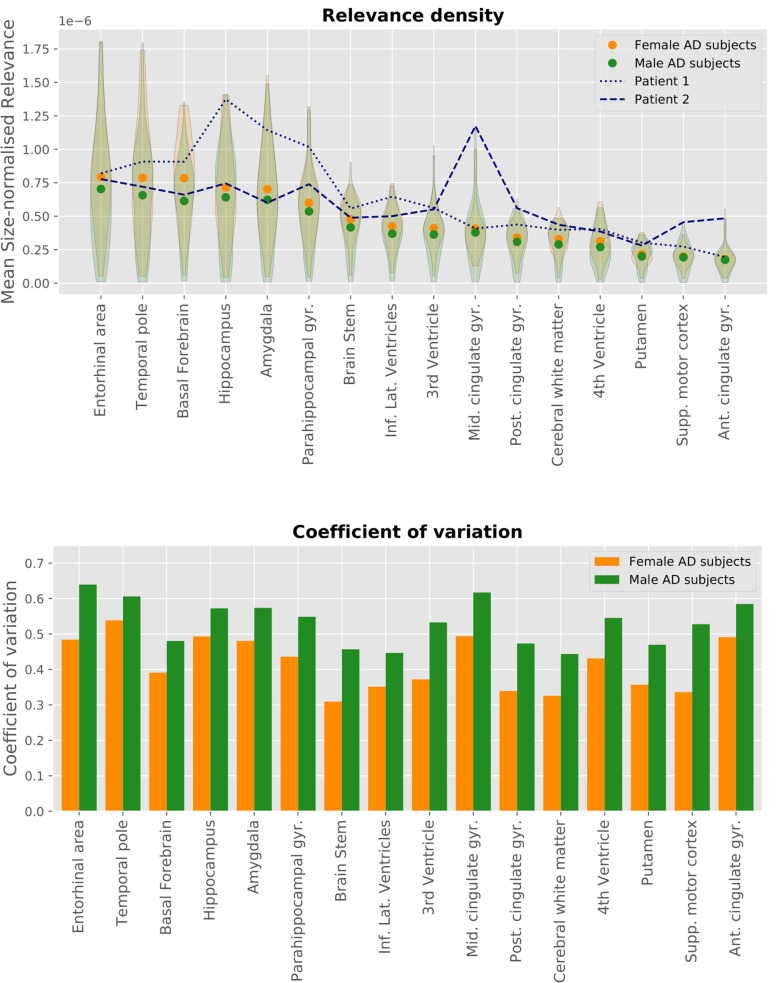
Results: The classifier performed significantly better for women (balanced accuracy [Formula: see text]) than for men ([Formula: see text]). No significant differences were found in clinical AD scores, ruling out a disparity in disease severity as a cause for the performance difference. Analysis of the explanations revealed a larger variance in regional brain areas for male subjects compared to female subjects.

Discussion: The identified sex differences cannot be attributed to an imbalanced training dataset and therefore point to the importance of examining and reporting classifier performance across population subgroups to increase transparency and algorithmic fairness. Collecting more data especially among underrepresented subgroups and balancing the dataset are important but do not always guarantee a fair outcome.

Trial registration: ClinicalTrials.gov NCT00106899.

Keywords: Alzheimer’s disease; Bias; Deep learning; MRI; Sex.


Conflict of interest statement

The authors declare that they have no competing interests.

Figures
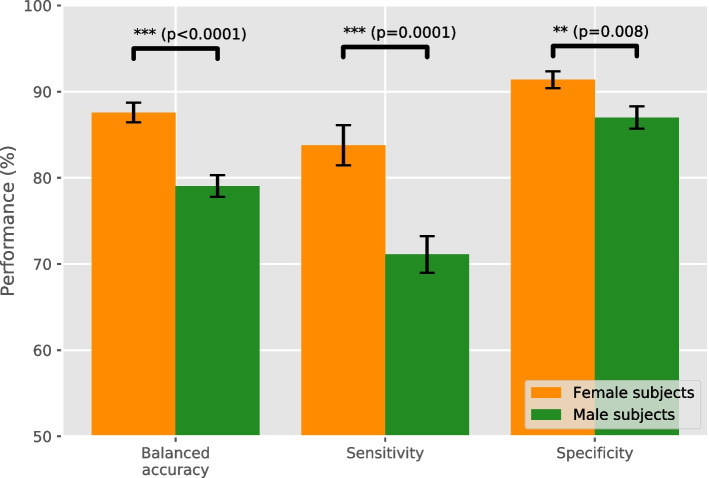
Fig. 1
Fig. 1
Classifier performance. The balanced accuracy, sensitivity, and specificity of the classifier for women and men averaged over all runs for all splits. The error bars show the standard error of the mean
Fig. 2
Fig. 2
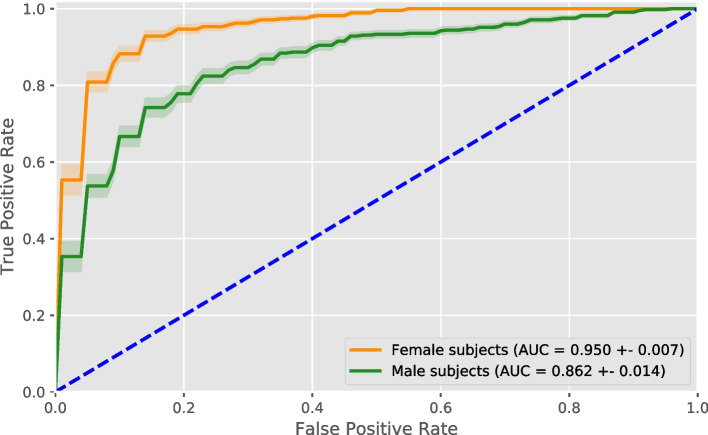
Receiver operating characteristic curve. The average ROC curve of the classifier when separately evaluated on women and men. The ROC curve was averaged over all runs for all splits, with the shaded area showing the standard error of the mean. The area under curve (AUC) is given in the legend
Fig. 3
Fig. 3
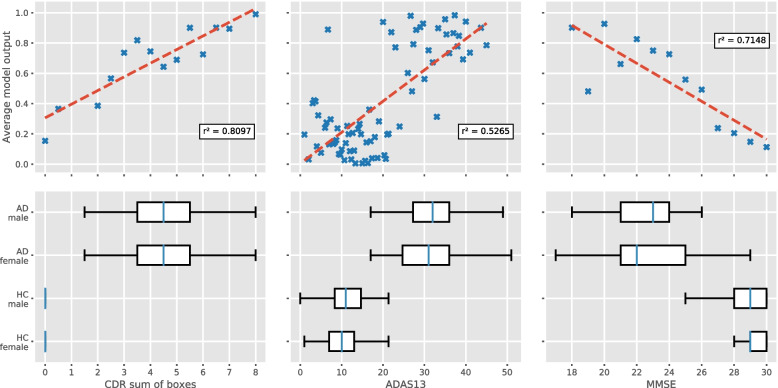
Clinical measures. Shown in the top row of plots is the relationship between the average model output and each of the three clinical measures (CDR sum of boxes, ADAS-Cog-13 and MMSE). While calculating the average output, only subjects appearing in at least two splits were taken into account. Overlaid in red is a linear regression, with the correlation coefficient also given. The plots on the bottom row show the distribution of the three clinical measures in the dataset. Note that, because this includes all subjects, the boxplot whiskers can extend past the values visible in the top plots
Fig. 4
Fig. 4
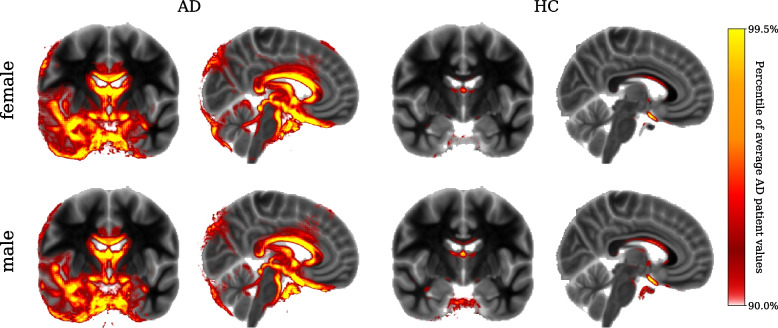
Average relevance heatmaps. The average relevance heatmaps across all subjects and all classifiers are shown separately for women (top row) and men (bottom row), as well as Alzheimer’s patients (left column) and healthy subjects (right column). The colour bar was chosen according to the relevance values of the average AD subject, with only the top 10% of values being shown to highlight the most relevant areas. For reference, the heatmaps are shown over the MNI-ICBM152 reference brain we used for registering the input images
Fig. 5
Fig. 5
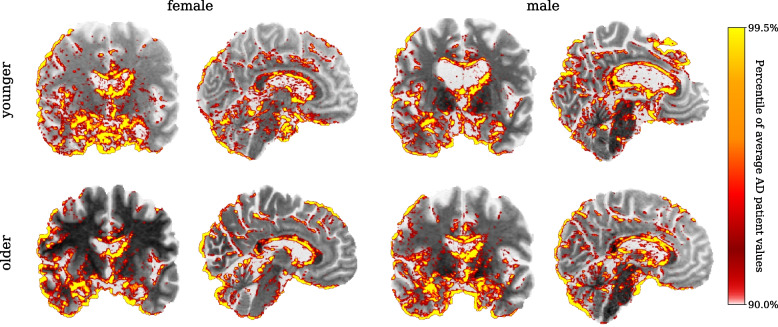
Individual relevance heatmaps. The relevance heatmaps for four individual AD patients are shown, each overlaid over the corresponding brain scan. All scans were classified by the same model, to enable a comparison of inter-subject differences. We selected two female (68 and 88 years) and two male subjects (67 and 87 years), which were correctly diagnosed by the classifier with high confidence (AD class score > 0.97). The colour bar was chosen as in Fig. 4, based on the relevance values of the average AD subject heatmap
Fig. 6
Fig. 6
Relevance by area for AD subjects. The top plot shows the size-normalised relevance for selected brain areas for female and male AD subjects. The mean values are displayed as dots, with the shaded areas showing the relevance density distribution across all AD subjects. The dotted and dashed lines show the values for two individual subjects, namely the young female (Patient 1) and young male (Patient 2) subjects for which the heatmaps are shown in Fig. 5. The bottom plot gives the coefficient of variation, i.e. the standard deviation divided by the mean of the relevance density for the same brain areas

References

    1. Payan A, Montana G. Predicting Alzheimer’s disease: a neuroimaging study with 3D convolutional neural networks. arXiv preprint. 2015. ArXiv:1502.02506.
    1. Wen J, Thibeau-Sutre E, Diaz-Melo M, Samper-González J, Routier A, Bottani S, et al. Convolutional neural networks for classification of Alzheimer’s disease: Overview and reproducible evaluation. Med Image Anal. 2020;63:101694. - PubMed
    1. Klöppel S, Stonnington CM, Barnes J, Chen F, Chu C, Good CD, et al. Accuracy of dementia diagnosis—a direct comparison between radiologists and a computerized method. Brain. 2008;131(11):2969–2974. doi: 10.1093/brain/awn239. - DOI - PMC - PubMed
    1. Böhle M, Eitel F, Weygandt M, Ritter K. Layer-wise relevance propagation for explaining deep neural network decisions in MRI-based Alzheimer’s disease classification. Front Aging Neurosci. 2019;11:194. doi: 10.3389/fnagi.2019.00194. - DOI - PMC - PubMed
    1. Nowogrodzki A. Inequality in medicine. Nature. 2017;550(7674):S18–S19. doi: 10.1038/550S18a. - DOI - PubMed

Publication types

Associated data