


Modulation of the IKS channel by PIP2 requires two binding sites per monomer
- PMID: 37082259
- PMCID: PMC10074941
- DOI: 10.1016/j.bbadva.2023.100073
Modulation of the IKS channel by PIP2 requires two binding sites per monomer
Abstract
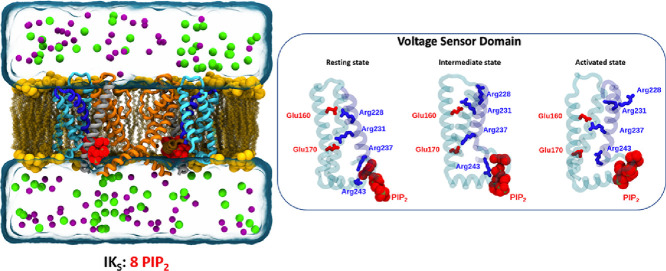
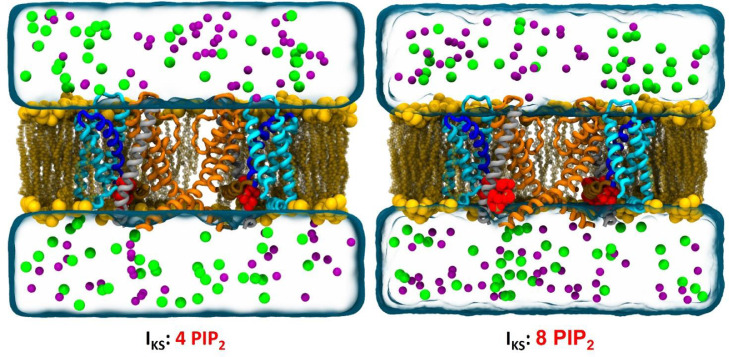
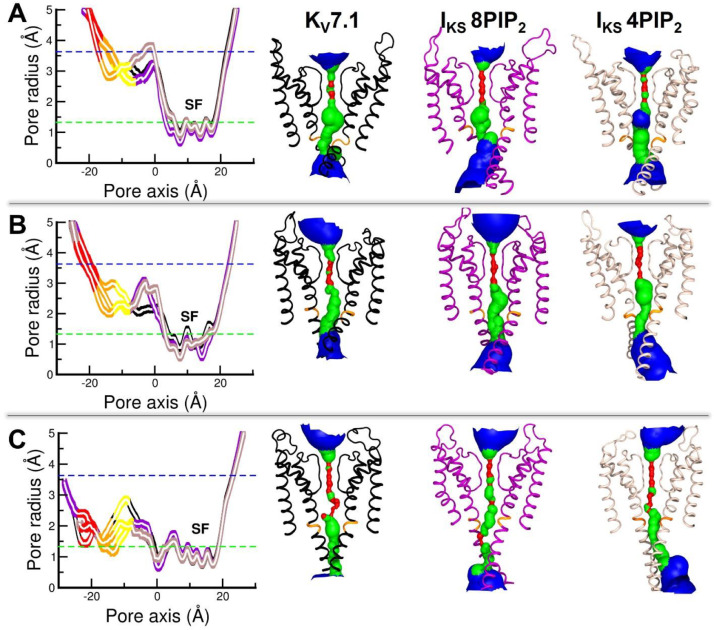
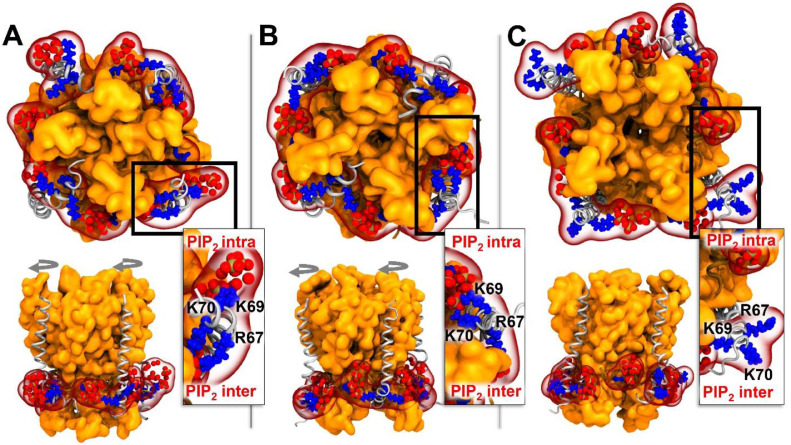
The phosphatidyl-inositol-4,5-bisphosphate (PIP2) lipid has been shown to be crucial for the coupling between the voltage sensor and the pore of the potassium voltage-gated KV7 channel family, especially the KV7.1 channel. Expressed in the myocardium membrane, KV7.1 forms a complex with KCNE1 auxiliary subunits to generate the IKS current. Here we present molecular models of the transmembrane region of this complex in its three known states, namely the Resting/Closed (RC), the Intermediate/Closed (IC), and the Activated/Open (AO), robustness of which is assessed by agreement with a range of biophysical data. Molecular Dynamics (MD) simulations of these models embedded in a lipid bilayer including phosphatidyl-inositol-4,5-bisphosphate (PIP2) lipids show that in presence of KCNE1, two PIP2 lipids are necessary to stabilize each state. The simulations also show that KCNE1 interacts with both PIP2 binding sites, forming a tourniquet around the pore and preventing its opening. The present investigation provides therefore key molecular elements that govern the role of PIP2 in KCNE1 modulation of IKS channels, possibly a common mechanism by which auxiliary KCNE subunits might modulate a variety of other ion channels.
© 2023 The Author(s).
Conflict of interest statement
The authors declare that they have no known competing financial interests or personal relationships that could have appeared to influence the work reported in this paper.
Figures
References
-
- Barhanin J., Lesage F., Guillemare E., Fink M., Lazdunski M., Romey G. KvLQT1 and IsK (minK) proteins associate to form the IKS cardiac potassium current. Nature. 1996;384:78–80. - PubMed
-
- Beckstein O., Tai K., Sansom M.S.P. Not ions alone: barriers to ion permeation in nanopores and channels. J. Am. Chem. Soc. 2004;126:14694–14695. - PubMed
-
- Catterall W.A. Molecular properties of voltage-sensitive sodium channels. New Insights Cell Membr. Transp. Process. 1986:3–20. - PubMed
LinkOut - more resources
Full Text Sources
