. 2023 Nov;19(11):4978-4986.
doi: 10.1002/alz.13009. Epub 2023 Apr 21.

Total sleep duration and daytime napping in relation to dementia detection risk: Results from the Million Women Study

Affiliations

Total sleep duration and daytime napping in relation to dementia detection risk: Results from the Million Women Study

Angel T Y Wong et al. Alzheimers Dement. 2023 Nov.

Abstract

Introduction: There is inconsistent evidence on the associations of sleep duration and daytime napping with dementia risk.

Methods: In the Million Women Study, a total of 830,716 women (mean age, 60 years) were asked about sleep duration (<7, 7-8, >8 hours) and daytime napping (rarely/never, sometimes, usually) in median year 2001, and were followed for the first hospital record with any mention of dementia. Cox regression estimated dementia detection risk ratios (RRs) during 17-year follow-up in 5-year intervals.

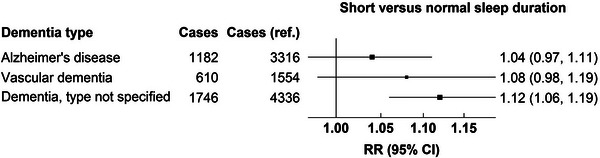
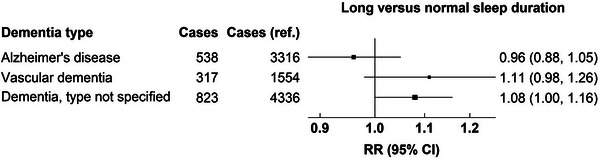
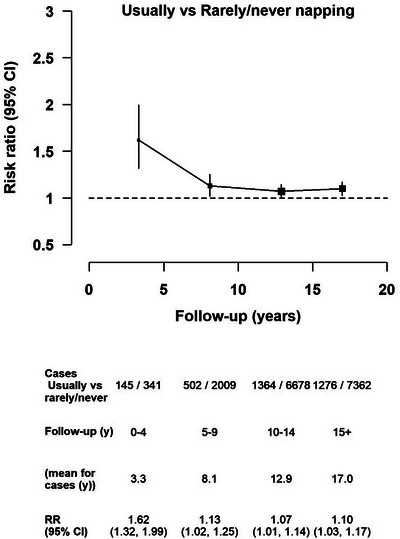
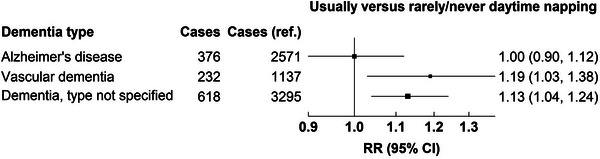
Results: With 34,576 dementia cases, there was strong attenuation over follow-up in the RRs related to long sleep duration (>8 vs 7-8 hours) and usually napping (vs rarely/never). Short sleep duration was modestly, positively associated with dementia in the long term (RR = 1.08, 95% confidence interval [CI] 1.04-1.12).

Discussion: There was little evidence to suggest that long sleep duration and regular napping are associated with long-term dementia risk. Short sleep duration was modestly associated with dementia risk, but residual confounding cannot be excluded.

Highlights: Long sleep duration was not associated with long-term dementia risk. Daytime napping was not associated with long-term dementia risk. There is some evidence for a small higher risk of dementia related to short sleep.

Keywords: daytime napping; dementia; prospective; sleep duration.


Conflict of interest statement

Angel T. Y. Wong, Gillian K. Reeves, and Sarah Floud: No conflict of interest to declare. Author disclosures are available in the supporting information.

Figures
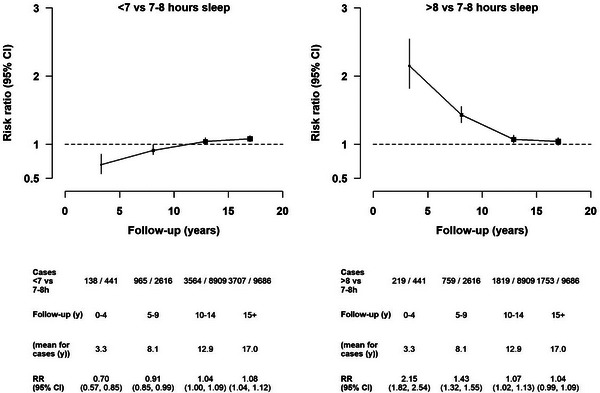
FIGURE 1
FIGURE 1
Associations of short and long sleep duration groups with dementia detection risks by period of follow‐up. All multivariable‐adjusted estimates were stratified by year of birth, year of returning the 2001 questionnaire, and region at recruitment, and were adjusted for deprivation, educational attainment, frequency of strenuous exercise, body mass index, smoking status, alcohol consumption, use of menopausal hormones, paid work, currently married or living with partner or alone, depression/anxiety, diabetes, high blood pressure, and self‐rated health. CI, confidence interval; RR, risk ratio; Y, year.
FIGURE 2
FIGURE 2
Associations of dementia‐detection risk for short sleep duration during 15+ years of follow‐up by subtype of dementia. CI, confidence interval; RR, risk ratio.
FIGURE 3
FIGURE 3
Associations of dementia detection risk for long sleep duration during 15+ years of follow‐up by subtype of dementia. CI, confidence interval; RR, risk ratio.
FIGURE 4
FIGURE 4
Associations of “usually” versus “rarely/never” daytime napping with dementia‐detection risk by period of follow‐up. All multivariable‐adjusted estimates were stratified by year of birth, year of returning the 2001 questionnaire, and region at recruitment, and were adjusted for deprivation, educational attainment, frequency of strenuous exercise, body mass index, smoking status, alcohol consumption, and use of menopausal hormones, self‐rated health, currently married or living with a partner or alone, paid work, and self‐reported treatment for diabetes, high blood pressure, and depression/anxiety (for each medical condition). CI, confidence interval; RR, risk ratio; Y, year.
FIGURE 5
FIGURE 5
Associations of dementia detection risk for “usually” versus “rarely/never” daytime napping during 15+ years of follow‐up by subtype of dementia. CI, confidence interval; RR, risk ratio.

References

    1. McCleery J, Cohen DA, Sharpley AL. Pharmacotherapies for sleep disturbances in dementia. Cochrane Database Syst Rev. 2016;11(11):Cd009178. - PMC - PubMed
    1. Ju YE, Lucey BP, Holtzman DM. Sleep and Alzheimer disease pathology–a bidirectional relationship. Nat Rev Neurol. 2014;10(2):115‐119. - PMC - PubMed
    1. Livingston G, Huntley J, Sommerlad A, et al. Dementia prevention, intervention, and care: 2020 report of the Lancet Commission. Lancet. 2020;396(10248):413‐446. - PMC - PubMed
    1. Sabia S, Fayosse A, Dumurgier J, et al. Association of sleep duration in middle and old age with incidence of dementia. Nat Commun. 2021;12(1):2289. - PMC - PubMed
    1. Fan L, Xu W, Cai Y, Hu Y, Wu C. Sleep duration and the risk of Dementia: a systematic review and meta‐analysis of prospective cohort studies. J Am Med Dir Assoc. 2019;20(12):1480‐1487.e1485. - PubMed

Publication types