


The role of chloroplast movement in C4 photosynthesis: a theoretical analysis using a three-dimensional reaction-diffusion model for maize
- PMID: 37083863
- PMCID: PMC10400148
- DOI: 10.1093/jxb/erad138
The role of chloroplast movement in C4 photosynthesis: a theoretical analysis using a three-dimensional reaction-diffusion model for maize
Abstract
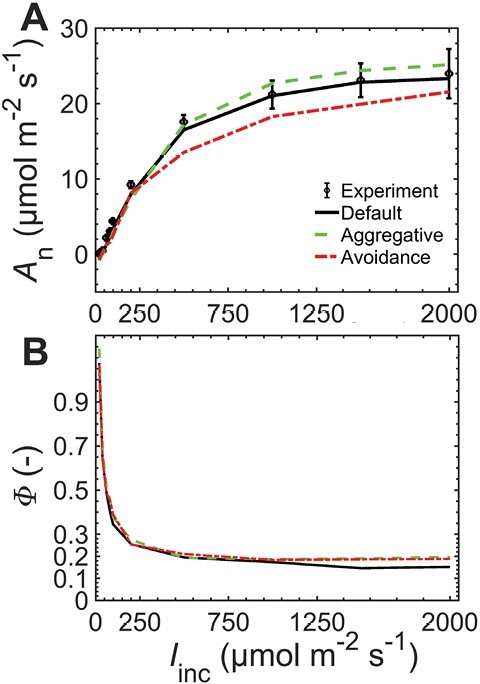
Chloroplasts movement within mesophyll cells in C4 plants is hypothesized to enhance the CO2 concentrating mechanism, but this is difficult to verify experimentally. A three-dimensional (3D) leaf model can help analyse how chloroplast movement influences the operation of the CO2 concentrating mechanism. The first volumetric reaction-diffusion model of C4 photosynthesis that incorporates detailed 3D leaf anatomy, light propagation, ATP and NADPH production, and CO2, O2 and bicarbonate concentration driven by diffusional and assimilation/emission processes was developed. It was implemented for maize leaves to simulate various chloroplast movement scenarios within mesophyll cells: the movement of all mesophyll chloroplasts towards bundle sheath cells (aggregative movement) and movement of only those of interveinal mesophyll cells towards bundle sheath cells (avoidance movement). Light absorbed by bundle sheath chloroplasts relative to mesophyll chloroplasts increased in both cases. Avoidance movement decreased light absorption by mesophyll chloroplasts considerably. Consequently, total ATP and NADPH production and net photosynthetic rate increased for aggregative movement and decreased for avoidance movement compared with the default case of no chloroplast movement at high light intensities. Leakiness increased in both chloroplast movement scenarios due to the imbalance in energy production and demand in mesophyll and bundle sheath cells. These results suggest the need to design strategies for coordinated increases in electron transport and Rubisco activities for an efficient CO2 concentrating mechanism at very high light intensities.
Keywords: 3D leaf anatomy; Biophysical model; CO2 concentrating mechanism; chloroplast movement; gas exchange; leakiness; ray tracing.
© The Author(s) 2023. Published by Oxford University Press on behalf of the Society for Experimental Biology.
Conflict of interest statement
The authors declare they have no conflict of interest.
Figures
References
-
- Aernouts B, Watté R, Van Beers R, Delport F, Merchiers M, De Block J, Lammertyn J, Saeys W.. 2014. Flexible tool for simulating the bulk optical properties of polydisperse spherical particles in an absorbing host: experimental validation. Optics Express 22, 20223–20238. - PubMed
-
- Allen WA, Gausman HW, Richardson AJ.. 1973. Willstätter-Stoll theory of leaf reflectance evaluated by ray tracing. Applied Optics 12, 2448–2453. - PubMed
-
- Bauwe H. 1986. An efficient method for the determination of Km values for HCO3 −of phosphoenolpyruvate carboxylase. Planta 169, 356–360. - PubMed
Publication types
MeSH terms
Substances
Associated data
LinkOut - more resources
Full Text Sources
Other Literature Sources
Miscellaneous
