Your Vestibular Thresholds May Be Lower Than You Think: Cognitive Biases in Vestibular Psychophysics
- PMID: 37084775
- PMCID: PMC10721247
- DOI: 10.1044/2023_AJA-22-00186
Your Vestibular Thresholds May Be Lower Than You Think: Cognitive Biases in Vestibular Psychophysics
Abstract
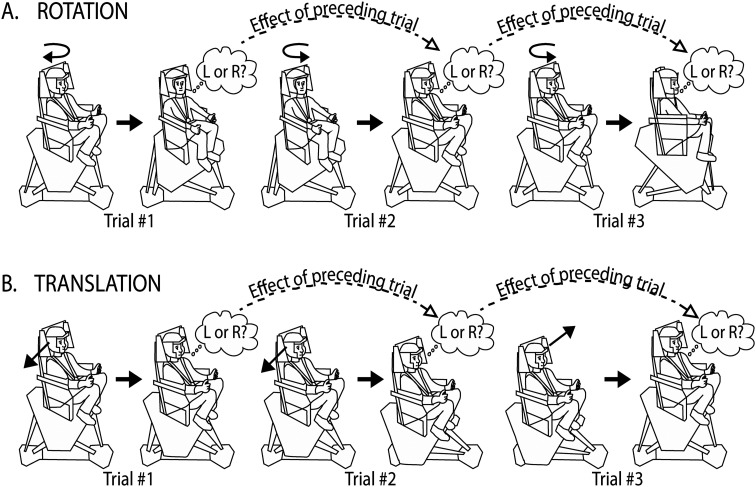
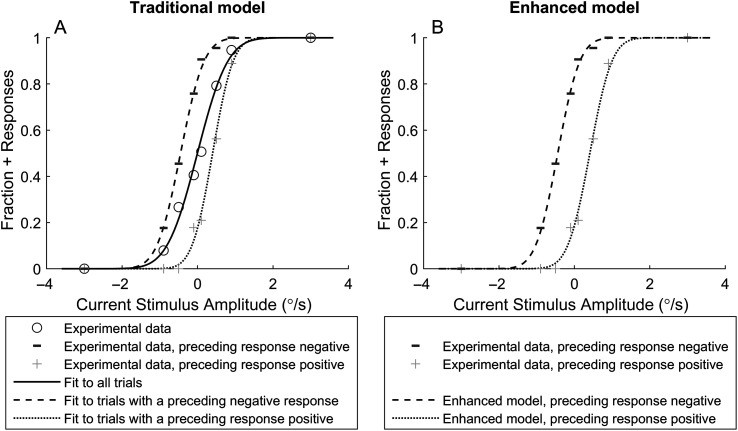
Purpose: Recently, there has been a surge of interest in measuring vestibular perceptual thresholds, which quantify the smallest motion that a subject can reliably perceive, to study physiology and pathophysiology. These thresholds are sensitive to age, pathology, and postural performance. Threshold tasks require decisions to be made in the presence of uncertainty. Since humans often rely on past information when making decisions in the presence of uncertainty, we hypothesized that (a) perceptual responses are affected by their preceding trial; (b) perceptual responses tend to be biased opposite of the "preceding response" because of cognitive biases but are not biased by the "preceding stimulus"; and (c) when fits do not account for this cognitive bias, thresholds are overestimated. To our knowledge, these hypotheses are unaddressed in vestibular and direction-recognition tasks.
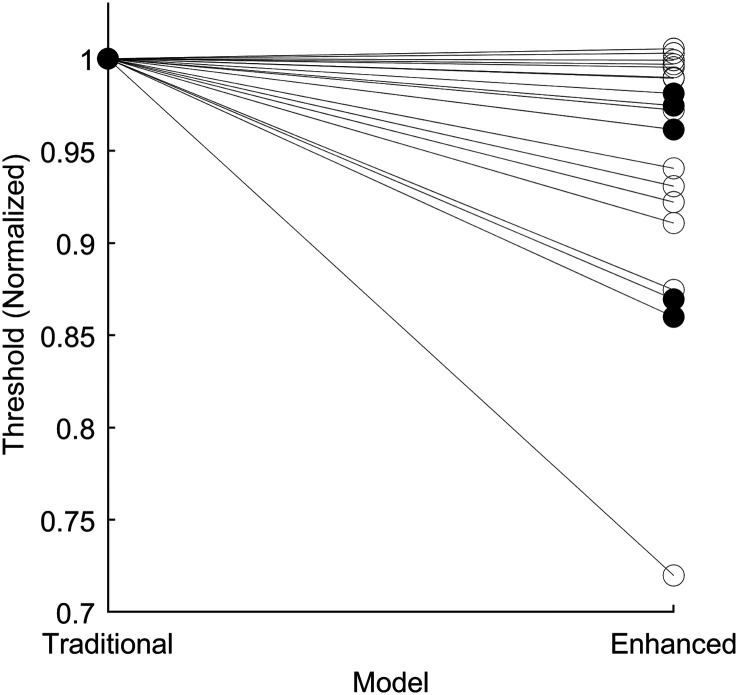
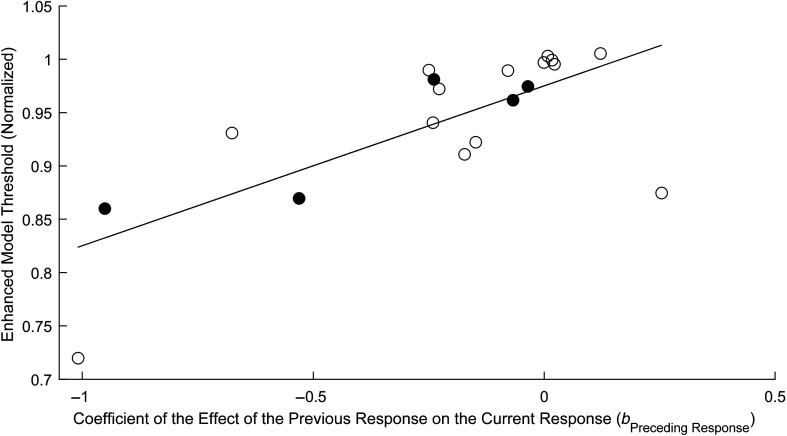
Conclusions: Results in normal subjects supported each hypothesis. Subjects tended to respond opposite of their preceding response (not the preceding stimulus), indicating a cognitive bias, and this caused an overestimation of thresholds. Using an enhanced model (MATLAB code provided) that considered these effects, average thresholds were lower (5.5% for yaw, 7.1% for interaural). Since the results indicate that the magnitude of cognitive bias varies across subjects, this enhanced model can reduce measurement variability and potentially improve the efficiency of data collection.
Figures
References
-
- Benson, A. J. , Hutt, E. C. , & Brown, S. F. (1989). Thresholds for the perception of whole body angular movement about a vertical axis. Aviation, Space, and Environmental Medicine, 60(3), 205–213. http://www.ncbi.nlm.nih.gov/pubmed/2712798 - PubMed
-
- Bremova, T. , Caushaj, A. , Ertl, M. , Strobl, R. , Bottcher, N. , Strupp, M. , & MacNeilage, P. R. (2016). Comparison of linear motion perception thresholds in vestibular migraine and Menière's disease. European Archives of Oto-Rhino-Laryngology, 273(10), 2931–2939. 10.1007/s00405-015-3835-y - DOI - PMC - PubMed
MeSH terms
Grants and funding
LinkOut - more resources
Full Text Sources
Miscellaneous