. 2023 Apr 21;14(1):2308.
doi: 10.1038/s41467-023-37787-0.

Rapid assembly of SARS-CoV-2 genomes reveals attenuation of the Omicron BA.1 variant through NSP6

Affiliations

Rapid assembly of SARS-CoV-2 genomes reveals attenuation of the Omicron BA.1 variant through NSP6

Taha Y Taha et al. Nat Commun. .

Abstract

Although the SARS-CoV-2 Omicron variant (BA.1) spread rapidly across the world and effectively evaded immune responses, its viral fitness in cell and animal models was reduced. The precise nature of this attenuation remains unknown as generating replication-competent viral genomes is challenging because of the length of the viral genome (~30 kb). Here, we present a plasmid-based viral genome assembly and rescue strategy (pGLUE) that constructs complete infectious viruses or noninfectious subgenomic replicons in a single ligation reaction with >80% efficiency. Fully sequenced replicons and infectious viral stocks can be generated in 1 and 3 weeks, respectively. By testing a series of naturally occurring viruses as well as Delta-Omicron chimeric replicons, we show that Omicron nonstructural protein 6 harbors critical attenuating mutations, which dampen viral RNA replication and reduce lipid droplet consumption. Thus, pGLUE overcomes remaining barriers to broadly study SARS-CoV-2 replication and reveals deficits in nonstructural protein function underlying Omicron attenuation.


Conflict of interest statement

The authors declare the following competing interests: T.Y.T., T.T., and M.O. are inventors on a patent application filed by the Gladstone Institutes that covers the use of pGLUE to generate SARS-CoV-2 infectious clones and replicons. All other authors declare no competing interests.

Figures

Fig. 1
Fig. 1. Golden gate assembly enables rapid cloning of SARS-CoV-2 variants.
A Schematic of cloning methodology and generation of infectious clones. The viral genome was rationally divided into 10 fragments and assembled into a bacterial artificial chromosome (BAC) vector containing T7 and cytomegalovirus (CMV) promoters, hepatitis delta virus ribozyme (HDVrz), and simian virus 40 (SV40) polyA sequence. The assembled vector was then directly transfected into cells or first in vitro transcribed into RNA, followed by electroporation into cells to generate SARS-CoV-2 variants. The estimated time required for each step is indicated in parentheses. IVT, in vitro transcription. The Electroporation image was created with Biorender. B Agarose gel electrophoresis of Golden Gate (GG) assembly of the 10 fragments. The gel is representative of 3 independent assembly reactions. C Cloning efficiency of SARS-CoV-2 variant infectious clones. Correct colonies are defined as those with perfectly correct sequence across the entire genome. Data are shown as average ± SD of 6 independent cloning experiments. A total of 47 (range 3–15), 37 (range 3–12), and 43 (range 3–15) colonies were analyzed for the WA1, Delta, and Omicron variants, respectively. D Agarose gel electrophoresis of PstI digest of 0.5 µg of SARS-CoV-2 variant infectious clone plasmids, demonstrating high quantity and quality of plasmid preps. The gel is representative of 5 independent plasmid preps and PstI digests. E In vitro transcription of assembled plasmid to generate full-length RNA under different conditions with two different commercial kits. The gels are representative of at least 2 independent IVT reactions for each kit. ssRNA, single-stranded RNA; ON, overnight. Source data are provided as a Source Data file.
Fig. 2
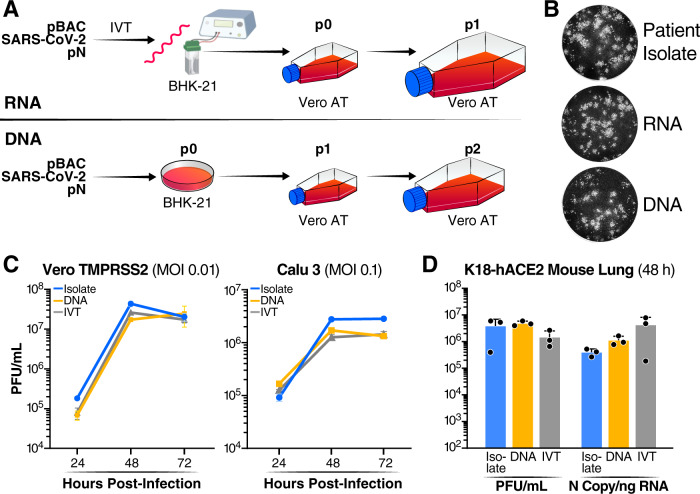
Fig. 2. DNA- and RNA-launched viruses replicate similarly to virus derived from patient isolate.
A Schematic of virus rescue from RNA or DNA. For RNA-launched virus rescue, in vitro transcribed RNA from viral construct (pBAC SARS-CoV-2) and N expression construct (pN) is electroporated into BHK-21 cells followed by co-culture with Vero ACE2 TMPRSS2 (Vero AT) cells to yield p0 viral stock, which is propagated in the same cells onward. For DNA-launched virus rescue, pBAC SARS-CoV-2 and pN are directly transfected into BHK-21 cells to yield p0 viral stock, which is then propagated in Vero AT cells. B Plaque morphology of DNA- and RNA-launched and patient-derived Delta variant viruses. Images were pseudocolored to black and white for optimal visualization. The images represent three independent replicate experiments. C Growth kinetics of the viruses in B in Vero TMPRSS2 and Calu3 cells over 72 h as measured by infectious particle release by plaque assay. Average of three independent experiments analyzed in duplicate ± SD is shown. D Replication of the viruses in B was assessed in K18-hACE2 mice lungs at 48 h post-infection by infectious particle release by plaque assay and viral RNA by RT-qPCR. Data are presented as average ± SD of 3 mice in each group. Source data are provided as a Source Data file.
Fig. 3
Fig. 3. Omicron mutations in Spike and ORF1ab reduce viral particle production and intracellular RNA levels.
A Schematic of recombinant infectious clones of Delta (green) and Omicron (orange) variants with indicated mutations. Mutations represent >90% of GISAID sequences of each variant as of January 2022. B Representative images of plaques from indicated recombinant infectious clones. Images were pseudocolored to black and white for optimal visualization. The images represent three independent replicate experiments. C Extracellular infectious particles from infected Calu3 cells (MOI 0.1). Average of four independent experiments analyzed in duplicate ± SD is shown and compared to Delta by two-sided Student’s T-test at each timepoint. D Intracellular RNA was quantified from infected Calu3 cells (MOI of 0.1). Data are expressed in absolute copies/ng based on a standard curve of N gene with known copy number. Average of four independent experiments analyzed in triplicate (independent qPCR runs) ± SD is shown and compared to Delta by two-sided Student’s T-test at each timepoint. Ο-δ, Omicron-Delta recombinant; δ-οS, Delta-Omicron S recombinant. *p < 0.05; ***p < 0.001; ****p < 0.0001 by two-sided Student’s T-test. Source data are provided as a Source Data file.
Fig. 4
Fig. 4. Omicron mutations attenuate viral replication independent of Spike.
A Schematic of the replicon system in which the Spike gene was replaced with secreted Nanoluciferase (Sec nLuc) and enhanced green fluorescent protein (EGFP) separated by a self-cleaving P2A peptide. B Experimental workflow of the SARS-CoV-2 replicon assay. VAT, Vero cells stably overexpressing ACE2 and TMPRSS2. C Luciferase readout from cells transfected with increasing amounts of Spike expression construct paired with either the Delta or Omicron replicon plasmids. Average of three independent experiments analyzed in duplicate ± SD and pairwise comparisons between the Delta and Omicron variants by two-sided Student’s T-test are shown. D Luciferase readout from Calu3 or Vero ACE2 TMPRSS2 cells infected with supernatant from BHK-21 cells transfected with Delta or Omicron replicons in B. Shown are the average of three independent experiments analyzed in duplicate ± SD and pairwise comparisons between the Delta and Omicron variants by two-sided Student’s T-test. E Correlation analysis of replicon-generated relative luminescence unit (RLU) signal in the supernatant of infected Calu3 cells with abundance of viral N gene RNA in the same well as measured by RT-qPCR. Pearson’s correlation (two-tailed) was utilized to calculate R2 value and p value. F Luciferase readout from transfected BHK-21 with Delta and Omicron replicons and a Delta Spike, Omicron Spike, or VSV-G expression vectors. The Omicron replicon plasmid was transfected at twice the amount of the Delta replicon. Average of three independent experiments analyzed in duplicate ± SD is shown. G Luciferase readout from infected Vero ACE2 TMPRSS2 cells with supernatant from F. Average of three independent experiments analyzed in duplicate ± SD is shown, and pairwise comparisons were made relative to the Omicron variant by two-sided Student’s T-test. *p < 0.05; **p < 0.01; ***p < 0.001; ****p < 0.0001 by two-sided Student’s T-test. Source data are provided as a Source Data file.
Fig. 5
Fig. 5. Omicron NSP6 slows viral RNA replication.
A Luciferase readout from transfected BHK-21 with Delta, Omicron, and Omicron-Delta recombinants replicons as indicated and a Delta Spike and Nucleocapsid expression vectors. Average of three independent experiments analyzed in duplicate ± SD is shown, and pairwise comparisons were made relative to the Omicron variant by two-sided Student’s T-test. B Luciferase readout from infected Vero ACE2 TMPRSS2 and Calu3 cells with supernatant from (A). Average of five and three independent experiments analyzed in triplicate and duplicate ± SD are shown for Vero ACE2 TMPRSS2 and Calu3 cells, respectively, and pairwise comparisons were made relative to the Omicron variant by two-sided Student’s T-test. C Luciferase readout from transfected BHK-21 with Delta, Delta-Omicron recombinants, Omicron, and Omicron-Delta recombinants replicons as indicated and a Delta Spike and Nucleocapsid expression vectors. Average of three independent experiments analyzed in duplicate ± SD is shown, and pairwise comparisons were made relative to the Omicron variant by two-sided Student’s T-test. D Luciferase readout from infected Vero ACE2 TMPRSS2 and Calu3 cells with supernatant from (C). Average of three independent experiments analyzed in duplicate ± SD is shown, and pairwise comparisons were made relative to the Omicron variant by two-sided Student’s T-test. E Representative images of transfected HEK293T cells with indicated FLAG-NSP6 expression vectors or untransfected control and stained for LD and FLAG. LD, lipid droplet. F Quantification of the relative LD mean fluorescent intensity (MFI) per transfected (BFP-positive) cells in images shown in (E). Average of six technical replicates ± SEM is shown, and pairwise comparisons were made as indicated by two-sided Student’s T-test. G Representative images of infected Vero ACE2 TMPRSS2 cells with indicated replicons and stained for LD and dsRNA. dsRNA, double-stranded RNA. H Quantification of the relative LD mean fluorescent intensity (MFI) per dsRNA positive cells in images shown in G using box and whiskers plot, and pairwise comparisons were made as indicated by two-sided Student’s T-test. Interquartile range (IQR) of boxplot is between 25th and 75th percentiles and center line indicates median value. Whiskers of boxplot is extended to the maxima and minima. Maxima is the largest value and minima is the smallest value in the dataset. *p < 0.05; **p < 0.01; ***p < 0.001; ****p < 0.0001 by two-sided Student’s T-test. Source data are provided as a Source Data file.

Update of

References

    1. WHO, Vol. 2022 (World Health Organization, 2022). https://covid19.who.int/ Accessed October 2022.
    1. Davies, N. G. et al. Estimated transmissibility and impact of SARS-CoV-2 lineage B.1.1.7 in England. Science. 372, eabg3055 (2021). - PMC - PubMed
    1. Liu Y, Rocklov J. The reproductive number of the Delta variant of SARS-CoV-2 is far higher compared to the ancestral SARS-CoV-2 virus. J. Travel Med. 2021;28:taab124. doi: 10.1093/jtm/taab124. - DOI - PMC - PubMed
    1. Liu Y, Gayle AA, Wilder-Smith A, Rocklov J. The reproductive number of COVID-19 is higher compared to SARS coronavirus. J. Travel Med. 2020;27:taaa021. doi: 10.1093/jtm/taaa021. - DOI - PMC - PubMed
    1. Perez-Then E, et al. Neutralizing antibodies against the SARS-CoV-2 Delta and Omicron variants following heterologous CoronaVac plus BNT162b2 booster vaccination. Nat. Med. 2022;28:481–485. doi: 10.1038/s41591-022-01705-6. - DOI - PMC - PubMed

Publication types

Supplementary concepts