


Rural and frontier access to mental health prescribers and nonprescribers: A geospatial analysis in Oregon Medicaid
- PMID: 37088967
- PMCID: PMC10590824
- DOI: 10.1111/jrh.12761
Rural and frontier access to mental health prescribers and nonprescribers: A geospatial analysis in Oregon Medicaid
Abstract
Objective: Medicaid enrollees in rural and frontier areas face inadequate access to mental health services, but the extent to which access varies for different provider types is unknown. We assessed access to Medicaid-participating prescribing and nonprescribing mental health clinicians, focusing on Oregon, which has a substantial rural population.
Methods: Using 2018 Medicaid claims data, we identified enrollees aged 18-64 with psychiatric diagnoses and specialty mental health providers who billed Medicaid at least once during the study period. We measured both 30- and 60-minute drive time to a mental health provider, and a spatial access score derived from the enhanced 2-step floating catchment area (E2SFCA) approach at the level of Zip Code Tabulation Areas (ZCTAs). Results were stratified for prescribers and nonprescribers, across urban, rural, and frontier areas.
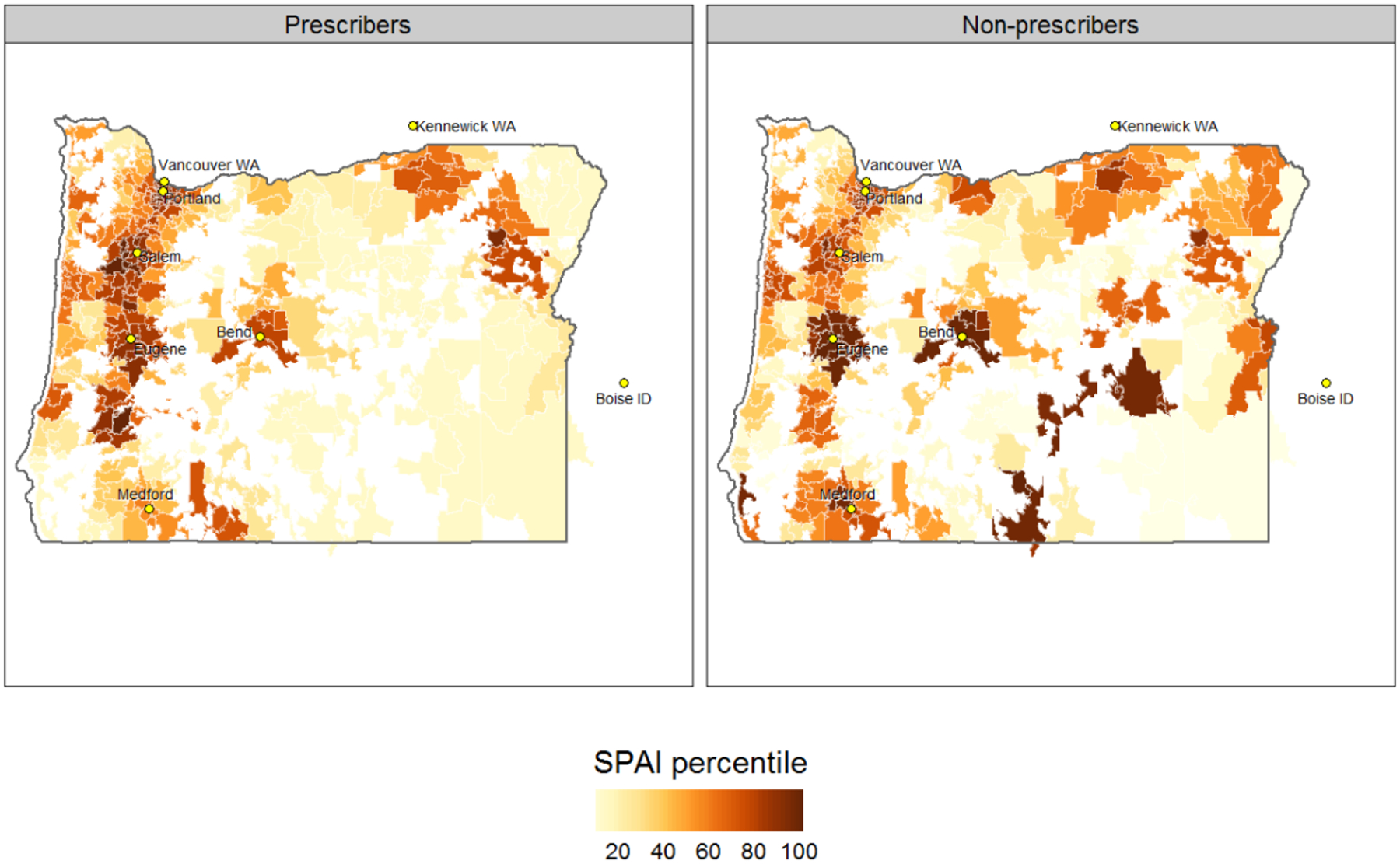
Results: Overall, a majority of ZCTAs (68.6%) had at least 1 mental health prescriber and nonprescriber within a 30-minute drive. E2SFCA measures demonstrated that while frontier ZCTAs had the lowest access to prescribers (84.3% in the lowest quintile of access) compared to other regions, some frontier ZCTAs had relatively high access to nonprescribers (34.3% in the third and fourth quartiles of access).
Conclusions: Some frontier areas with relatively poor access to Medicaid-participating mental health prescribers demonstrated relatively high access to nonprescribers, suggesting reliance on nonprescribing clinicians for mental health care delivery amid rural workforce constraints. Efforts to monitor network adequacy should consider differential access to different provider types, and incorporate methods, such as E2SFCA, to better account for service demand and supply.
Keywords: access to care; mental health; provider networks; rural disparities.
© 2023 National Rural Health Association.
Figures



References
-
- HHS H Designated Health Professional Shortage Areas Statistics.; 2022. Accessed August 24, 2022. https://data.hrsa.gov/Default/GenerateHPSAQuarterlyReport
-
- McCall-Hosenfeld JS, Mukherjee S, Lehman EB. The Prevalence and Correlates of Lifetime Psychiatric Disorders and Trauma Exposures in Urban and Rural Settings: Results from the National Comorbidity Survey Replication (NCS-R). Elhai JD, ed. PLoS ONE. 2014;9(11):e112416. doi: 10.1371/journal.pone.0112416 - DOI - PMC - PubMed
-
- Hedegaard H, Curtin S, Warner M. Suicide Mortality in the United States, 1999–2017. https://www.cdc.gov/nchs/data/databriefs/db330-h.pdf - PubMed
Publication types
MeSH terms
Grants and funding
LinkOut - more resources
Full Text Sources
Medical
