Review
. 2023 Apr 3;14(2):125-133.
doi: 10.1007/s13340-023-00624-2. eCollection 2023 Apr.

Heterogeneity of adipose tissue-resident macrophages-beyond M1/M2 paradigm

Affiliations
Review

Heterogeneity of adipose tissue-resident macrophages-beyond M1/M2 paradigm

Allah Nawaz et al. Diabetol Int. .

Abstract

Adipose tissue-resident macrophages (ATMs) are reported to be important for maintaining adipose tissue remodeling and homeostasis. ATMs were classified for the first time in 2007 into the M1 and M2 types. This theory suggests that in the non-obese adipose tissue, the anti-inflammatory, alternatively activated macrophages (AAMs) predominate, and regulate tissue homeostasis, remodeling, and insulin sensitivity. On the other hand, classically activated M1-type macrophages increase rapidly in obesity, secrete inflammatory cytokines, such as TNFα and IL-6, and induce insulin resistance. In recent years, experimental findings that cannot be explained by this theory have been clarified one after another and the theory is being reconsidered. In this review, based on recent findings, we summarize reports on the novel metabolic regulatory functions of ATMs beyond the M1/M2 paradigm.

Keywords: Adipose tissue; Insulin resistance; M2 macrophage; Preadipocytes.


Conflict of interest statement

Conflict of interestK.T. received honoraria for lectures from MSD K.K. and scholarship grants from Novo Nordisk Pharma Ltd., Takeda Pharmaceutical Company., Daiichi Sankyo Company, Ltd., Mitsubishi Tanabe Pharma Corporation, Asahi Kasei Pharma Corporation, Taisho Pharmaceutical Co., Ltd., Japan Diabetes Foundation and Japan Association for Diabetes Education and Care.

Figures
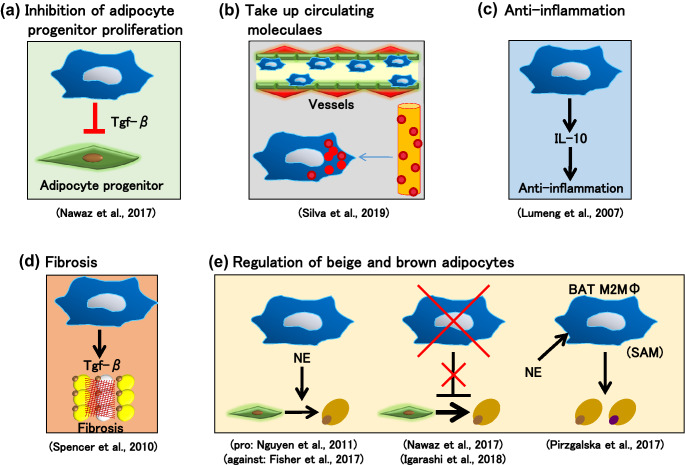
Fig. 1
Fig. 1
M2 macrophages in lean adipose tissues. M2-ATMs inhibit adipocyte progenitor proliferation/differentiation through Tgf-β (a), take up circulating macromolecules (b), secrete anti-inflammatory cytokines, including IL-10 (c), and promote fibrosis (d). M2-ATMs are also reported to be associated with beiging and browning of white adipocytes (e), but their mechanisms are a matter of controversy
Fig. 2
Fig. 2
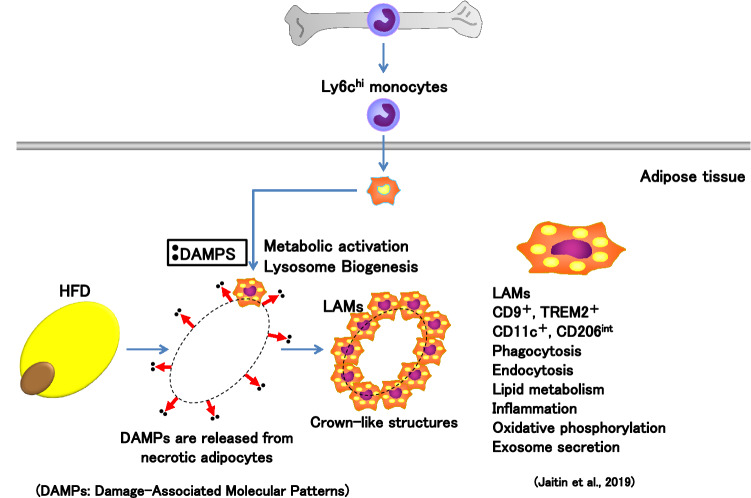
M2 macrophages in obese adipose tissues. Obesity induces the recruitment of circulating Ly6c + monocytes to adipose tissue, and they differentiate into macrophages that regulate metabolism and lysosomal biogenesis. Adipocyte cell death that occurs in obese adipose tissue may result in the release of damage-associated molecular patterns (DAMPs) that induce proinflammatory responses in immune cells, and these ATMs that are present around dead adipocytes form crown-like structures (CLSs). Lipid-associated macrophages (LAMs) are also a major constituent of ATMs that are involved in disposing lipids released by dead adipocytes
Fig. 3
Fig. 3
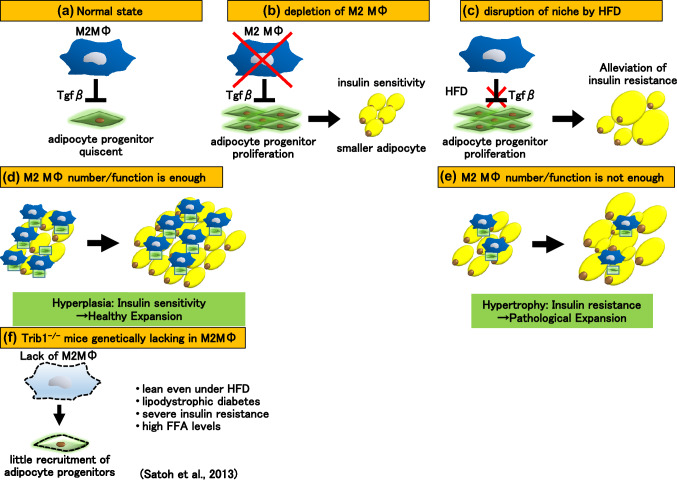
M2 macrophages serve as a niche for preadipocytes that contributes to maintaining adipose tissue homeostasis. a On a normal chow diet, M2 macrophages form a niche with preadipocytes via TGFβ thus keeping preadipocytes in a quiescent state, avoiding unnecessary division and preventing cell senescence and their exhaustion to maintain their pool. b Depletion of M2 macrophages release their inhibitory effect of proliferation and differentiation of preadipocytes. As preadipocytes are constantly receiving growth and differentiation signals from blood circulation, they begin to proliferate and differentiate to generate small matured adipocytes, thus inducing insulin sensitivity. c When animals are put on a high-fat diet, signals of free fatty acids from the blood circulation might stimulate PPARγ in the preadipocytes and reduce the expression of molecules involved in M2 macrophage-preadipocyte interaction and the niche structure is disrupted. As a result, preadipocytes are released from the niche and begin to proliferate and differentiate to generate matured adipocytes and exacerbation of insulin resistance is at least in part alleviated. d The following explanation is based on the assumption that the number of M2 macrophages and that of preadipocytes are almost parallel. When the number of M2 macrophages is large, there may be more preadipocytes, and more adipocytes are generated even under high-fat diet, making it less likely to become insulin resistant (hyperplasia: healthy expansion). e On the other hand, when the number of M2 macrophages is not enough, there are less preadipocytes and less matured adipocytes generated under a high-fat diet, then existing adipocytes become larger, leading to inflammation and insulin resistance (hypertrophy: pathological expansion). Similarly, when the function of M2 macrophages is impaired, or the number of preadipocytes regulated by M2 macrophages is decreased, these result in reduced adipogenesis and insulin resistance under a high-fat diet. f The reason why Trib1-deficient mice lacking M2 macrophages in adipose tissue exhibit a lipodystrophic diabetes phenotype is that there may be only a small number of preadipocytes recruited in this mouse adipose tissue because of the lack of M2 macrophages, resulting in little adipogenesis occurred [28]
Fig. 4
Fig. 4
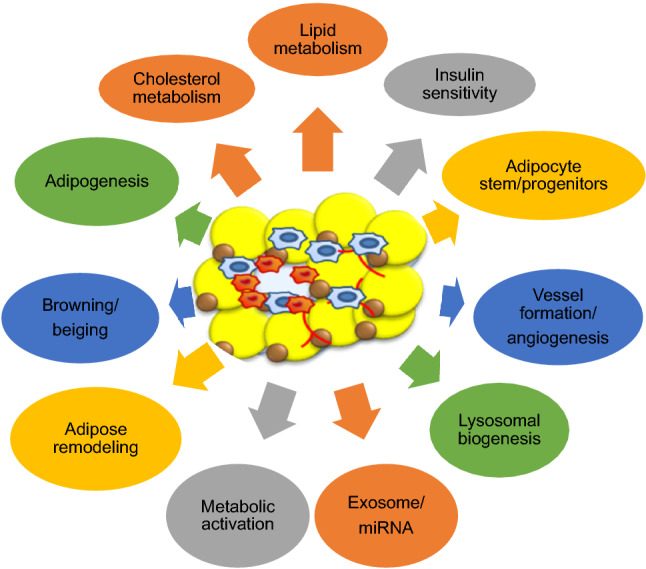
Overview of the different functions of ATMs. ATMs not only contribute to maintaining the adipose tissue microenvironment, but also regulate several metabolic processes, including exosomal biogenesis, miRNA secretion, lipid metabolism, insulin sensitivity, lysosomal biogenesis, and energy expenditure

References

    1. Lumeng CN, Bodzin JL, Saltiel AR. Obesity induces a phenotypic switch in adipose tissue macrophage polarization. J Clin Invest. 2007;117(1):175–184. doi: 10.1172/JCI29881. - DOI - PMC - PubMed
    1. Wu D, Molofsky AB, Liang HE, Ricardo-Gonzalez RR, Jouihan HA, Bando JK, et al. Eosinophils sustain adipose alternatively activated macrophages associated with glucose homeostasis. Science. 2011;332(6026):243–247. doi: 10.1126/science.1201475. - DOI - PMC - PubMed
    1. Igarashi Y, Nawaz A, Kado T, Bilal M, Kuwano T, Yamamoto S, et al. Partial depletion of CD206-positive M2-like macrophages induces proliferation of beige progenitors and enhances browning after cold stimulation. Sci Rep. 2018;8(1):14567. doi: 10.1038/s41598-018-32803-6. - DOI - PMC - PubMed
    1. Nawaz A, Aminuddin A, Kado T, Takikawa A, Yamamoto S, Tsuneyama K, et al. CD206(+) M2-like macrophages regulate systemic glucose metabolism by inhibiting proliferation of adipocyte progenitors. Nat Commun. 2017;8(1):286. doi: 10.1038/s41467-017-00231-1. - DOI - PMC - PubMed
    1. Fujisaka S, Usui I, Nawaz A, Takikawa A, Kado T, Igarashi Y, et al. M2 macrophages in metabolism. Diabetol Int. 2016;7(4):342–351. doi: 10.1007/s13340-016-0290-y. - DOI - PMC - PubMed