


The Relationship of Hispanic Cultural Factors and Sexual Behaviors of Hispanic Men who have Sex with Men
- PMID: 37090487
- PMCID: PMC10121202
- DOI: 10.1007/s12119-018-9557-8
The Relationship of Hispanic Cultural Factors and Sexual Behaviors of Hispanic Men who have Sex with Men
Abstract
Background/significance: Hispanics are the largest ethnic minority group in the U.S., and account for 21% of new cases of HIV infection. Previous researchers have examined the relationship of Hispanic cultural factors and the sexual behaviors of Hispanic men who have sex with men (HMSM). However, the exact influence of Hispanic culture factors on the sexual behaviors of these men is currently unclear.
Objective: The purpose of this study was to investigate the relationship of selected Hispanic cultural factors and the sexual behaviors of a sample of HMSM.
Method: A descriptive, cross-sectional design was used to collect data from 125 Hispanic men in Miami-Dade County, FL. Participants completed standardized measures of Hispanic cultural factors, sexual behaviors, and a demographic questionnaire.
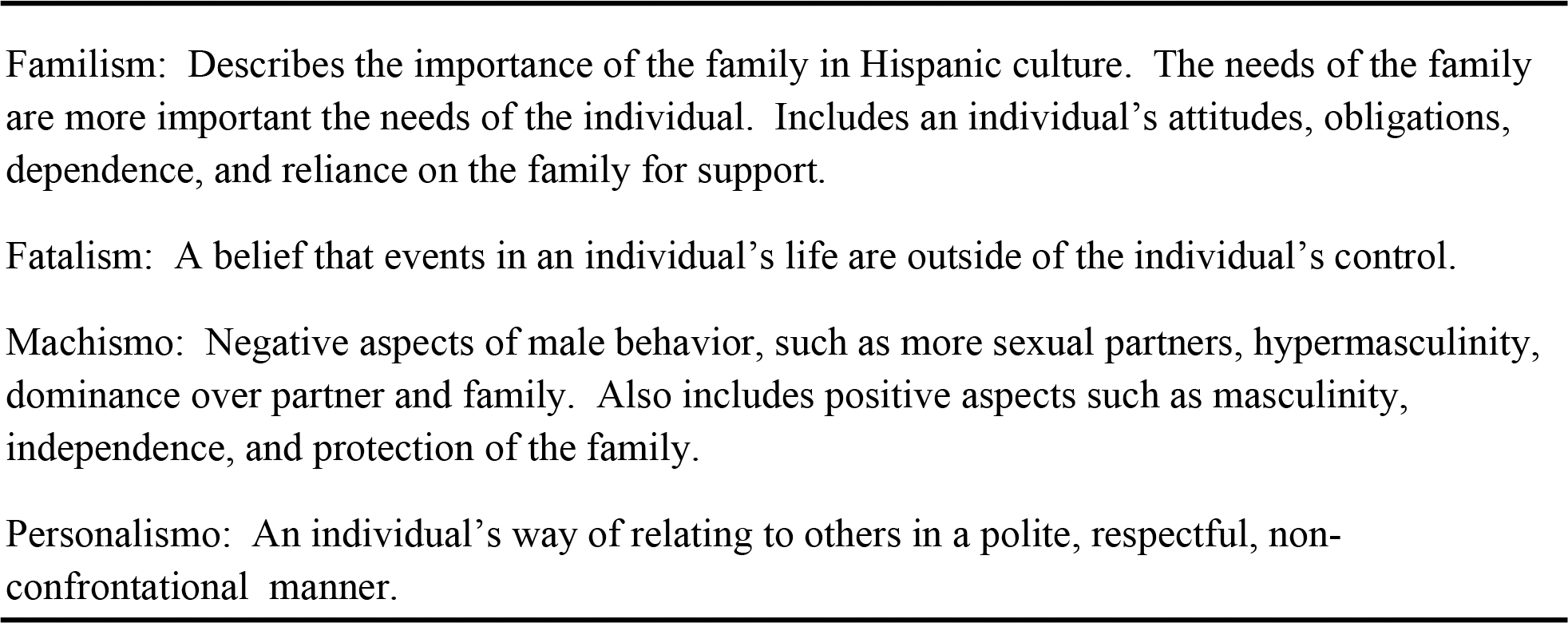
Results: Statistically significant positive correlations were noted between age and total cultural constructs, familism, personalism, and machismo. Statistically significant negative correlations were noted between education and total cultural constructs, and education and fatalism. No statistically significant correlation coefficients were noted between total cultural constructs and total sexual behaviors. However, statistically significant positive correlations were noted between condom use and personalism, and assertiveness and personalism. A statistically significant negative correlation was noted between familism and anal sex.
Implications: Nurses and other clinicians providing care for HMSM need awareness of certain Hispanic cultural factors (personalism and familism) that may be related to sexual behaviors among HMSM. More research is needed to understand how personalism and familism may be used as protective factors to decrease sexual risk of HMSM.
Keywords: Culture; Gay men; Hispanics; Sexual behaviors.
Figures
References
-
- Adam BD, Betancourt G, & Serrano-Sanchez A (2011). Development of an HIV prevention and life skills program for Spanish-speaking gay and bisexual newcomers to Canada. Canadian Journal of Human Sexuality, 20(1–2), 11–17.
-
- Almaguer T (1993). Chicano men: A cartography of homosexual identity and behavior. In Abelove H, Barale MA, and Halperin DM. (Eds). The Lesbian and Gay Studies Reader. (pp. 255–273). New York, NY: Rutledge.
-
- Antshel KM (2002). Integrating culture as a means of improving treatment adherence in the Latino population. Psychology, Health & Medicine, 7(4), 435–449. DOI: 10/1080/1354850021000015258.
-
- Centers for Disease Control and Prevention [CDC]. (2015). HIV among Hispanics/Latinos. Atlanta, GA: CDC.
-
- Cianelli R, Villegas N, Lawson S, Ferrer L, Kaelber L, Peragallo N, & Yaya A (2013). Unique factors that place older Hispanic women at risk for HIV: Intimate partner violence, machismo, and marianismo. Journal of the Association of Nurses in AIDS Care, 24(4), 341–354. DOI: 10.1016/j.jana.2013.01.009. - DOI - PMC - PubMed
Grants and funding
LinkOut - more resources
Full Text Sources