


Predicting and grading liver injury in the absence of computed tomographic imaging
- PMID: 37091021
- PMCID: PMC10114565
- DOI: 10.4103/jfmpc.jfmpc_1532_22
Predicting and grading liver injury in the absence of computed tomographic imaging
Abstract
Background: Even developed countries lack computed tomography (CT) scan in rural areas. Availability, affordability and accessibility of CT scan play an important role in the management of blunt hepatic trauma.
Materials and methods: A descriptive observational study among 56 hepatic blunt trauma patients as Group 1 and 56 non-hepatic blunt trauma patients as Group 2 enrolled retrospectively. Observational analysis of presence of liver trauma, grades of liver injury (I-VI) and clinical course with the liver function tests are done.
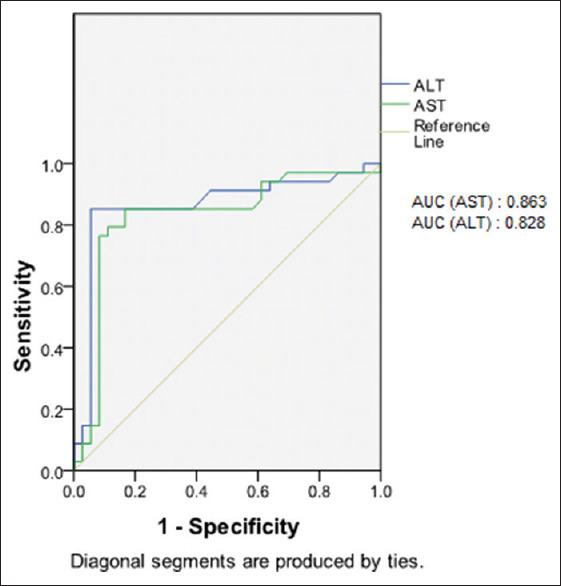
Results: Aspartate transaminase (AST) (P = 0.02) and alanine transaminase (ALT) (P = 0.003) levels were significantly elevated among Group 1. Significantly elevated levels in Group 1 than Group 2 of AST [467.5 (22-5097) vs. 95 (23-1780); P < 0.001] and of ALT [422 (28-1548) vs. 69 (20-727); P < 0.001] noted. Significant elevation of AST and ALT levels, as the AAST (American Association for the Surgery of Trauma) CT grade of liver injury increases, noted (P = 0.001). Using the ROC curve analysis, the optimal cut-off values of AST and ALT were set at ≥467.5 U/L and ≥111.5 U/L, respectively. At this cut-off, AST had sensitivity 50%, specificity 91.7%, PPV 85%, NPV 66%, ALT had sensitivity 85.3%, specificity 86.1%, PPV 85.3% and NPV 86.1% for liver injury.
Conclusion: ALT is more sensitive for liver injury. AST peak is seen in the immediate period. Combining clinical assessment, transaminase levels and Focused Assessment with Sonography in Trauma improves the sensitivity and specificity. Transaminase levels can vary with ethnicity and local epidemiological diseases; therefore, optimal cut-off levels should be established for local population. This would predict and grade the liver injury, helping in early decision-making and avoid wasting the golden hour in trauma.
Keywords: Health services research; haemorrhage; liver; tomography; transaminases; trauma; ultrasonography.
Copyright: © 2023 Journal of Family Medicine and Primary Care.
Conflict of interest statement
There are no conflicts of interest.
Figures
References
-
- Karamercan A, Yilmaz TU, Karamercan MA, Aytaç B. Blunt abdominal trauma:Evaluation of diagnostic options and surgical outcomes. Ulus Travma Acil Cerrahi Derg. 2008;14:205–10. - PubMed
-
- Kumar MM, Venkataramanappa M, Venkataratnam I, Kumar NV, Babji K. Prospective evaluation of blunt abdominal trauma by computed tomography. Indian J Radiol Imaging. 2005;15:167–73.
LinkOut - more resources
Full Text Sources