


IMMUNOREACT 5: female patients with rectal cancer have better immune editing mechanisms than male patients - a cohort study
- PMID: 37093072
- PMCID: PMC10389582
- DOI: 10.1097/JS9.0000000000000214
IMMUNOREACT 5: female patients with rectal cancer have better immune editing mechanisms than male patients - a cohort study
Erratum in
-
IMMUNOREACT 5: female patients with rectal cancer have better immune editing mechanisms than male patients - a cohort study: Erratum.Int J Surg. 2023 Dec 1;109(12):4396. doi: 10.1097/JS9.0000000000000947. Int J Surg. 2023. PMID: 38259009 Free PMC article. No abstract available.
Abstract
Background: Studies evaluating sex differences in colorectal cancer (CRC) tumor microenvironment are limited, and no previous study has focused on rectal cancer patients' constitutive immune surveillance mechanisms. The authors aimed to assess gender-related differences in the immune microenvironment of rectal cancer patients.
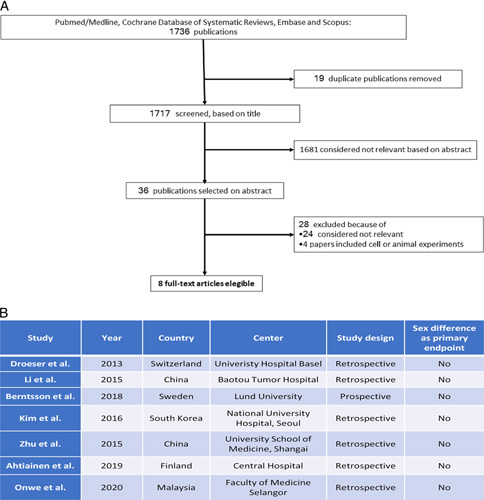
Methods: A systematic review and meta-analysis were conducted up to 31 May 2021, including studies focusing on gender-related differences in the CRC tumor microenvironment. Data on the mutational profile of rectal cancer were extracted from the Cancer Genome Atlas (TCGA). A subanalysis of the two IMMUNOREACT trials (NCT04915326 and NCT04917263) was performed, aiming to detect gender-related differences in the immune microenvironment of the healthy mucosa in patients with early (IMMUNOREACT 1 cohort) and locally advanced rectal cancer following neoadjuvant therapy (IMMUNOREACT 2 cohort). In the retrospective IMMUNOREACT 1 cohort (therapy naive), the authors enrolled 442 patients (177 female and 265 male), while in the retrospective IMMUNOREACT 2 cohort (patients who had neoadjuvant therapy), we enrolled 264 patients (80 female and 184 male). In the prospective IMMUNOREACT 1 cohort (therapy naive), the authors enrolled 72 patients (26 female and 46 male), while in the prospective IMMUNOREACT 2 cohort (patients who had neoadjuvant therapy), the authors enrolled 105 patients (42 female and 63 male).
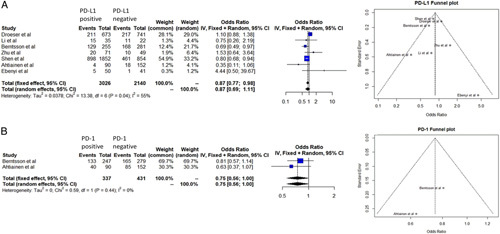
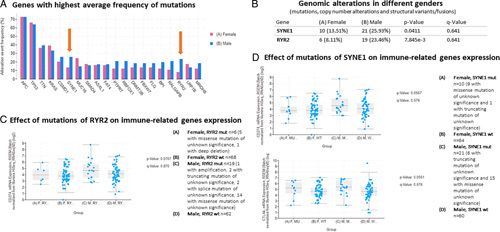
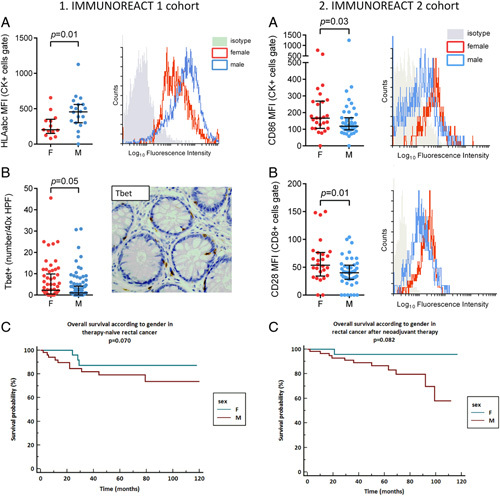
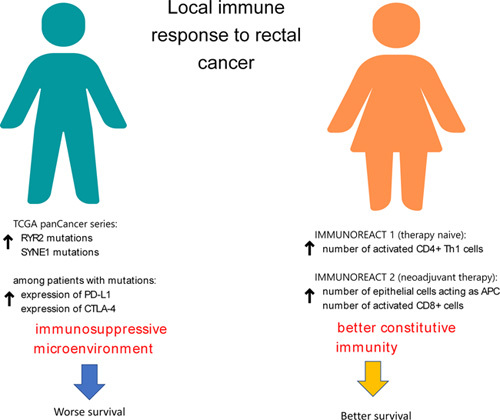
Results: Seven studies reported PD-L1 expression in the CRC microenvironment, but no significant difference could be identified between the sexes. In the TGCA series, mutations of SYNE1 and RYR2 were significantly more frequent in male patients with rectal cancer. In the IMMUNOREACT 1 cohort, male patients had a higher expression of epithelial cells expressing HLA class I, while female patients had a higher number of activated CD4+Th1 cells. Female patients in the IMMUNOREACT 2 cohort showed a higher infiltration of epithelial cells expressing CD86 and activated cytotoxic T cells (P=0.01).
Conclusions: Male patients have more frequent oncogene mutations associated with a lower expression of T-cell activation genes. In the healthy mucosa of female patients, more Th1 cells and cytotoxic T cells suggest a potentially better immune response to the tumor. Sex should be considered when defining the treatment strategy for rectal cancer patients or designing prognostic scores.
Copyright © 2023 The Author(s). Published by Wolters Kluwer Health, Inc.
Conflict of interest statement
None.
Sponsorships or competing interests that may be relevant to content are disclosed at the end of this article.
Figures
References
-
- Siegel RL, Miller KD, Goding Sauer A, et al. Colorectal cancer statistics, 2020. CA Cancer J Clin 2020;70:145–64. - PubMed
-
- AJCC/UICC. 2017. TNM Classification of Malignant Tumours, 8th ed. Wiley Blackwell.
-
- Galon J, Costes A, Sanchez-Cabo F, et al. Type, density, and location of immune cells within human colorectal tumors predict clinical outcome. Science 2006;313:1960–4. - PubMed
Publication types
MeSH terms
Associated data
LinkOut - more resources
Full Text Sources
Medical
Research Materials
