


Exploring the association between precipitation and hospital admission for mental disorders in Switzerland between 2009 and 2019
- PMID: 37093854
- PMCID: PMC10124868
- DOI: 10.1371/journal.pone.0283200
Exploring the association between precipitation and hospital admission for mental disorders in Switzerland between 2009 and 2019
Abstract
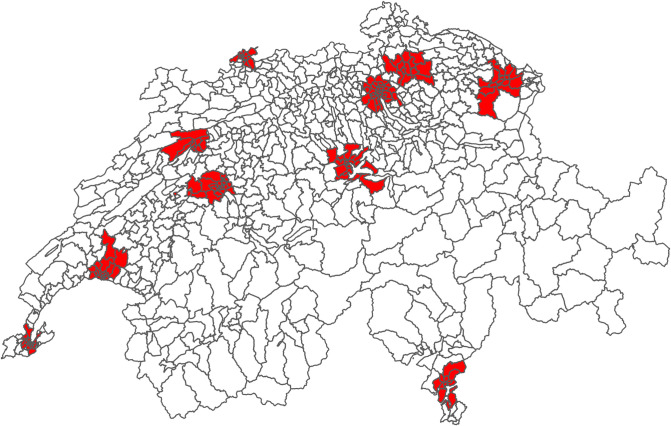
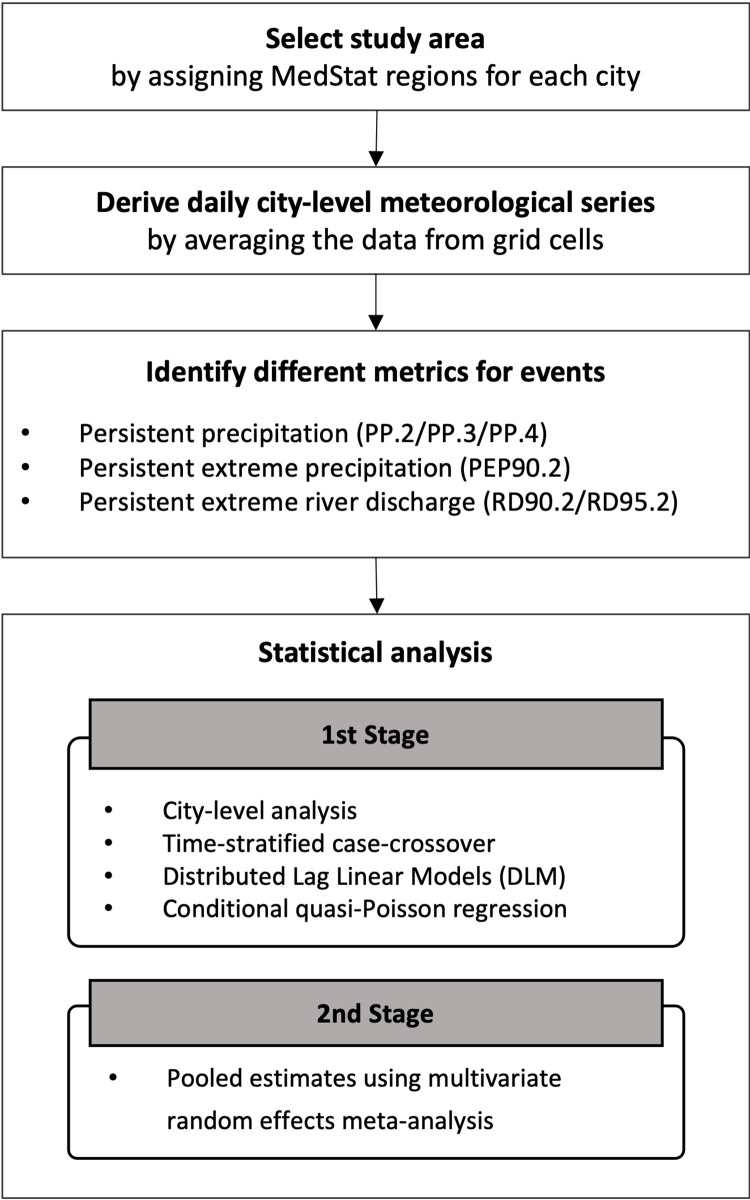
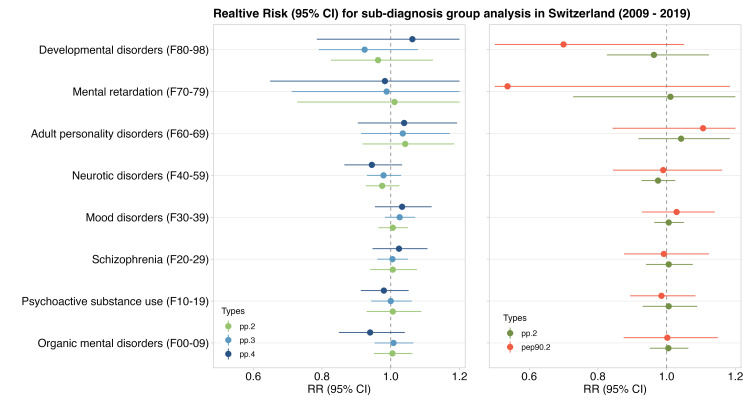
While several studies proved the relationship between increasing temperatures and poor mental health, limited evidence exists on the effect of other weather factors, such as precipitation. This study assessed the impact of precipitation on hospital admissions for mental disorders in Switzerland between 2009-2019. We defined different precipitation events based on the duration (daily precipitation ≥1mm for 2, 3, or 4 days; PP.2/PP.3/PP.4) and intensity (≥90th percentile for 2 consecutive days; PEP90.2). First, we conducted aggregated time-stratified case-crossover analysis in eight main Swiss cities with distributed lag models to assess the association up to 3 days after the exposure. Then, we pooled the estimates in each city using a multivariate random effects meta-analysis for all hospital admissions and by subgroups (sex, age, diagnosis). Evidence of an association between precipitation and hospital admission for mental disorders was not found in Switzerland (PP.2: 1.003[0.978-1.029]; PP.3: 1.005[0.985-1.026]; PP.4: 0.994[0.960-1.030]; PEP90.2: 1.000[0.953-1.050]). Although the results were highly uncertain, we found an indication of increasing risks of hospital admission with increasing intensity of precipitation in warmer seasons (PP.2: 1.001[0.971-1.032] vs PEP90.2: 1.014[0.955-1.078]), while the risks of hospital admission slightly increased by the duration in colder season (PP.2: 1.009[0.981-1.039]; PP.3: 1.008[0.980-1.036]; PP.4: 1.017[0.956-1.081]). Overall, risks tend to be higher in people aged < 65 years. Duration of the events may influence more than intensity in females, while opposite patterns were observed in males. Risks tended to be larger but still uncertain for schizophrenia, mood disorders, and adult personality disorders. An indication of a negative association was found in neurotic disorders and null risks in the remaining groups. Although our findings did not show a clear association between precipitation and mental disorders, further research is required to clarify the role of precipitation and the potential implications of climate change and extreme precipitation events on mental health.
Copyright: © 2023 Lee et al. This is an open access article distributed under the terms of the Creative Commons Attribution License, which permits unrestricted use, distribution, and reproduction in any medium, provided the original author and source are credited.
Conflict of interest statement
The authors have declared that no competing interests exist.
Figures
References
-
- IPCC, 2022: Summary for Policymakers. In: Climate Change 2022: Impacts, Adaptation, and Vulnerability. Contribution of Working Group II to the Sixth Assessment Report of the Intergovernmental Panel on Climate Change [H.-O. Pörtner, D.C. Roberts, et al. (eds.)]. Cambridge University Press. In Press.
-
- CH2018. CH2018 –Climate Scenarios for Switzerland, Technical Report. National Centre for Climate Services, Zurich, 271 pp. ISBN: 978-3-9525031-4-0; 2018.
-
- Scherrer SC, Fischer EM, Posselt R, Liniger MA, Croci-Maspoli M, Knutti R. Emerging trends in heavy precipitation and hot temperature extremes in Switzerland. J Geophys Res Atmospheres. 2016;121(6):2626–37.
Publication types
MeSH terms
LinkOut - more resources
Full Text Sources
Miscellaneous
